1 Overview
Times TR100 Pocket Surface Roughness Meter is a new generation of pocket surface roughness meter launched by our company. It has the characteristics of high measurement accuracy, wide measurement range, easy operation, easy to carry, stable work, etc. It can be widely used in the detection of various metal and non-metal processing surfaces. Features, more suitable for use in the production site.
2 Working principle and structural features
2.1 Working principle
When the sensor is driven by the driver to make a uniform linear motion along the measured surface, the stylus perpendicular to the working surface moves up and down with the microscopic fluctuations of the working surface, and the movement of the stylus is converted into an electrical signal. Amplify, filter, convert to digital signal by A/D, and then process by CPU to calculate and display Ra and Rz values.
2.2 Structural features
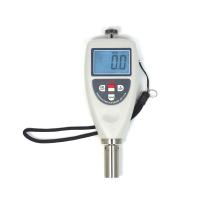
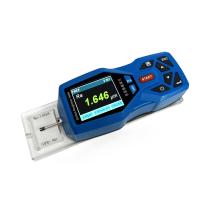
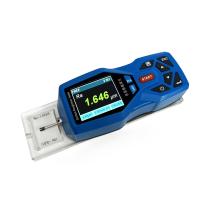
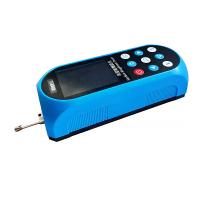
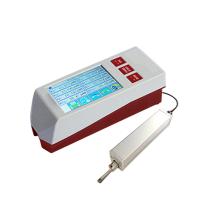
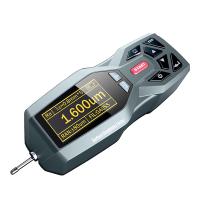
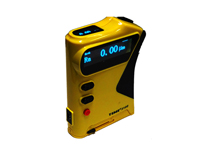
2.2.1 Basic configuration: the appearance is shown in Figure 1


3 main performance indicators


4. Use and operation
4.1 Operation
Turn on the power, the screen will display in full screen, and enter the measurement state after a beep. The measurement parameters and the sampling length will remain in the state before the last shutdown.
Before starting the sensor, the user selects the measurement parameters Ra, Rz and the appropriate sampling length 2.5, 0.8 or 0.25 (please refer to the appendix for the selection of the sampling length).

After selecting the measurement parameters and sampling length, the measurement can be started. Aim the instrument at the area to be measured, lightly press the start button, the sensor moves, after two beeps, the measurement ends, and the screen displays the measured value.
Precautions:
1) During the movement of the sensor, try to make the instrument placed on the surface of the workpiece stable so as not to affect the measurement accuracy of the instrument;
2) Before the sensor returns to its original position, the instrument will not respond to any operation, and it will not allow another measurement until after a complete measurement process.
4.2 Calibration
When the measured value of the instrument is found to be out of tolerance, the instrument can be calibrated with a standard sample. The Ra value of the standard sample that can be used for calibration is: 0.1µm~10µm.
The method is:


5Maintenance and Repair
5.1 Maintenance
Avoid collisions, violent vibrations, heavy dust, humidity, oil stains, strong magnetic fields, etc.; after each measurement, turn off the power in time to maintain battery energy, and charge the battery in time; when charging, pay attention to controlling the charging The time is generally suitable for 10-15 hours. To prevent damage to the battery due to overcharging for a long time; the sensor is a precision part of the instrument, so remember to maintain it carefully. After each use, gently cover the protective cover of the instrument. Avoid causing severe vibration to the sensor; the random standard sample should be carefully protected to avoid scratches that may cause the calibration instrument to be inaccurate.