 1. Purpose
 1. Purpose
This instrument is mainly used to measure the kinematic viscosity of Newtonian or near-Newtonian fluid coatings, and can also be used for comparative measurement as required. It is a portable viscometer with convenient use and stable performance. The Flow Cup and outlet are made of corrosion-resistant materials.
2. Principle
The viscosity measured by the NDJ-5 viscometer is the conditional viscosity, that is, the time for a certain amount of sample to flow out of a hole with a specified aperture at a certain temperature, expressed in seconds. Use the following formula to convert the sample outflow time in seconds (S) into kinematic viscosity (mm2/s).
γ=(t-6.0)/0.223 (30s≤t≤100s)
Among them, t - outflow time (s)
γ——kinematic viscosity (mm2/s)
3. Technical characteristics
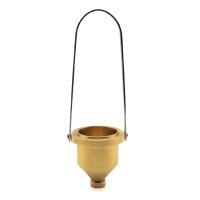
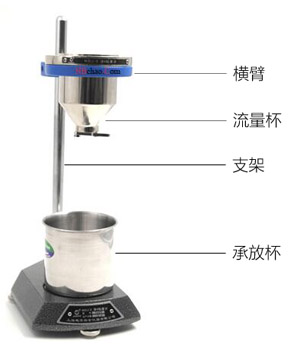
1. NDJ-5 viscometer is made of brass, with a capacity of about 100ml. Its geometric size and inner wall roughness meet the requirements of "GB/T1723 Paint Viscosity Measurement Method", and its bottom is a stainless steel outflow hole.
2. Correction coefficient K: Multiply the viscosity measured by the corrected viscometer by the K value, which is the condition measured by the viscometer. The correction coefficient K should be within the range of 1±0.03, otherwise the viscometer should be replaced. The viscometer should be calibrated periodically according to the frequency of its use.
3. The difference between the measured value of the flow time of the standard viscosity liquid with known kinematic viscosity from the NDJ-5 viscometer and the computer should be within ±3% of the calculated value.
4. Installation
1. Place the Flow Cup in the ring of the cross arm.
2. The viscometer stand consists of a level-adjustable platform and a cross. A circular blister is attached to the cross arm of the cross. Adjust the horizontal bolt of the platform to center the blister.
5. Instructions for use
1. Before or after measurement, use gauze dipped in solution to wipe the viscometer clean and dry it in the air or with cold wind. No residual liquid is allowed to adhere to the cup or flow out of the tube hole. The inner wall and outflow hole of the cup should be kept clean, and the original smoothness should be maintained when observing the light.
2. The test should be carried out in a constant temperature room at 25±1°C, and the support platform should be adjusted to maintain a horizontal position.
3. Stir the test solution evenly, and keep it at a temperature of 25±1°C after filtering through a sieve with no less than 567 holes/cm.
4. Inject the test solution into the viscosity agent, block the outflow hole with your fingers (if there is a stopper on the corrosive liquid cup), slowly pour the tested solution into the cup until the liquid surface protrudes from the upper edge of the cup, if there is any Bubbles, when the bubbles float to the surface, use a clean flat glass plate to push it along the edge once, and divide it to remove the protruding liquid surface and bubbles, so that the level of the measured liquid and the upper edge of the flow are on the same level.
5. Let go of your finger (or push away the stopper), the test solution will flow out vertically, take it up with the cup, and start the stopwatch at the same time, the test solution will flow out into a line, stop the stopwatch when it is disconnected, and the measured time represents its viscosity. The unit is seconds.
6. Secondary parallel test, the error shall not exceed 3% of the average value.
7. The first method should be used to clean after each use.