How does an ultrasound machine work?
High frequency sound waves are very directional, they propagate through one medium (like a piece of steel or plastic) until they meet the boundary of another medium (like air), at which point they are emitted back to their source. By analyzing these reflections, it is possible to measure the thickness of the inspected part, or to find signs of cracks, or other hidden internal defects.
What types of materials can be tested with ultrasonic instruments?
In industrial applications, ultrasonic testing is widely used in metals, plastics, composite materials and ceramics. Common engineering materials that are not suitable for ultrasonic testing with conventional equipment are wood and wood paper products. Ultrasound technology is also widely used in the biomedical field for diagnostic imaging and medical research.
What are the advantages of ultrasound testing?
Ultrasonic testing is completely non-destructive. Test pieces do not need to be cut, fragmented, or use destructive chemicals. Access to only one side is required, unlike measuring with mechanical thickness gauging tools such as calipers and micrometers. There is no potential mechanical damage using ultrasound, unlike radiography. When a test is properly set up, the results are highly repeatable and reliable.
What are the potential limitations of ultrasound testing?
Ultrasonic defect detection requires a trained operator who can set up a test with proper reference standards and proper interpretation of results. Detecting workpieces with some complex geometries can be challenging. Ultrasonic Thickness Gauges need to be calibrated respecting the material being measured, applications requiring a wide range of thickness measurements or acoustically dissimilar materials requiring multiple setups. Ultrasonic Thickness Gauges are much more expensive than mechanical measuring equipment.
What is an ultrasound probe?
A probe is any device that converts one form of energy into another. An ultrasound probe converts electrical energy into mechanical vibrations (sound waves), and sound waves into electrical energy. Typically, they are small, hand-held assemblies, and come in a variety of frequencies and types to serve specific test needs.
What is an ultrasonic testing instrument?
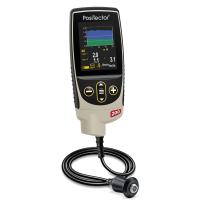
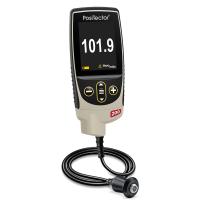
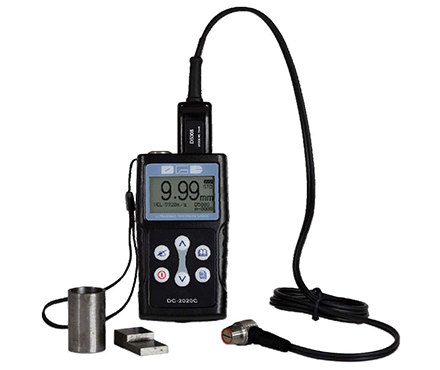
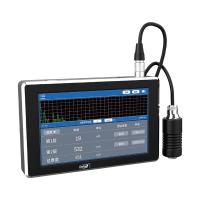
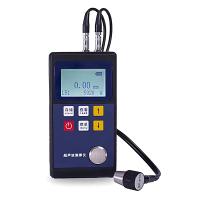
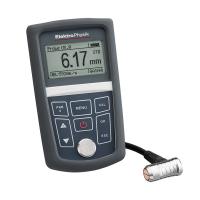
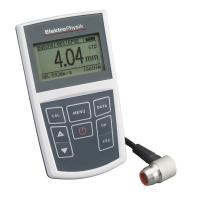
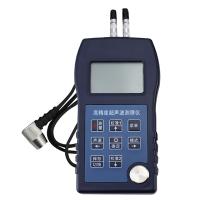
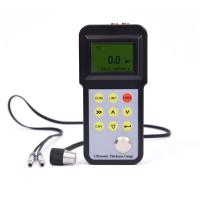
An ultrasonic Thickness Gauge is a device that generates pulses of sound within a test piece, very accurately measuring the time interval until the echo is received. The sound velocity of the material to be tested has been programmed, and the instrument uses the sound velocity information and the measurement time interval to calculate the thickness through a simple relationship. [Distance] is equal to [Sound Velocity] multiplied by [Time].
What is an ultrasonic Thickness Gauge?
The ultrasonic Thickness Gauge is based on the principle of ultrasonic pulse reflection to measure the thickness. When the ultrasonic pulse emitted by the probe passes through the object to be measured and reaches the material interface, the pulse is reflected back to the probe. Measure the thickness of the material. All kinds of materials that can make ultrasonic waves propagate inside them at a constant speed can be measured by this principle.