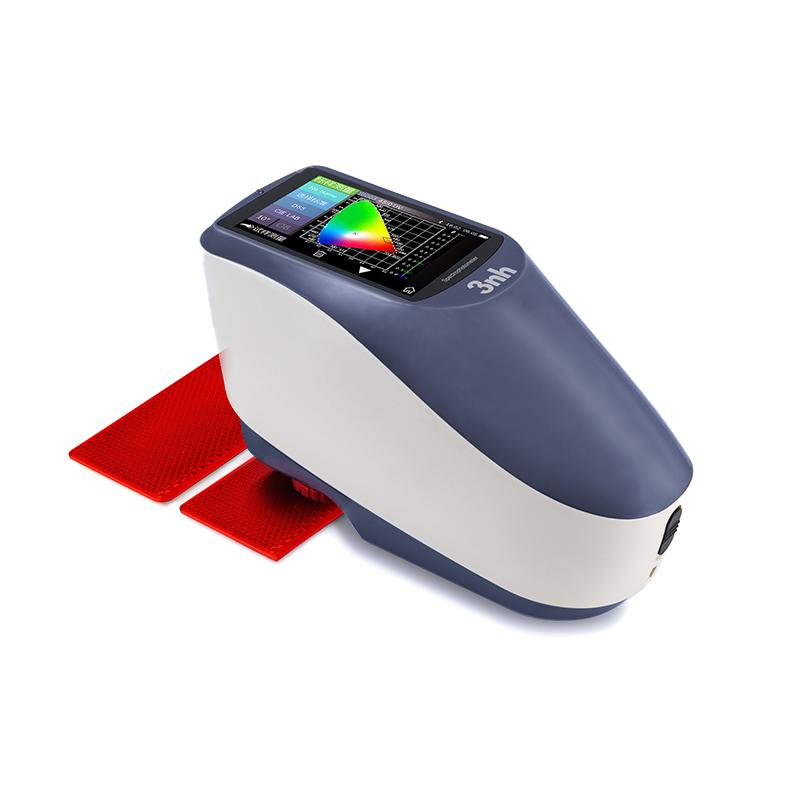
The color measurement of translucent substances is more complicated and requires special instruments and methods. Here are some possible measurements:
Diffuse reflectance spectroscopy: This method uses light incident at a certain angle to irradiate the sample, and measures the spectrum scattered by the sample to obtain its reflectance spectral line. This method is suitable for translucent substances with high light transmission.
Transmission spectroscopy: This method uses light of a certain wavelength to pass through the sample, and then measures the spectrum transmitted by the sample to obtain its transmittance spectrum. Transmission spectroscopy is suitable for translucent substances with good light transmission.
Color difference measurement method: This method uses a color difference meter to measure the color difference between a translucent sample and a reference. This method is usually calculated using the standard CIE Lab* color space, and the color coordinate value of the translucent substance can be obtained.
Polarization spectroscopy: Polarization spectroscopy is a method of measuring the color of a sample based on its optical properties such as absorption, scattering, and birefringence. This method is suitable for translucent substances where the anisotropy and polarization properties of the sample need to be considered.
North and South Chao reminds you: Different translucent substances may require different color measurement methods, so it is necessary to select the appropriate method and instrument according to the actual situation before measurement, and perform calibration and standardization to obtain accurate and reliable measurement results.