I. Overview
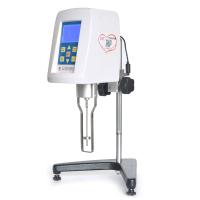
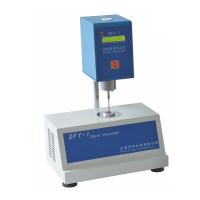
The Stormer viscometer is a test instrument used to measure the viscosity of paints and other coatings expressed by KU value. The instrument can display the KU value representing the viscosity of the tested sample, or the load value (unit: g) associated with the KU value.
The instrument is controlled by a microcomputer. The stirring paddle is driven by a special constant speed motor and rotates at a speed of 200 rpm. The resistance moment of the stirring paddle rotating in the sample to be tested is converted by the computer to the KU value (Krebs Krebs unit (KU) to generate 200 A logarithmic function of the load required for the revolution/minute speed, generally used to express the viscosity of brush coating and roller coating). The operator only needs to put the stirring paddle into the sample to the specified depth, and the KU value of the sample can be directly read from the instrument without looking up the table. Linked load value.
The design basis of this instrument is ASTM-D562 standard and GB9269-88 standard.
2. Technical parameters:
1. Measuring range: 40.2KU~141.0KU (KU value), 32g~1099g (load value)
2. Measurement accuracy: ±1.5% of full scale
3. Measurement repeatability: ±1.5% of full scale
4. Stirring shaft speed: 200r/min±1r/min
5. Container volume: about 500 ml
6. Input voltage: 220V 50Hz
7. Power: 10w
8. Dimensions: 210×180×500 mm (length×width×height)
9. Weight: 10Kg
3. Test environment
1. The instrument should be placed on a solid and flat table away from strong air currents, strong magnetic fields, strong electric fields, and strong electric pulses.
2. In order to ensure the safety of the operator, the power socket in the laboratory should be reliably grounded.
3. The temperature in the laboratory should be 23oC2oC, and the relative humidity should not be greater than 75%.
4. The sample temperature is 23oC0.2oC.
4. Operation and use:
1. Take the instrument out of the box and place it on the workbench.
2. Take out the stirring blade from the packaging box, insert it into the sleeve of the rotating shaft, and fix it with the tightening screw. Note that the tightening screw should be on the flat mouth of the stirring blade.
3. Plug in the power plug, turn on the power switch at the rear, the system starts self-test, and enters the standby state after the self-test is completed, and the display shows "- - - -".
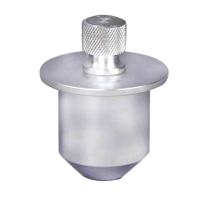
4. Fully stir the sample to be tested and put it into the container that comes with the instrument. The liquid surface is about 10mm away from the container mouth.
5. Put the container containing the sample to be tested on the container seat, and select the unit of measurement ("KU" means to display the KU value of the sample to be tested, and "gm" means to display the load value of the sample to be tested). Press down the lifting handle, immerse the stirring paddle into the sample to be tested, and the mark on the paddle shaft is flush with the liquid surface. The instrument starts running automatically.
6. After a few seconds, the display will display the viscosity value of the sample to be tested, and it can be read at this time. (The sample to be tested needs to be stirred for a few seconds to reach a dynamic balance, and the data displayed at this time can be considered accurate. Before the data is displayed, the instrument will display "- - - -")
7. After the measurement, lift the lifting handle to a high place, and there is a limit device near the highest position, which can keep the instrument at this position all the time. The instrument stops spinning and goes back into standby.
8. The built-in intelligent display and stabilization program of STM-IV Stommer viscometer makes the readings of each measurement stable and convenient for the operator to read. If you want to measure different measurement units, you don’t need to stop the machine, just adjust the selection switch to the measurement unit. Can.
9. The STM-IV Stommer viscometer has a HOLD switch externally. When the switch is turned on (downward), the number of the sample to be tested can be kept unchanged, and different measurement units can be selected for conversion for future use. Record. The instrument has the function of holding memory. When the hold switch is turned off, and the previous measurement reading is to be retrieved, only the hold switch is turned on to retrieve it. To re-measure, hold the switch off (up).
5. Matters needing attention:
1. There are precision measuring parts in the case of this instrument, which should be handled with care when handling.
2. This instrument is a special instrument. Non-professionals should not disassemble the instrument shell by themselves, so as not to affect the measurement accuracy of the instrument.
3. When the instrument is not in use temporarily, the lifting handle of the instrument should be kept on the high position limit device, and should not be placed at a lower position, otherwise it may cause the lifting failure.
4. Come to our company regularly for inspection once a year or send it to the relevant measurement and monitoring department for inspection once a year.