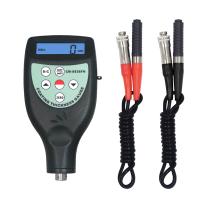
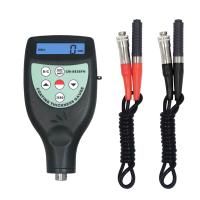
1. Features
*This instrument is a battery-powered portable measuring instrument , which uses the principle of magnetic induction and eddy current. The measurement method conforms to international standards ISO2178, ISO2360 and national standards GB4956, GB4957. It uses computer technology , non-destructive testing technology and other professional technologies to accurately measure the thickness of the measured object without damaging it.
*F-type probe can directly measure the thickness of non-magnetic coating layer (such as: paint, plastic, enamel, copper, aluminum, zinc, chromium, etc. ) on the surface of magnetic conductive material (such as iron, nickel ). It can be applied to the thickness measurement of electroplating layer, paint layer, enamel layer, aluminum tile, copper tile, babbitt tile, phosphating layer, paper, and also can be used for thickness measurement of hull paint and attachments of underwater structural parts.
*NF-type probe can measure the thickness of the insulating , such as paint, plastic, rubber coating on the surface of aluminum, copper, zinc, non-magnetic stainless steel and other materials , and can also measure aluminum or aluminum The thickness of the anodic oxide layer of the alloy material .
*The spring guide sleeve probe with wear-resistant hard metal probe can not only measure on hard or rough surfaces, but also ensure that the probe has constant pressing force and stable sampling value.
*Digital display, wide measuring range and high resolution.
* Automatic memory calibration value, easy to use.
*Sturdy and delicate structure, easy to carry.
* Integrated structure, small size and light weight.
*Using optional RS232C software and cables, it can communicate with PC computer to realize data collection, processing, analysis and printing functions.
*The instrument is equipped with automatic shutdown to realize power saving function.
2. Specification
Display: 4-digit 10mm LCD
Lantai CM-8825fn coating Thickness Gauge test range: 0~1250um
Other measuring ranges need to be ordered separately.
Resolution: 0.1um/1um
Measurement accuracy: ±1~3%n or ±2.5um
It has the function of automatically identifying the measured matrix.
Measurement mode: single measurement and continuous measurement.
It has the conversion function of metric and imperial units to realize um/mil conversion.
With a standard RS232C interface.
Power supply: 4 AAA batteries.
Operating conditions: temperature 0~40°C, humidity <80%
Dimensions: 126x65x27mm
Weight: 81g (excluding battery)
Standard accessories:
Carrying case.................................. 1 piece
Iron base.................................... 1 block
Aluminum base.................................... 1 piece
Instruction manual................................1 copy
Calibration diaphragm
CM50.................................1 piece
CM100.................................1 piece
CM300.................................1 piece
CM500.................................1 piece
(The actual thickness of the diaphragm is marked on the diaphragm)
Optional accessories:
RS232C communication cable and software
4. measurement procedure
4.1 Press the power button ( ) lightly, after turning on the power of the whole machine, the instrument will automatically enter the measurement state, and automatically restore the parameter settings before the last shutdown.
4.2 After confirming that the calibration is correct, the measurement . If there is any doubt about the previous calibration, another calibration should be performed. The specific method of calibration is detailed in the calibration part of the instrument. Once the instrument is calibrated, the calibration result will be automatically stored in the instrument, and it is not necessary to calibrate again when the instrument is turned on for measurement next time, unless there is doubt about the accuracy of the measurement.
4.3将测量传感器压紧到被测涂层上,显示器上的值即为待测涂层的测量值。注意:由于所有的磁性涂层测厚仪都是采用电磁感应原理;非磁性涂层测厚仪采用电涡流的原理,因此,一定要注意探头压上被测体的速度不能太慢。否则,会造成人为测量误差。
4.4要进行下次测量,需要将测量传感器提起到1厘米以上,然后再重复4.3。
4.5如有必要,测量值可通过加1键或减1键来修正。南北潮提示您:按加1键或减1键修正时,测量探头一定提起,否则,按加1键或减1键无效。
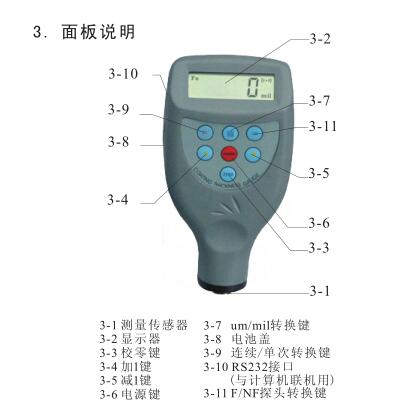
4.6要更换测量单位,实现mm和mil的转换,只要轻按一下单位转换键3-7即可。
4.7要更换测量模式,实现单次测量和连续测量的转换,只要轻按一下连续/单次转换键3-9即可。另一方面,也可以通过轻按电源键不放,直到显示器上出现SC才松开按键(从按下电源键到出现SC大约需要9秒钟)。然后,再按一下ZERO键即可。若显示器上有符号,表示测量模式为连续测量,测量时,蜂鸣器不响。否则为单次测量模式,每测量一次,蜂鸣器都响一下。
4.8 After the measurement is completed, lightly press the power button to turn off the power. The instrument has two shutdown methods, namely manual shutdown and automatic shutdown . At any time, just press the power button lightly to turn off the power of the whole machine manually; on the other hand, if no button is pressed within 50 seconds, it will automatically shut down to save power Function.
5. Instrument Calibration
5.1 Zero calibration
5.1.1 Press the measuring probe on the reference block (or the uncoated measuring body), and then lightly press the zero calibration key ZERO to perform zero calibration. When pressing the ZERO key, the measuring probe should not shake on the reference block. At the same time, it should be noted that the probe can only be lifted after pressing the ZERO key, otherwise, the zero calibration will be incorrect.
5.1.2 Lift the measuring probe by more than 1 cm, then press the probe onto the reference block (or the measuring body without coating) at a normal speed, and observe the measured , if If the measured value is near 0, it means that the zero calibration is successful, otherwise, the zero calibration should be performed again.
5.2 Full calibration
5.2.1 According to the coating thickness to be measured, select an appropriate standard diaphragm for full scale calibration.
5.2.2 First place the standard diaphragm on the reference block (or on the measuring body without coating ).
5.2.3 Then press the measuring probe on the standard diaphragm, and the measured value will be displayed on the display. If the measured value is different , the measured value can be corrected by adding 1 key or minus 1 key.
5.2.4 In order to ensure the accuracy of the calibration, it can be verified by measuring the same standard diaphragm several times.