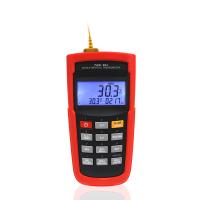
1. Principle of temperature measurement
The temperature measurement principle of the above-mentioned thermocouple is to use the temperature change and convert it into a change of thermoelectric potential, and then use the corresponding instrument to ground to measure the temperature. Thermocouples are usually used to measure higher temperatures, because in low temperature areas The output thermoelectric potential is small, so another temperature measuring element, thermal resistance, is often used for temperature measurement when measuring lower temperatures.
The principle of thermal resistance temperature measurement is to use the property that the resistance value of some metal conductors (or semiconductors) changes regularly with changes in temperature to measure temperature. When the temperature rises for most metals, the resistance value increases by 0.46%~0.6%, while the resistance value of semiconductors decreases with the increase of temperature. Try to measure the change of the resistance value of conductors or semiconductors at different temperatures. To achieve the purpose of temperature measurement. The thermal resistance temperature measurement system is composed of thermal resistance, a display instrument for measuring resistance and connecting copper wires.
2. Types and characteristics of thermal resistance
There are two commonly used thermal resistances, copper resistance and platinum resistance. Their resistance elements are shown in Figure 9-26 and Figure 9-27, and their characteristics are described as follows:
(1) Copper resistance. Copper resistance is the most widely used in industry, because it is cheap, easy to purify, easy to process into insulating filaments, and has a high temperature coefficient of resistance. In the range of 0~150 °C, the copper resistance value is linear with temperature relationship, which can be expressed as follows:K t =R 0 (1+At+Bt 2 )


The resistance value of platinum resistors at 0°C is generally made into three types: 46Ω, 100Ω and 300Ω.
The relationship between copper resistance and platinum resistance and temperature given above does not need to be calculated with it, because in actual work, the relationship table between Rt and t is often used, also known as the graduation table of thermal resistance, different thermal resistance The temperature and resistance comparison table of the resistor is listed in the appendix.
Table 9-7 shows the technical characteristics of collar resistors and platinum resistors.