Scope and description
Since the naked eye is limited by factors such as color memory ability and natural conditions, human errors will inevitably occur. Therefore, in industrial practice, Colorimeters are often used to measure the color difference of paint films. The reflectance value of the sample is measured by a Colorimeter under a certain light source condition, and then converted into a tristimulus value. According to the color measurement principle, data and calculation method stipulated by the International Commission on Illumination (CIE), the color change is expressed digitally . The method of measuring the color of the coating film with a color difference meter is generally called the photoelectric color difference meter color measurement method.
Instruments and Materials
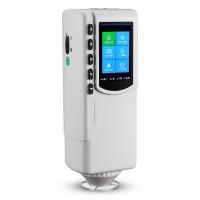
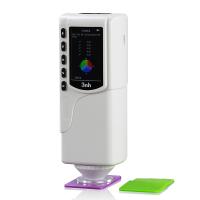
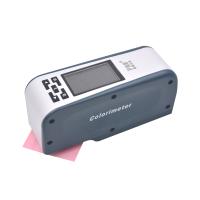
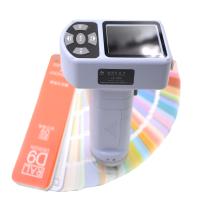
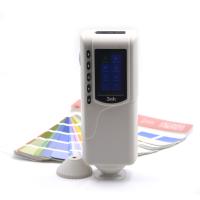
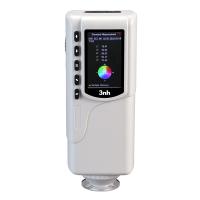
(1) Color difference meter, also known as Colorimeter or color measuring instrument, is an instrument for measuring the tristimulus value or chromaticity coordinates of a color. The picture on the left below shows a portable color difference meter. The geometric structure commonly used in Colorimeters can be divided into two types: directional type and integrating sphere type (diffuse type). Typical illumination observation conditions of directional Colorimeter are 45°/0° (illumination at 45° angle and observation and measurement at 0° angle perpendicular to the sample plane) and 0°/45° (illumination at 0° angle/measurement at 45° angle ) two types; the typical illumination observation conditions of the integrating sphere Colorimeter are d/8° and 8°/d, providing spherical diffuse illumination and 8° angle measurement.
There are many types of Colorimeters, the principle of which is to measure the tristimulus value of the reference sample and the sample or the color coordinates in the color space, so as to quantitatively measure the color difference between the sample and the reference sample, usually expressed by the total color difference △E. The two widely used color spaces today are Hunter L, a, b and CIE L*, a*, b*, Hunter and CIE L*, a*, b* scales are X, Y, Z values for arithmetic derivation Come out, the CIE L*, a*, b* color space recommended by the International Commission on Illumination (CIE) is widely used at present. The system includes two coordinate axes b* and b*, which are at a right angle of 90° to each other, representing the hue Or color, the coordinate axis is perpendicular to the a*b* plane, representing brightness, as shown in the lower right figure. Any color can be represented by the coordinates L*, a*, b*.
The selected color difference meter, standard light source, standard chromaticity observer, color space and observation area are different, and the measured color difference value
There will also be differences. Depending on the selected Colorimeter, standard light source, standard chromaticity observer, color space and observation area, the measured color difference values will also be different.
(2) Colorimeter Calibration Board It consists of a set of calibration white boards, calibration black boards and calibration fluorescent boards.
(3) Reference sample A standard color sample approved by both the supplier and the purchaser. The reference sample should be stored in a dark and laboratory environment to avoid large changes in color and affect the measurement results.
test methods
(1) Turn on the Colorimeter, and calibrate the instrument with the Colorimeter calibration plate according to the instruction manual.
(2) Select the standard light source, standard chromaticity observer and color space, etc. as agreed by both parties. Measure the chromaticity coordinates CIELAB L*, a*, b* or HumerLab L, a, b of the reference sample under the selected instrument conditions, and then determine the chromaticity coordinates of the sample under the same conditions.
The result shows
The color difference is represented by ΔE or ΔE, ΔL, Δa, Δb. Take the arithmetic mean of the color difference of the coating at three different measurement locations, which is the color difference of the sample.
The color difference △E between the sample and the reference sample can be directly displayed by the instrument, and can also be calculated by the following formula:

Reference standard
National standard GB/T 11186.2 "Coating Film Color Measurement Method Part II Color Measurement".
National standard GB/T 11186.3 "Measurement method of coating film color Part III Color difference calculation".