Pigment properties
As a pigment for latex paint, people have many requirements for it, such as color, hiding power, tinting power, oil absorption, light resistance, weather resistance, acid and alkali resistance, critical surface tension and dispersibility.
Color is the most characteristic property in the performance of pigments, especially colored pigments. The color of the pigment is the basis for the variety of latex paint colors. It mainly depends on its chemical composition and structure, and is also related to factors such as light source, pigment particle size and people who perceive color.
1. The relationship between light and color
Light is an electromagnetic wave. It is generally believed that the wavelength of visible light is 380~780nm. Only visible radiation can stimulate the eyes to produce vision.
Light and pigments have the following effects: transmission, reflection, absorption and scattering. If all visible light passes through the pigment, the pigment is colorless. If all are reflected, the pigment is white. If fully absorbed, the pigment is black. Pigments are colored only when they choose to absorb certain wavelengths of visible light and reflect others. The color that people perceive is not the spectral color of the absorbed light wavelength, but the spectral color of the reflected light, which is caused by the reflected light acting on human vision, and it is the complementary color of the absorbed light.
2. Three parameters of color
In the colorful world, the types of colors seem to be endless, such as red, orange, yellow, green, blue, purple, black, gray, white and so on. They do not exist in isolation, but there is a certain internal connection. A color can be determined by three parameters, namely hue, saturation and lightness.
(1) hue (hue)
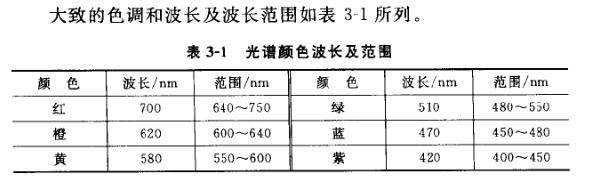
Hue, also known as hue, is used to express the characteristics of red, yellow, green, blue, purple and other colors, and is a visual perception attribute. The hue of an object is determined by the spectral composition of the light source and the ratio of the radiation of each wavelength reflected (or transmitted) by the surface of the object to the human eye.
There is no absolute limit for the division of hues. There are two adjacent colors in which visible light waves change continuously, such as between red and yellow, and between yellow and green. There is a transition zone from one color to another, and the color change between them is continuously.
(2) Brightness (1ightness)
Lightness refers to the visual perception characteristic value of the brightness of the surface color of an object, and is graded based on absolute white and absolute black.
(3) Saturation (chroma)
Saturation is the color purity expressed on the basis of the "quality" of the hue, also known as chroma. The various monochromatic lights of visible light are the most saturated colors. The more white light is mixed in these colors, the less saturated they will be, and the poorer the reflection selectivity to light waves will be. The final result becomes white, and the stronger the selectivity to light waves, the better. saturation.
For color representation, please refer to GB/T156o8-1995 "Chinese Color System".
3. Classification of colors
(1) non-color (achromaticcolor)
Non-color is the result of non-selective absorption of visible light waves, and what is presented is a series of black, gray, and white colors. Achromatic colors only differ in lightness, so-called neutral colors, which are arranged on the vertical axis of Munsell's three-dimensional color. When the reflectance of all wavelengths of visible light is above 8o%~9o%, it reflects a high brightness and can be regarded as white. If the reflectance of all wavelengths of visible light waves is below 4%, it will have a very low brightness and can be regarded as black. The reflectance between these two is gray, and pure white is a desirable total reflection object, whose light reflectance is equal to 1. In fact, the so-called white pigment is not pure white, and its reflectance to all wavelengths of the visible spectrum is not exactly the same, and it absorbs slightly selectively. Therefore, there are still differences in color between various white pigments, and the same is true for black.
(2) color (chromaticcolor)
Colors other than the black color series are colors, which are the result of the selective absorption of the wavelengths of the spectrum by objects. There are both "quantity" and "quality" changes in the reflection of light. The so-called "quantity" change is the visible spectrum. The level of reflectivity shows the selectivity of color to light wave. The stronger the selectivity, the higher the saturation, the higher the reflectivity, and the higher the lightness. The so-called "quality" difference means that the reflectance of each wavelength of the visible spectrum is different. If the reflectance of a certain wavelength is large, it mainly shows the color of the light wave in this interval. Therefore, different spectral reflectance curves also show the color tone. different. Therefore, color can comprehensively include three characteristics of color: hue, lightness, and saturation, while non-color only includes one color characteristic—lightness.
4. Measurement of color
(1) Visual inspection method
At present, the detection of domestic pigment color mostly uses the visual method, specifically according to GB/T1864-89 "Comparison of Pigment Color", which stipulates that the pigment should be dispersed into the vehicle under the same conditions, and then coated with a Wet Film Applicator On a colorless and transparent glass plate, under scattered sunlight or a standard light source immediately after coating, parallel comparison is made with the standard sample, and the color difference is graded into four grades: approximate, slight, slightly, relatively. Among them, slight, slight, and relatively should be included in the comments of hue, bright, and dark. White pigments are rated as better than, equal to or worse than the standard sample plus hue.
(2) Instrument measurement
Each color can be measured digitally with a color measuring instrument, which is accurate and fast, and the information is easy to exchange and save. However, there are also limitations in instrumental color measurement. In some cases, there is a big difference between the instrumental measurement results and the visual inspection results. A combination of visual and instrumental measurements can provide an objective and accurate assessment of color.
