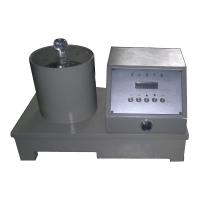
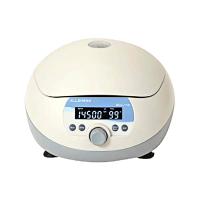
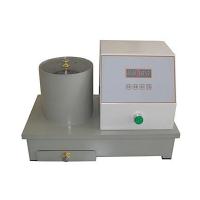
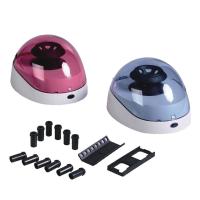
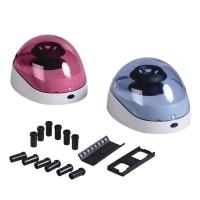
Electric centrifuges are often used to separate sediment from solutions, various viscous solutions that are not easy to filter, emulsions, oil solutions and biological products. The efficiency of centrifuge separation is mainly determined by the size of the centrifugal force generated, and the size of the centrifugal force is determined by the difference in mass density of the separated material and the speed and radius of rotation of the motor.
(1) Classification of centrifuges
According to the highest speed, it can be divided into low-speed centrifuge (≤8000r/min), high-speed centrifuge (8000~28000r/min) and ultracentrifuge (28000~120000r/min).
According to the purpose, it is divided into: ①preparative centrifuge, which can control the centrifugation speed, temperature and time, and is used to separate, concentrate and purify the particles in the solution; ②analytical centrifuge, which can not only separate the particles in the solution, but also pass through The optical detection system observes, filmes and measures some physical parameters of particles during the whole process of centrifugal sedimentation.
According to the structure, it can be divided into floor type centrifuge and desktop centrifuge.
In addition, there are large-capacity centrifuges and microcentrifuges; refrigerated centrifuges and ordinary centrifuges.
The basic parameters of the centrifuge are determined by the main engine and the rotor, which include: maximum speed, maximum preparation capacity, maximum relative centrifugal force field, speed control accuracy, temperature control accuracy, temperature control range, acceleration and deceleration time, machine vibration and noise etc.
Common centrifuges with 6 tubes and covers are usually used, with a centrifuge volume of 10-20mL and an adjustable speed of 0-8000r/min. The speed of the high-speed refrigerated centrifuge is 24000r/min, and the temperature is -20~1040°C. The operation of this type of centrifuge is controlled by a built-in computer, with digital display of temperature, time, speed, etc., with anti-unbalance mechanism, safety protection, low noise and other measures, with various types of rotors, which can be replaced according to needs.
(2) Precautions for the use of ordinary electric centrifuges
①The centrifuge should be placed on a stable table to prevent accidents due to sliding or vibration of the centrifuge.
② When starting the centrifuge, it should be accelerated gradually. When the sound is found to be abnormal, it should be stopped for inspection and troubleshooting (such as asymmetrical centrifuge tubes, uneven quality, uneven position of the centrifuge, or loose nuts, etc.) before starting work.
③ The centrifuge tubes should be placed symmetrically. If the tubes are odd and asymmetrical, add another empty tube to fill with water of the same quality, and adjust to make the quality symmetrical.
④ The casing of the centrifuge should be kept clean, and the bottom of the casing should be covered with soft materials such as foam plastics to prevent the centrifuge tube from breaking.
⑤When shutting down the centrifuge, slow down gradually until it stops automatically, and do not force it to stop.
⑥ Sealed centrifuges should be covered when working to ensure safety.