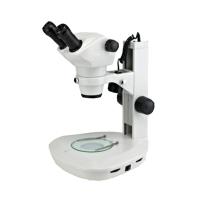
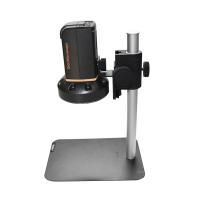
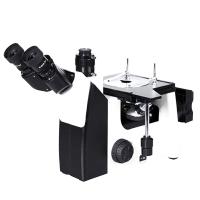
(1) The main difference between a solid microscope and a biological microscope
① The magnification of the solid microscope is low, usually 80-100 times, and the highest magnification of some can reach 160-300 times, but it is much smaller than the magnification of the biological microscope. Therefore, solid microscopes cannot observe slices of animals and plants, but can only observe a certain type of mold and other larger specimens.
②Using a solid microscope to observe specimens generally does not go through film-making procedures. Specimens can be directly observed under the objective lens, which can be directly used to observe the morphology of small insects, seed structure, and the investigation of jewelry and antiques.
③ The specimen can be dissected under a solid microscope, and can be dissected and observed at any time.
④ The image presented by the solid microscope is positive, which is different from the biological microscope.
⑤ Solid microscopes are all binoculars, and there are two independent optical paths forming an angle of 12° inside the machine, simulating the two lines of sight of human eyes, and the observed image has a three-dimensional effect. Other biological microscopes can be monocular or binocular, but the image of the binocular is still not stereoscopic.
(2) Mechanical structure of solid microscope
The mechanical structure of the solid microscope is simpler than that of the biological microscope, and its characteristics are as follows:
①The solid microscope has only coarse adjustment, but no fine adjustment, because the depth of focus of the solid microscope is large.
②The solid microscope has no collecting mirror and no filter.
③ There is no specimen pusher on the solid microscope stage.
(3) Stereo Microscope Optical System
In addition to the eyepiece and objective lens, the solid microscope also has a Schmitt prism (for inclined eyepiece), a reflective prism system (for upright eyepiece) and a Galileo system (installed between the large objective lens and the small objective lens to rotate Those who change the magnification of the drum are equipped with such a system).
(4) Usage and precautions of solid microscope
The use of a solid microscope is simpler than that of a biological microscope. First, it is necessary to determine what type of illumination to use (i.e., epi-illumination or transmitted illumination) according to the different conditions of the specimen, and select a suitable stage (with a transparent glass stage and a side surface). white and black on the other side).
① When observing opaque specimens, epi-illumination should be used.
② When observing translucent specimens, use transmitted illumination.
③ If the specimen is black (and dark in color), a stage with a white porcelain surface should be used.
④ If the specimen is white or light-colored opaque, a stage with a black porcelain surface should be selected.
⑤If you use transmitted illumination, you need to use a glass stage.
⑥ When observing the specimen with a solid microscope, first place the specimen on the stage, select appropriate lighting, look at the eyepiece, and adjust the coarse adjustment knob to make the image clear. It should be noted here that the distance between the two eyepiece tubes needs to be adjusted so that the two fields of view seen by the two eyes overlap into one field of view. At this time, the image has a three-dimensional effect, which is the key to using a solid microscope. The distance between the eyepiece tubes can be adjusted freely according to the different eye distances of each person.