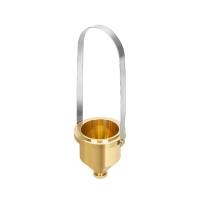
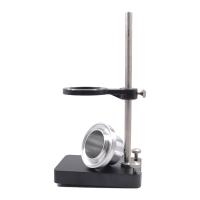
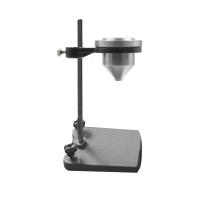
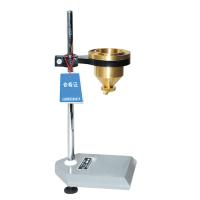
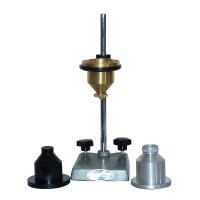
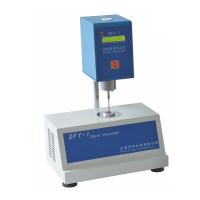
The name of Tu-4 Cup Viscometer is derived from the popular name of its outflow hole diameter of 4mm. Tu-4 Cup Viscometer is mainly used to measure the fluid condition viscosity within 150s of outflow time. According to the production process and materials of different manufacturers, the mainstream Tu-4 cup viscometer includes copper, stainless steel, aluminum alloy, and some manufacturers even use Bakelite.
In addition, depending on the purpose of the test, the manufacturer designed the Tu-4 cup viscometer with a portable type and a desktop type. The portable type is more convenient for on-site inspection, as long as it is used with a stopwatch (in fact, in most cases, the author uses a mobile phone stopwatch) to test. Viscosity of on-site fluids; while benchtops are mainly used in laboratories, this type of measurement is relatively more accurate than portable ones because there are fewer errors in manual operation. In contrast, according to the author's experience, because the Tu-4 cup viscometer is used domestically, more ISO outFlow Cups and Ford cups are used internationally.
The choice of Tu-4 cup viscometer is mainly based on the use of the model. Secondly, the accuracy problem is that most manufacturers advertise the same error range, but this is not necessarily the case in actual use. This has nothing to do with whether the manufacturer falsely advertises, but It is the ability of its production process, especially the errors that are convenient for fine production can easily bring more uncertain consequences. For the desktop Tu-4 cup viscometer, choosing a matching bracket and matching level will be more helpful to the experiment. Some manufacturers (such as Yueping NDJ-5) have a fluid switch at the opening, and it will be more convenient to seal the orifice without fingers. In addition, regarding the material of the cup body, from my personal point of view, most fluids are still corrosive to a certain extent. Copper will be coated on the surface. Although it is so corrosion-resistant, the coating is still relatively easy to fall off. The results can be imagined. , In terms of the material selection of the cup body, the author recommends the use of stainless steel.
The following is a comparison of the parameters of the mainstream brand Tu-4 cup viscometer. The data is taken from " Zha Instrument ".
| Comparison category of Tu-4 viscometer | NDJ-5 | QND-4D | QND-4C | QND-4C | T-4 | QND-4D | QND-4A (bakelite cup) | QND-4A | NDJ-5 | BGD 124/1 | 124/2 |
| brand | Yueping | Jingke | Kexin | Jingke | modern environment | Kexin | Kexin | Jingke | Heaven precision | Domestic | Domestic |
| place of origin | CHINA | ||||||||||
| Model comparison | |||||||||||
| type | desktop | Portable | desktop | desktop | desktop | Portable | desktop | desktop | desktop | desktop | desktop |
| material | Stainless steel | aluminum alloy | Copper | Copper | aluminum alloy | aluminum alloy | other | other | Copper | Copper | aluminum alloy |
| tolerance scope | ±3% | ±3% | ±3% | ±3% | ±1% | ||||||
| Measurement time (s) | 30s≤t≤100s | 10~150s | less than 150 seconds | less than 150 seconds | less than 150 seconds | less than 150 seconds | less than 150 seconds | 30s~100s | less than 150 | less than 150 seconds | |
| Capacity (ml) | 100ml | 100ml | 100ml | 100ml | 100ml | 100ml | 100ml | 100±1ml | |||
| Ambient temperature (℃) | 25±1℃ | 25±0.2℃ | 25±1℃ | 25℃±0.5℃ | |||||||
| tolerance scope | ±3% | ±3% | ±3% | ±3% | 2 times measurement error 0.5s | ||||||
| material | Stainless steel | aluminum | Copper | Copper | Cup aluminum alloy; filter stainless steel | Aluminum | bakelite | bakelite | pure brass | copper cup | Aluminum Cup |
| Type (Desktop/Portable) | desktop | Portable | desktop | portable | desktop | desktop | |||||
| Whether with flow switch | have | no | none | none | yes | ||||||
| Is there a spirit level | have | no | none | none | yes | ||||||
| Applicable standard | GB/T1723 | ||||||||||