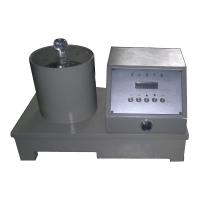
In recent years, CHINA's laboratory centrifuges have developed rapidly, especially high-speed refrigerated centrifuges and ultracentrifuges. The laboratories of universities and research institutes across the country are equipped with centrifuges to meet the needs of teaching and scientific research, and the utilization rate is relatively high. There are relatively few documents describing the principle, operation and precautions of the centrifuge and the maintenance system. This article mainly discusses the principle of the centrifuge, the precautions for operation and the maintenance of the centrifuge, which can be used for the management and use of the centrifuge managers and users. Provides useful reference to get the most out of your centrifuge.
1 Principle of centrifuge
1.1 centrifugal force
Centrifugal force (centrifugal force, Fc) is to use the principle of material sedimentation to place the rotor of the centrifuge tube containing the sample solution on the centrifugal shaft, and the strong centrifugal force generated by the high-speed rotation of the rotor around the shaft makes the particles of different properties in the sample Their densities or shapes and sizes are separated from each other [1,3]. According to the law of uniform circular motion in physics, the material particles in the centrifuge tube placed in the rotor are subject to an outward centrifugal force in the centrifugal field:
Fc=mω2r(1)
Among them, ω is the angular velocity, ω=2πn/60, n is the rotational speed of the rotor per minute (r/min), r is the distance (cm) between the centrifuge tube and the rotating shaft, that is, the centrifugal radius.
1.2 Relative centrifugal force
Due to the different radius of the centrifuge rotor or the distance from the centrifuge tube to the center of the rotating shaft , the centrifugal force on the particles is also different. In addition to the centrifugal force, the material particles are also affected by the gravity P. Therefore, in recent years, relative centrifugal force (relative centrifugal force, RCF) has been adopted internationally in ultracentrifugation, that is, the multiple value of the centrifugal acceleration generated by the centrifuge and the acceleration of gravity of the earth, and the unit is the acceleration of gravity g (g=9.8m/s2). Express the centrifuge speed [3].
(2) Any centrifuge rotor can calculate the maximum radius (rmax), minimum radius (rmin) and average radius (rav) or the relative centrifugal force at any position by formula (2).
In general, the relative centrifugal force of rav is selected as the centrifugal condition.
1.3 Settlement coefficient
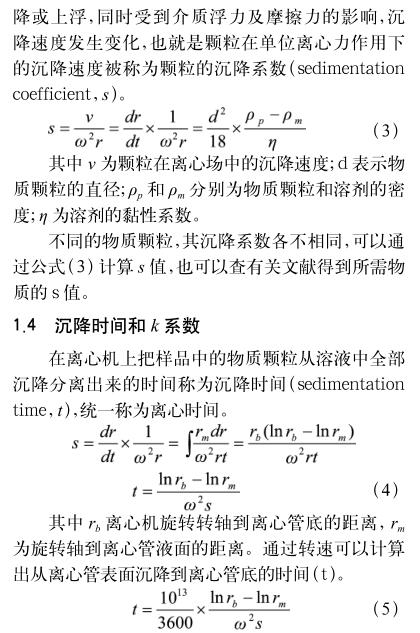
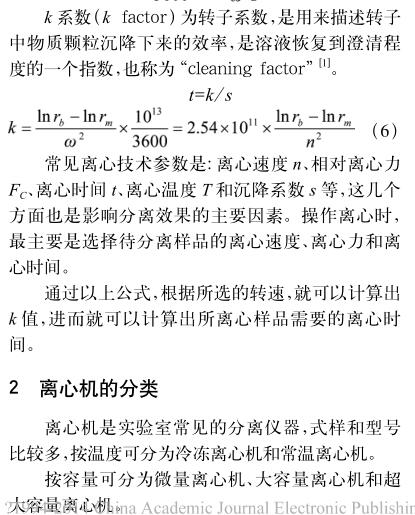
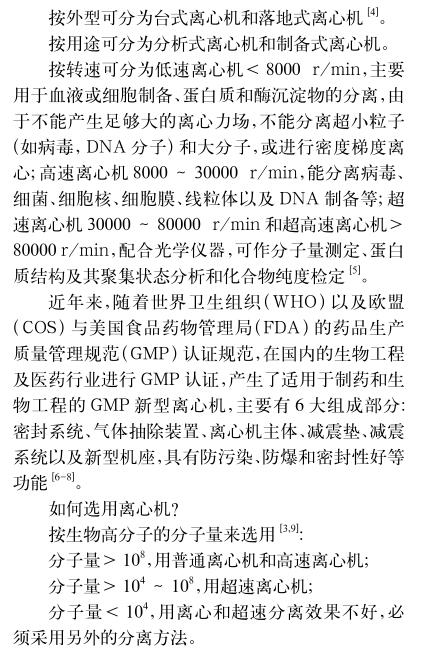
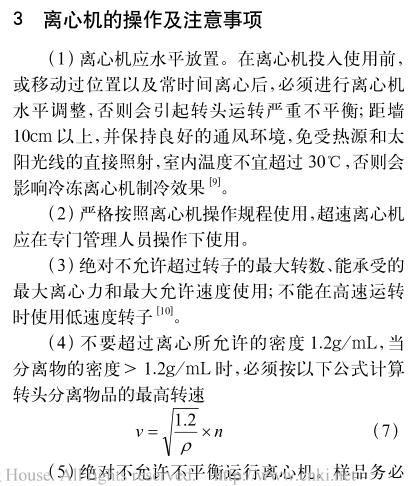
Substance particles in the sample sink in a gravitational or centrifugal field