As a fluid, openness is one of the main physical properties of liquid coatings. The degree value reflects the flow resistance caused by the interaction between liquid molecules, that is, the size of the internal friction force, and is a characterization of the fluid flow resistance; the value is equal to the shear stress per unit area when the unit velocity gradient is received, and the international The unit is Pas (Pas), [the usual units are P (poise), ep (centipoise), lpa, IOp, 1Pma, 1cP]. The ratio of power density to density is called motion tolerance, and its international unit is square meter per second (mlzs) [common units are ts (S), est (centis), Icst = 1mmZzs]. Fluids are divided into Newtonian and non-Newtonian, and non-Newtonian includes pseudoplastic fluids, expansive fluids, Bingham fluids, and thixotropic fluids. Newtonian flow is a fluid whose velocity remains constant over a wide range of shear rates at a certain temperature. In non-Newtonian flow, the shear force is not proportional to the velocity. With the increase of the shear rate, the fluid whose porosity value decreases is called pseudoplastic flow; the fluid which increases the shear rate and the porosity value is called dilatant flow; if a certain shear stress is required to yield before the fluid flow occurs Fluids that can flow only when the value is high are called Bingham flows. The openness of non-Newtonian flow is usually called apparent openness, which is distinguished from that of Newtonian fluid. The apparent openness is that the openness value is only related to one shear rate, and a fluid can exhibit different apparent openness values at different shear rates.
Except for solvent-based varnishes and low-booy color paints that belong to Newtonian flow in liquid coatings, most of the color paints belong to non-Newtonian pseudoplastic flow or plastic flow, so their bogey values are actually their representations. Observation degree. For thick paste paints such as putty, it is customary to call its milkiness as consistency, which also means its fluidity.
Some paint varieties have thixotropy, which is also a rheological property , that is, these varieties have lower openness at high shear rates, which is convenient for brushing; they have higher openness at low shear rates, which can prevent sagging and pigmentation. Settling, this property is conducive to the construction of coatings.
In addition, liquid paints, especially paints containing pigments with high density , usually maintain a high bogey value for long-term storage in containers, which is commonly known as the original boeness of the paint. During construction, it is necessary to use a thinner to adjust to a lower degree to suit the needs of different construction methods. At this time, Hedu is commonly known as construction degree. The original milkiness of paint varies from species to species. The construction volume varies with the construction method. In addition, the original opening and construction opening of the coating change its value with the rise and fall of temperature, so it can only be measured under the same certain temperature condition.
1 Viscosity detection of liquid paint
The detection of the latitude of liquid coatings is mainly determined . The outflow method (including capillary method and Flow Cup method) is the main method for testing transparent varnishes and low-bulk paints, and the bubble method and falling ball method are also used for testing transparent varnishes. For high-density paints, the density is determined by measuring the stress at different shear rates. This method can also be used to determine other corresponding rheological properties.
11 outflow method
By measuring the outflow the degree of the paint is expressed.
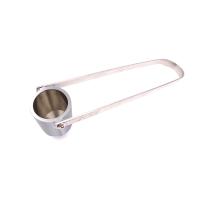
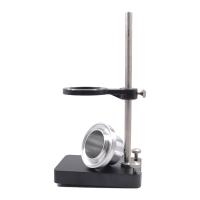
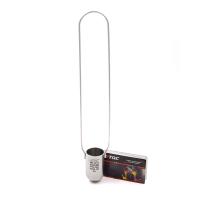
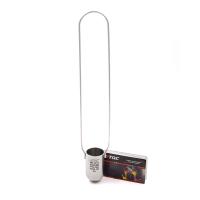
The flow rate measured by the Flow Cup method is the movement rate, which is usually expressed by the time when a certain amount of sample flows out of the Flow Cup, and the unit is seconds. It is suitable for low-bulk varnishes and paints, not for determining the viscosity of non-Newtonian flow such as high-viscosity, high-pigment paints. This method is easy to operate and clean, and can be used to determine the degree of opaque color paint. However, due to the large diameter and short length of the outflow hole, the stability of the flow is poor; in addition, the Reynolds index is relatively large during the flow process, so it cannot replace the capillary gauge for scientific research.
The Flow Cup meters used in various countries in the world have different names and slightly different structural dimensions, but their shapes are roughly the same, and they are all divided into different models according to the size of the outflow aperture. Each type of bodo cup has its own good measurement range, so when choosing a Flow Cup to measure the volume, it is necessary to select the appropriate type of boo meter according to the sample volume, and indicate which type of boo meter is used Measured by the meter. The outflow time can be converted into exercise tolerance, but the conversion formulas of various bodu cups are different. Commonly used Flow Cups include Tu-1 cup, Tu-4 cup, 510 cup, Ford cup, DIN Burdo cup, etc. There is also a Zahn cup suitable for construction sites.
相关的测量标准有:GB/T1723一93、GB/6753.4一86、1502431、ASTMD 1200、DIN53211、ASTM4212。
毛细管法测定涂料勃度是最古老的方法,它适用于测定清澈透明的液体。但由于毛细管豁度计易损坏,而且操作清洗均较麻烦,不适合用于工业生产,而主要用于其他勃度计的较正。毛细管勃度计有多种型号,如奥斯特瓦尔德勃度计(otswladviseoemtre)、赛波特豁度计(S盯boltviscoemet)r、坎农一芬斯克勃度计(Cannon一eFsnekvisocmete)r、乌氏(乌布洛德)豁度计(bUbelohdeviseoemte)等。各种豁度计又按毛细管内径尺寸不同规格,分别适用于不同范围勃度的测量。
1.2落球法
落球法利用固体物质在液体中流动的速度快慢来测定液体的私度。所用仪器称为落球豁度计,适用于测定豁度较高的透明液体涂料,如硝酸纤维素清漆及漆料,多用于生产控制。简单的落球豁度计是由一根精确尺寸的玻璃管,内装满被测液体,用一钢质(或铝质玻璃),J、球沿管中心自由落下,取自由降落过程中的一段距离,测定其时间,以秒(s)表示。所测得的秒数可以由一定公式换算成动力私度。偏心式落球私度计是落球豁度计的改进产品,即赫伯勒(HoplPre)勃度计。其特点是管子倾斜成一定的角度,使小球沿管壁稳定下滑,可避免小球在垂直降落过程中因偏离垂线而引起的测量误差;另外小球沿管壁下滑时,在管壁上能映出银灰点,故也可以测定不透明液体的勃度。
相关的测量标准有:GB厅1732一93涂料勃度测定法,规定了落球勃度计的规格和测试方法。
①气泡法:利用空气气泡
在液体中的流动速度来测定涂料产品的勃度,所测豁度也是运动勃度,它只适用于透明清漆。工业L常用的是加氏气泡勃度计,测量时与标准管比较,以与最近似的标准管的编号表示其豁度,通称加氏标准管编号豺度;也可不与标准管比较,而是测定气泡上升的时间,用秒数作为表示豺度的单位。编号、秒等这些条件豁度可以换算成标准的运动豁度或动力勃度。此外美国AsTMD1545一76(8)l规定的检测赫度方法,原理与加氏管法相同,只是管的规格与计算单位与加氏管法不同。
②设定剪切速率测定法:这种测定乳度的方法
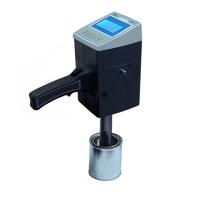
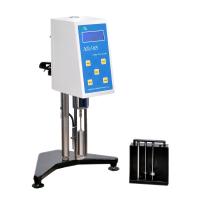
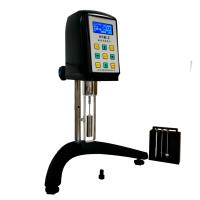
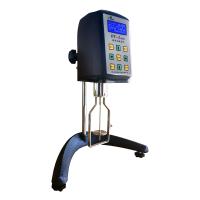
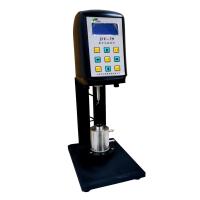
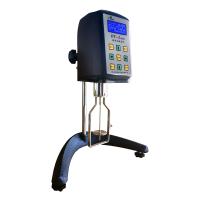
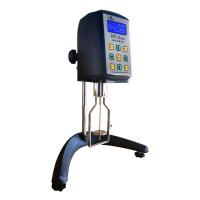
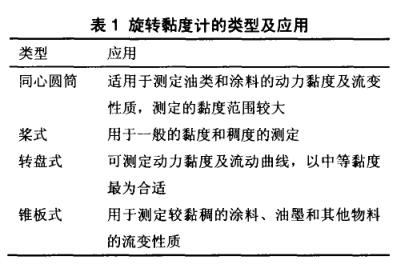
就是使涂料试样产生流动(通常是回转流动)测定使其达到固定速率时需要的应力,而换算成豁度单位。这种测定仪器称为旋转豁度计。最初的旋转豁度计的构造为两个同心的圆筒,内筒可以转动。测定在一定条件下内筒转动对外筒造成的力矩,就可换算成动力勃度的数值。现代的旋转勃度计有很多形式。各种类型的旋转勃度计分别适用于测试不同的涂料产品。一般色漆的质量控制,通常选用转盘式的,它的精确度已能满足要求,可测得几个转速下的勃度,由此可得出流动曲线,可以测定触变性。对于乳胶漆类大多使用桨式,如斯托默勃度计(sto~rivscoemte)r。对于特别赫稠的涂料通常采用锥板式旋转豁度计。豁度计的类型及应用。
2厚漆、腻子的稠度的测定
厚漆、腻子及其他厚浆型涂料是采用测定其稠度来反映其流动性能。稠度的测定方法采用CB汀1749一7(8)9厚漆、腻子稠度测定法中规定,取定量试样,在固定压力下经过一定时间后,以试样流展扩散的直径表示,单位为cm。
3涂料触变性的测定
When the flow of a pseudoplastic fluid is related to its history, that is, it is time-dependent, it is called a thixotropic fluid. The thixotropy of different varieties of coatings is different. The presence and size of thixotropy can be determined using a rotary Hertzometer. First, start from a low speed, gradually increase the speed (that is, the shear rate), and change the speed once at a fixed interval, so that the relationship curve between the shear rate and the temperature can be obtained; then the speed is gradually decreased at the same interval. Measure again by the same method to get the relationship curve between shear rate and Heddler, that is, the thixotropy of each point measured at the same shear rate does not coincide, which means that the paint has thixotropy. From the area surrounded by the curve, it can be seen that the thixotropic Variable size.