Under the condition of scientific and technological progress, a large amount of fluorine is decomposed and released. Therefore, fluorine has become a common pollutant in the surrounding environment. Therefore, the determination methods for studying fluorine content have increased, and the requirements for the sensitivity of the method have also increased.
Some methods for determining fluorine, which are currently applied according to the physical-chemical composition of different media and the analytical chemical characteristics of fluorine, have their advantages and disadvantages. For example, the measurement results of the meter measurement method are not highly reproducible, so it is recommended to use a fixed complex-forming masking reagent, extraction, and ion exchange for each specific sample. Even in the case where the constituent fluoride ions are equal, significant analytical errors occur. It is impossible to accurately determine the equivalence point in the determination of fluoride by direct titration analysis. When there is a small amount of fluorine near the equivalence point, the competition reaction of fluoride and fluorine will affect the titration result. The method of fluoride means that the analysis method can complete the determination within 0.3 seconds. According to class y two. The data of BA. Kou and co-workers determined the potential equilibrium value in seconds. Analysis can be performed with a small amount of sample, and in most cases no pre-treatment of the sample is required. The ion-selective electrode reacts to the change of the activity of the free ions in the solution, and at the same time can determine the form of fluoride in the tested sample. Adding buffer solution can mask the influence of interfering ions and improve the reproducibility and accuracy of the analysis. This method is simple and convenient, and has been widely used in a large number of analysis work.
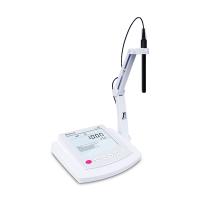
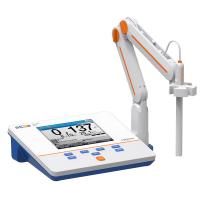
We recommend the use of fluoride ion selective electrode potentiometry for the determination of total fluoride and water-soluble fluoride in soil. The electrode system used in the determination is selected by the fluoride ion
The interference of ferric ions and trivalent aluminum ions is eliminated by adding background solution to the tested solution (g1 Triron E, 598 sodium chloride, 5 ml glacial acetic acid are dissolved in distilled water to make the solution The total volume reaches 700ml, then use 50% sodium hydroxide solution to neutralize the pH to 5.8 ± 0.1, and then add sodium nitrate and sodium fluoride to the solution after the pH value is determined. Move the solution in the beaker into the volumetric flask, and use Distilled water was adjusted to 1) L. The background solution is stable over a period of 3 months, keep it in a polyethylene container.
In order to determine the fluoride content in the tested sample, it is necessary to draw a calibration curve. For this purpose, add 0.1 mol background solution and 0.1 lm distilled water into a small polyethylene beaker, then immerse the fluoride ion selective electrode and silver chloride electrode in the beaker, turn on the magnetic stirrer, determine the electrode potential difference and record the readings, and use this value as a graph the original point. Carefully rinse the electrodes with distilled water after measurement. The standard solution of sodium fluoride with different molar concentrations was started to calibrate the ion-selective electrode. Add 10ml of background solution and 10min-10-`M standard sodium fluoride solution into a small beaker, stir with a magnetic stirrer
When measuring water-soluble fluorine, take 10 lm of air-dried soil into a small polyethylene beaker, add 50 lm of distilled water, centrifuge for 51 minutes, then add 0.1 ml of background solution to an aliquot of 0.1 ml of sample, stir, and measure the electrode potential difference . Find out the content of fluoride according to the calibration curve. The time to determine the electrode potential difference ranges from 0.5 to 3 minutes.
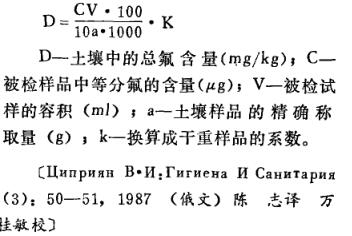
When measuring the total fluorine content in soil, the samples to be tested need to be processed in advance. Take g1 of air-dried soil and add more than 01 times of potassium-sodium carbonate, fuse at 900°C, then dealkalize, neutralize with SN hydrochloric acid, and measure fluorine quantitatively in the same way as checking water-soluble fluorine. Calculate soil according to the following formula Fluorine content in: