白度、亮度在造纸行业里使用极为频繁,无论是生产实践、商业贸易还是书刊文献中都经常使用,但是在实际使用过程中经常出现概念模糊和混淆的情况。本文从定义、光源、测量仪器和测量结果的差异等方面就白度、ISO亮度与D65亮度的称为D65亮度。
对亮度的定义进行比较可知,ISO标准定义的ISO亮度与国家标准定义存在区别,ISO亮度采用C光源,而我国国家标准定义的亮度采用D65光源。According to定义,只有符合ISO2469的规定才能称之为ISO亮度,按照GB/T7973规定的亮度应称之为D65亮度。
白度的另外一种表示方法是CIE白度,这个术语在我国造纸工业应用较少,造纸行业也没有制定相应的方法标准,但是在国际上应用较为广泛,ISO/TC6制定了相应的测试方法标准,国内也有部分企业采用这种白度表示方法。CIE白度分为C光源和D65光源两种照明条件,相应的ISO标准分别为ISO11475《纸和纸板———CIE白度的测定,D65/10°(室外光)》和ISO11476《纸和纸板———CIE白度的测定,C/2°(室内光)》,两种不同光源的CIE白度公式分别为:
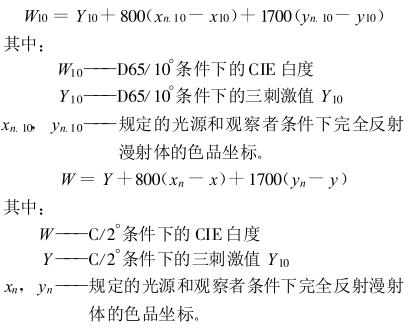
从上面两个公式可以看出,CIE白度是在整个可见光谱范围内对白色的评价,CIE白度比亮度更符合人眼对白度的评价。ISO亮度或D65亮度只是457nm蓝光的反射因数,它反映的只是纸张的亮度,反映不出样品的颜色或色调的特点,但是它能较好的反映出近白色纸张的白色差别,并且表示方法简单,因此使用亮度指标来反映纸张的白度。
2光源及测量结果的差别
从定义上比较可以看出,因采用光源的不同,亮度表示方法也不相同。下面从光源的光谱特性来分析比较不同光源对ISO亮度与D65亮度量值的影响,图1是两种光源的相对功率分布比较。
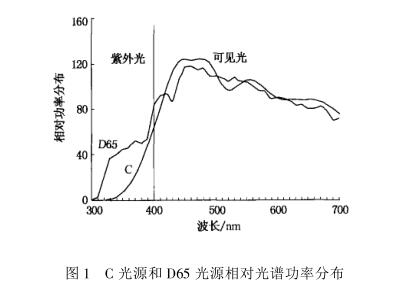
C光源代表相关色温6774K的平均昼光,它的光色近似于阴天的天空,相当于室内光。D65光源代表相关色温6504K时相状态的昼光,相当于室外光。从两种光源相对光谱功率分布比较可以看出,在可见光范围内,C光源和D65光源相对光谱功率分布有差异,但相差不大。但是在紫外光范围内,D65光源的紫外成分大大高于C光源。因此,在测量不含荧光增白剂样品时,两种光源条件对亮度测试的结果相差不大,但是在测量含有荧光增白剂的样品时,由于荧光增白剂经紫外光照射后激发出蓝色可见光,从而达到提高白度和亮度的目的,而D65光源中紫外成分大大高于C光源,比C光源可以激发出更多的可见光,因此测试含有荧光增白剂的同一样品时,D65亮度大于ISO亮度。我国造纸工业及欧洲国家亮度采用D65光源,而北美及日本亮度采用C光源。
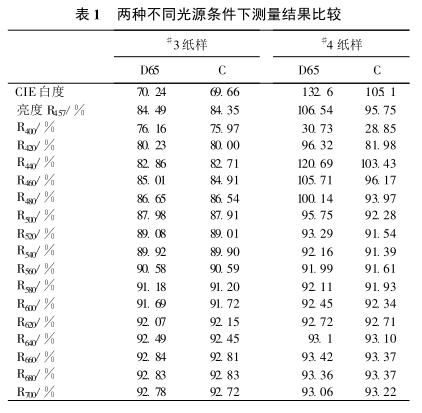
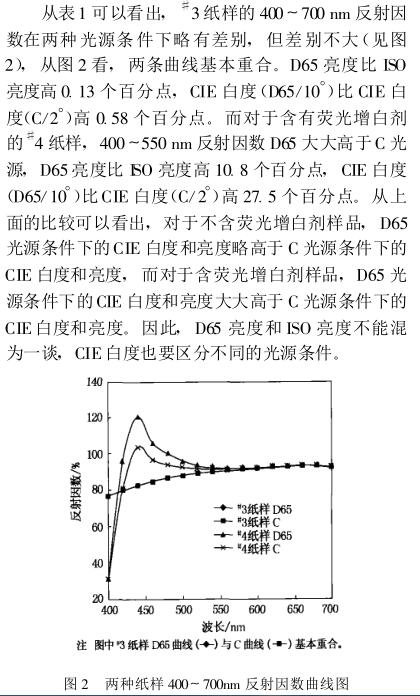
为了比较两种光源条件下亮度测量的差别,采用同一浆样在同样的打浆、抄造条件下抄制两种纸样,其中#3纸样不含荧光增白剂,#4纸样含有一定量的荧光增白剂。使用L&WElrepho分光度计分别测量两种纸样在D65和C两种光源条件下400~700nm波长的反射因数、CIE白度和亮度(见表1)。
3测量仪器功能的比较
随着测量技术的发展,测量白度、亮度的仪器也有很大发展。20世纪60~70年代主要使用ZBD型白度仪,到80年代主要使用SBD型白度仪,它们的几何条件均为45/0,从90年代开始大量使用d/0型白度仪,以WS-SD、YQ-Z-48A/B、DN-B型为代表,近几年来许多单位进口了专业的分光光度仪。因此,我国造纸行业使用的白度仪规格型号较多。下面就这些型号的白度仪的主要差别、测量范围及仪器的主要功能进行比较。
从仪器的几何条件分为45/0和d/0仪器两种。
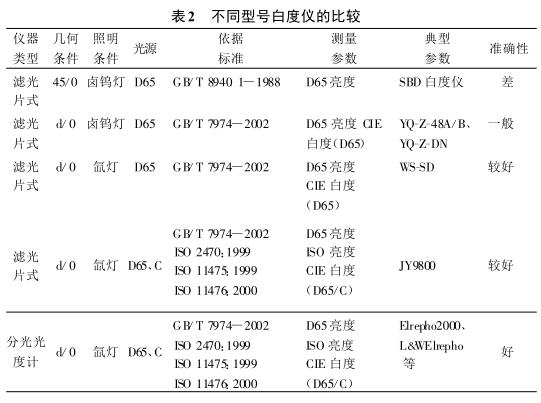
The 45/0 instrument uses parallel light at 45° to the sample surface to irradiate the sample, and receives reflected light in the vertical direction of the sample. The typical instrument is the SBD Whiteness Meter. This instrument is based on GB/T8940.1-1988 and uses D65 light source. Therefore, only D65 brightness can be measured. At present, more d/0 instruments use an integrating sphere to form diffuse light to irradiate the sample, and receive reflected light in the vertical direction of the sample. The light source varies with the model of the instrument (see Table 2).
From the type of instrument, it can be divided into filter type Whiteness Meter and simple Spectrophotometer . The filter-type Whiteness Meter uses photoelectric technology to measure whiteness and brightness after the light emitted by the light source or the light reflected by the sample surface is filtered by a specific blue filter. Most domestically produced instruments use D65 light source ( Such as SBD type Whiteness Meter, YQ-Z-48A/B, YQ-Z-DN, WS-SD type Whiteness Meter), can only measure D65 degrees, JY9800 type reflection photometer includes two kinds of light sources, which can be used simultaneously Measure ISO brightness and D65 brightness. Therefore, the ability to measure ISO brightness varies depending on the model of the instrument. The simple Spectrophotometer adopts the spectrophotometric method to divide the light reflected by the sample surface into monochromatic light through a monochromator or grating, and then measures the light reflection factor according to a certain wavelength interval through photoelectric technology, and then calculates the two parameters based on the relative spectral power distribution. Whiteness and brightness under different light source conditions. The use of spectrometry can make the control of the spectral characteristics of the instrument more precise, so it can get higher accuracy and more functions. Elrepho2000L & WElrepho Spectrophotometer s are commonly used. Table 2 lists the characteristic differences of several different models of Whiteness Meters.
It can be seen from Table 2 that there are certain differences in the light sources, geometric conditions and standards used by these instruments. The parameters measured by different instruments are different, and they should be correctly distinguished during use.
4 Epilogue
Whiteness is used to indicate the degree of whiteness of objects, and CIE whiteness, ISO brightness and D65 brightness are specific applications in the paper industry. ISO brightness and D65 brightness are two different concepts. From the definition, the light source used, and the measurement There are differences in several aspects of instruments and measurement results, which should be correctly understood and distinguished during use, and should not be confused.