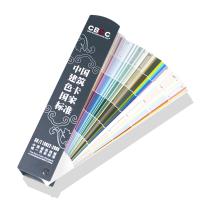
For the ink that has been used, you can adjust the viscosity of the ink to an appropriate value, use a color wheel to make a good sample, and compare it with the qualified color sample or standard color sample retained last time, and you can initially check whether the hue is consistent. Another method is to place a few drops of the wet color sample of the ink to be tested and the ink that passed the previous test on the color development wheel at a distance of about 1cm, and scrape them out side by side. At this time, two adjacent color bands will be left. By comparing these two color bands, you can more accurately judge whether the hue is the same.
b. Tinting strength test
Ink tinting strength testing uses white ink as a reference color sample, and judges the strength of a certain ink's tinting strength by the degree of influence it has on the white ink. The test of tinting strength is to add the ink to be tested and the standard color ink into a small beaker, stir evenly before making a plate, and then compare it with the standard tinting power color sample to judge the strength of the ink's tinting power. The specific method is as follows:
Add 10g of the ink to be tested and 100g of the standard white ink into a small beaker, stir evenly and scrape the sample, and compare the scraped color sample with the standard ink coloring power Color Chart provided by the supplier. If the color of the ink is lighter, it means that the coloring of the ink is weak; if the color of the ink is darker, it means that the coloring power of the ink is stronger, and if it is basically the same, it means that the coloring power of the ink is qualified.
In addition, the degree of change in tinting strength can be detected by increasing the weight of the ink to be tested or the standard white ink.
If the ink color is lighter, the weight of the ink to be tested can be appropriately increased. For example, add 2g of the ink to be tested into a small beaker, stir evenly, and scrape the sample again. If it is consistent with the standard color sample, then calculate according to (10+2):100=10:x, then x=100×10÷12=83.3 (g), indicating that the coloring power of this color ink is only 83.3 of the standard color ink %, it can also be said to be 16.7g weaker.
If the ink color is darker, the weight of white ink can be added appropriately. If 10g of standard white ink is added to the small beaker and the scraped sample is consistent with the standard Color Chart, press 10: (100+10) = 10: x = 110 (g), indicating that the coloring power of the ink to be tested is 110% of the standard ink , It can also be said to be 10g stronger.
The x above all represent the weight of the white ink when a certain amount of white ink is added to 10g of the ink to be tested and meets the standard tinting strength Color Chart. That is to say, the strength of tinting strength is measured by the amount of white ink.
In addition, there is also a wet color sample comparison method, that is, the wet color sample of the ink to be tested is compared with the wet color sample of the ink previously judged to be qualified, and then the wet color sample is compared after scraping. This detection method eliminates the disadvantages of color shift between the wet color sample and the dry color sample, which has a bad influence on the real result evaluation. Since they are all wet color samples and they are adjacent to each other, it is convenient to compare colors and the accuracy is higher.
After finishing the tinting strength and hue testing, remember to keep the wet and dry color samples during the test, especially the wet and dry color samples of standard inks must be sealed and marked for the next test used when. Since the spot color requires stable color, the hue of the ink must be correct, and the tinting strength must be stable. The general standard is: acceptable within ±10%, qualified within ±5%, neither too high nor too low.
2) Detection of ink viscosity
The ink used in gravure printing has relatively low viscosity and good fluidity, and the method of detecting viscosity is also very simple. Only a Viscosity Cup and a stopwatch are needed to complete the detection of ink viscosity. The plastic printing industry generally uses Charn No. 3 cups.
The specific operation method is: first stir the water-based ink evenly, then immerse the Viscosity Cup in the ink, and then lift the Viscosity Cup out at a constant speed. When the Viscosity Cup is just pulled out of the ink surface, press the stopwatch to time, and observe the outflow of the ink; when the ink just has a break point, press the stopwatch immediately. At this time, the time value on the stopwatch represents the viscosity of the ink. If the viscosity is high, the seconds will be large; if the viscosity is low, the seconds will be few. because
The viscosity of the ink will change as the temperature is different. Therefore, the general detection temperature is fixed at 25°C.
3) Light resistance test and heat resistance test of ink
The light fastness of the ink refers to a property that the ink maintains a stable color after exposure to light. The heat resistance of the ink is the performance of the ink to keep the color and other indicators stable after being heated. Inks with poor light resistance will fade or change color after a period of light exposure. Inks with poor heat resistance will change color after being heated.
The color of some printed matters meets the requirements when printed in the printing factory, but after being used by the customer for a period of time or in the post-processing process, there will be color shift, which is mostly due to this. Generally speaking, inorganic pigments tend to darken and become darker after a certain amount of light or heat; while organic pigments tend to fade after a certain amount of light or heat.
Here is a method for roughly testing the lightfastness of inks.
Divide the solid color sample after printing or plate-making into two parts, one part is placed in sunlight for about 4 hours, and the other part is placed in a dark place away from light. Or fold the color sample in half and place it under the sunlight, with a part of the printed surface facing up to let the sunlight shine, and a part of the printing surface placed under the backlight. After 4 hours, compare the color deviation of the two parts of the color samples. If there is obvious color shift, it means that the light fastness of the ink is unqualified or not suitable for a certain type of product.
Heat resistance test: directly simulate the post-processing conditions (such as boiling, steaming and heat sealing, etc.), and observe the color of the ink. If there is a change, it means that the heat resistance of the ink is unqualified or not suitable for a certain type of product.
The quality of the ink is not as high as possible, but to meet the conditions of use as the standard. For example, the ink used in ice cream cold drink packaging does not need too good light fastness (of course, color-changing inks have also begun to be used in plastic gravure printing processes. Such as temperature-changing inks and light-changing inks).