Over the past five years, we have studied several sets of color recognition systems, and the "non-touch color recognition system" can be said to be far more professional than other similar products in terms of accuracy.
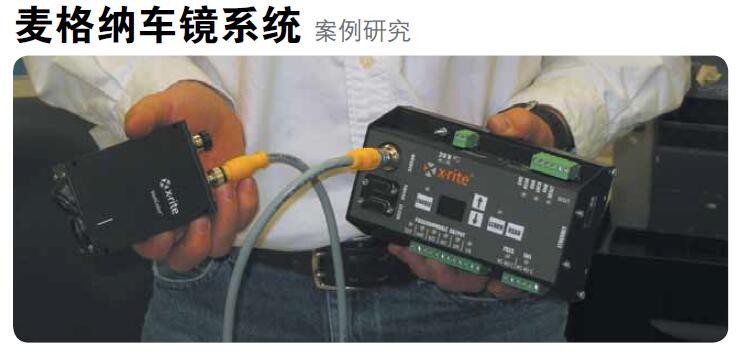
As a leader in the production of automotive rearview mirrors, Magna understands the importance of delivering the highest quality and value to major automotive manufacturers around the world. Magna's customers expect Magna to be flexible enough to produce hundreds of high-quality rearview mirrors. The same is true for the color, and they hope that every rearview mirror produced by Magna needs to match the car well. In order to be able to make accurate color detection, Magnat used X-Rite's "VeriColor non-contact color recognition system". The system is an industrial grade color sensor, sufficient to enable production departments to achieve a high level of color resolution. It can accurately detect subtle color differences, but has no special requirements for the surrounding light environment and manufacturing environment. The "VeriColor non-contact color recognition system" can avoid the problem of color recognition errors caused by traditional sensors that cannot sense the color difference of metamerism. It is unacceptable for Magna to stop production when the product is complete and the customer delivery deadline is approaching. With more than 25,000 mirrors produced every day (one every second), even a few minutes of downtime due to inaccurate color recognition issues can cost the company valuable time and money. According to Steve Guidaro, an equipment engineer who works at Magna's Michigan plant and oversees production at Japan's Suzuki division, most of the stoppages are caused by color recognition problems. "Before using the VeriColor non-contact color recognition system, our production line used a composite color recognition system based on camera color recognition," Guidaro said. "That system was not designed for an industrial production environment, and it was difficult to discern the difference in subtle color changes. This once caused us to have to shut down the production line because of an inaccuracy in the final quality inspection stage."
In 2003, Guidaro installed an experimental Veri-Color non-contact color system on a production line, which consisted of two sensor heads and a data hub. After only a few weeks on the production line, Guidaro noticed a key difference between the system and several existing systems. "For more than five years, we have studied several sets of color recognition systems, and the "VeriColor non-contact color recognition system" can be said to be far more professional than other similar products in terms of accuracy," Guidaro said. “We immediately installed the VeriColor Non-Contact Color Recognition System on the other production lines. The operators liked it very much. For them, it means that there will be no further downtime due to errors and the quality of the products will be better.” Taller."
According to Guidaro, the savings in reduced downtime alone more than offset the investment in purchasing the "VeriColor Non-Contact Color Identification System."
