 Anthony Guarriello grew up working in his father's textile factory in Rhode Island. "I love this business," he says, "and about 20 years ago, I decided to go out on my own." Guarriello relocated to Rutherfordton, North Carolina, where he built a new textile business from the ground up. “The weaving mills give us blanks,” he explained, “and we finish the fabrics to our customers’ end-use specifications, including color and finish. I feel like this business is a reflection of my own personal reputation, which means making sure The quality of the goods shipped from us is very good.” About three years ago, Ultimate Textile received the prestigious GOTS certification. The wide variety of fabrics processed by Ultimate serve a wide variety of end uses, including upholstery fabrics, high-tech fire-resistant uniforms, bulletproof vests, handbags, and more.
Color Measuring Instruments: Believer
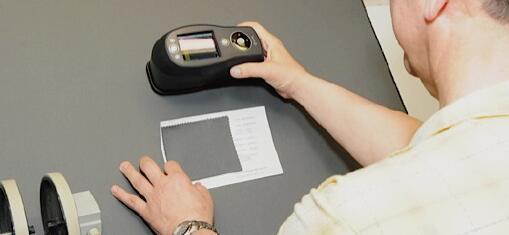
Guarriello knows the benefits of having accurate color Measurement Instruments and the right lighting conditions throughout the plant. He said, "I've had a long relationship with X-Rite. I actually worked with X-Rite back in 1993 when they were developing one of their early products, the SP-78, and in their brochure There’s even a picture of me!” That being said, when he decided to update his color Measurement Instrumentation, Guarriello still did proper due diligence, testing several alternatives. "Then I decided to go with X-Rite's Ci64UV Integrating Sphere Spectrophotometer," he says. "The long-term relationship is important. But the final decision was made with the accuracy and reliability of the instrument." A key factor in Guarriello's decision was the enhancement of the instrument by X-Rite software. "Color iMatch makes work easier," he says. “I can walk around the factory with the Ci64UV, measure different things, download the data to iMatch, evaluate the results, and print out reports if necessary.”
Ultimate Textile uses a variety of instruments for their measurements, and they also use X-Rite Color i7, X-Rite ColorEye 7000A, and others. "That's another great benefit of the Color iMatch software," he said. "It really does a good job of integrating data in a mixed-instrument environment."
 process
 process
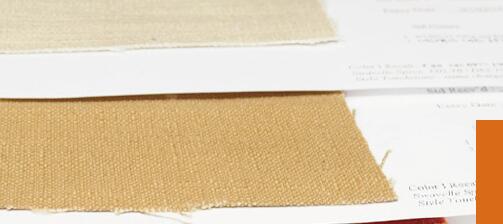
Ultimate Textile receives rough fabrics from weaving mills and processes them to customer specifications. Most fabrics are woven with natural fibers from around the world. "Because it's a natural fiber," Guarriello explains, "the color range can be very wide, so our first step was to standardize the color as much as possible, using a bleaching or washing process, depending on the fiber.
Next, we read the whiteness using the Ci64UV. The reason we bought the UV version was to accommodate the optical brighteners used in polyester and some other man-made fibers. "
The reflectance values recorded by the Ci64UV are read into a special computer program which matches this reflectance value to that of the dye and then generates the recipe. "Ci64UV plays an important role in this process," Guarriello said.
"Once we have the recipe and put the right fabric and the right dye into the infrared dyeing machine, we can replicate the color of the fabric with very little variation. One of the things you really shouldn't be doing is guesswork, and when you put the fabric In production, the Ci64UV takes most of the guesswork out of the production process. Guess is expensive. While you may be talking about a few hundred grams in the lab, multiply that by thousands of times in production. A small mistake in the lab can end up being a huge mistake in production."
Ultimate is a dyeing house with an exhaust system. Guarriello explains, “Time, temperature and chemistry are all important in this process. After the dye has been absorbed, we take a small swatch, condition it, let it dry, and take a reading with the Ci64UV. Results generated using iMatch software It's a graph of where you are in the color space, whether you're using L*a*b, CMC, or something else."
Once the fabric is in production, Guarriello adds, there are six or seven other checkpoints, “Every time you do something, there’s an opportunity to change it. If you add water repellants or add other chemicals, use a hot dryer or a tumbler, Each process has the ability to change color, so we test frequently during production to make sure we are always within tolerance.”
Light source is the key factor
Guarriello also understands that the importance of light sources when checking and measuring color cannot be overemphasized. For this, he uses a Macbeth EXAMOLITE above the dyer's desk and a Spectra Light III light box in the lab. All lighting in the sample room, dyer's office and laboratory was TL-84 narrowband 4100 K, and all walls in those rooms were painted Munsell neutral gray.
epilogue
Guarriello is proud of where his business is today and the strong customer base it has earned as a certified organic facility in the United States. In line with his GOTS certification, the product is stamped all the way from raw material to weaving to his workshop to the final manufacturer. And, he keeps his factory scrupulous, saying, "I make fine finished fabrics; why shouldn't I have my factory reflect my finished product?"
He is also concerned with being as environmentally friendly as possible. "The way I do everything is green, whether I need to be or not," he said. “My grandson and the rest of my family work here. I don’t want the factory to be a source of pollution. I want to be responsible. Part of that responsibility is our use of X-Rite’s color measurement and management solutions that ultimately help us eliminate waste from the dyeing process, Because dyes are one of the toughest wastes that municipal wastewater treatment plants deal with.”
"It's exciting to see how far X-Rite has come in the last two decades since I first started working with the SP-78. The Ci64UV is a small instrument with good battery life, The calibration works great and is easy to use in production. It's a very safe, well-designed instrument and I'm excited to add it to the ones we use as we continue to work hard to improve our position in a dynamic and highly competitive quality in the market."
