case study
 About 4Life
In 1998, 4Life founders David and Bianca Lisonbee launched the company's flagship product, 4Life Transfer Factor®, a product that supports the immune system. Seventeen years later, 4Life's leadership team of physicians, scientists, and researchers continues to advance the science of the immune system with innovative product formulations, manufacturing standards, delivery methods, and more. Today, the company has offices in 24 countries, and customers in more than 50 countries benefit from the immune system support from 4Life products. The company employs more than 700 people all over the world.
Dr. David Vollmer, Vice President of Analytical and Quality Services, joined the company in 2013 from a pharmaceutical background. “In our industry, many ingredients that are formulated into products are of plant origin. Depending on when they were harvested, how they were handled, and other parameters, the color of these ingredients can vary widely. Obviously, the color of the incoming The color of the final product has a significant impact. We need to find a way to better control all these parameters in order to achieve higher quality and more consistent products.”
Another problem facing the industry, Vollmer noted, is that specifications for receiving and testing materials are often ambiguous and open to interpretation. "As scientists," he said, "we would like to have objective measures that rely less on individual interpretation or subjectivity and more on scientific fact. We would like to have a way to develop better specifications, objectively accurately test against these specifications and ensure that our tests are reproducible."
4Life started this exploration by using the PANTONE Guidelines as the first step in creating a target Pantone Color for each product or material. "Then, when coming in materials or evaluating the final product," Vollmer explained, "we can compare against these physical criteria."
While this approach helps, Vollmer notes, if 10 different people compared the sample to the target, they might get eight or nine different answers, and that's because of differences in perception of color. "This is a solid step in the right direction," he said. "Let's think about this in terms of color consistency. This led us to investigate what affordable instruments could be used to further test our color theory." .”
The primary regulatory agency establishing testing protocols for 4Life's work is the United States Pharmacopeia (USP). According to Vollmer, USP1061 involved instrumental colorimetry, a clue that prompted the company's team to decide to pursue it further.
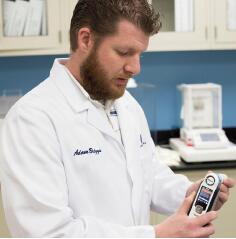
As a result, 4Life Labs chemist Adam Briggs discovered the X-Rite RM200QC SpectroColorimeter. "It's a relatively inexpensive device that allows us to take one step after another on the color journey," he said.
The first step in the process was to determine if the RM200QC could be used to repeatedly measure a large number of incoming materials with consistent results, and the RM200QC passed this test with flying colors. "We now have a good scientific basis to start our work on," Vollmer said.
The next step is to examine different batches of material from different suppliers to determine how variable the color is between different batches from the same supplier and different batches from different suppliers. “We tested hundreds of ingredients and finished products,” says Briggs, “to determine a reasonable range of variability.” “In the process,” adds Vollmer, “we also gained a deeper understanding of color.”
Impact on customers
One of the many findings revealed by this research is that a large proportion of customer complaints about products are related to color. Vollmer explained, "In the analytical lab, we really do all the various tests—are the vitamins in the right amount?
Is the moisture content correct? But customers don't necessarily think about those tests. Appearance and color are what they focus on. "
Vollmer continues: "Essentially, customers are doing a 'quality check' every time they pick up one of our products. When they see that this bottle is a different color than the last, they notice right away. This is a very important aspect of our product that we haven’t always considered in the past, mostly because we didn’t have a good way of measuring it. Now we have it, and it’s been amazing.”
Specifications and Tolerances
One outcome of this work was the successful construction of a clear specification library for 4Life that measures the raw material, the final product and every step in between. "This takes the guesswork and subjectivity out of the process," Briggs said. “Whereas in the past we might have a 20-minute discussion about whether the material was tan or beige, now we’re just measuring it and nobody’s arguing about the measurement. It’s what it is, and there’s data to prove it.”
Ultimately, 4Life established a process to average the L*a*b color space values measured from different batches of material, and this result was used to find a very representative Pantone color to be used as a target. “We need to account for variability,” he said. “We determined that the maximum acceptable color difference for the raw material is 15 from the target, and for the finished product, the maximum acceptable color difference is 10.”
there are more
Vollmer cites the contribution of the RM200QC and the value of this work: “We came in and were preparing a new product launch. As part of a good product development process, we did stability testing and found that the RM200QC was able to detect the stability of the product under different stability conditions. changes that were not captured by other tests we did. This led us back to evaluating different approaches to mitigate this issue. We will continue to discover new values and new uses for the RM200QC."
Vollmer concludes: "It has been a positive experience. Now we have an objective and reproducible way of evaluating color. And remember: it's exciting, it's fun, what we traditionally do in the lab The work is often repeated analysis, which has changed the pace of our work. We are excited about what the future holds!"
