As people improve the quality of product packaging, the process of tobacco packaging is becoming more and more complicated, and the printing quality requirements are getting higher and higher, which also promotes the continuous improvement of the performance of printing inks. At the same time, with the enhancement of people's safety awareness, tobacco, as a special commodity, has put forward higher requirements on the safety of its packaging paper and printing ink.
This paper proposes some testing methods and testing standards for the properties of UV cigarette pack ink and printing requirements.
1. Detection of UV cigarette pack ink performance
(1) Routine testing
The routine detection of UV ink is generally divided into 5 items, namely fineness, color cap, tightness, fluidity and curing speed. Ink suppliers must carry out routine inspections before each batch of ink leaves the factory, and as ink users, they only need to do random inspections.
1. Fineness
The fineness index is tested by a Fineness Meter. The UV offset printing ink standard is ≤15µ,m, and some suppliers have raised this standard to less than 10µ,m mainly to improve the coloring power of UV ink. Since the fineness index is related to the pigment dispersion, the lower the fineness index is controlled, the better the pigment dispersion is, the brighter the ink color is, and the higher the tinting strength is. so the oil
Ink suppliers have strict control over this indicator.
2. Hue
In the past, the detection of hue has always adopted the method of manual detection. The ink standard samples and samples are respectively arranged in parallel on the scraping paper, and the ink is scraped with a scraper to observe the imprint of the ink left on the scraping paper and compare the color bundles. This method depends entirely on the experience of the testing personnel, and there is a greater risk of human error. At present, some large ink factories are trying to use digital
Technical description Hue and color difference value, use ink color development instrument to mark ink
The samples and samples were developed separately to make color chips. Under the environment of standard light source 065, use a Spectrophotometer to measure the Lab value of the color chip, and the marked
The sample is compared with the sample, and the color difference AE is calculated using the color difference formula.
At present, various ink suppliers have different standards for controlling color difference. According to the "G87705-87" standard, the color difference in the printing process is controlled at 0.5-1.5NBS, so it is more satisfactory to control the color difference within lNBS.
3. Viscosity and fluidity
Viscosity and fluidity are two indicators that describe the fluid characteristics of ink, and are generally greatly affected by temperature. There are many testing instruments for fluid properties. Ink suppliers generally use more professional snow Whiteness Meters and parallel plate point meters. For ink research and analysis, they use drop stick point meters (Ray point point meters) and cone-plate point point meters. And rheometer to detect. Printing companies control the workshop temperature well, and general inks will show good printability. UV ink is more sensitive to temperature, sudden cooling and sudden heating will aggravate the change of ink fluid properties. Maintaining constant temperature and humidity conditions is a prerequisite for good printability of UV inks.
4. Curing speed
Curing speed is a very important indicator of UV inks, generally using UV curing instrument for detection, to indicate the degree of curing by means of dry method. In addition to the performance of the ink itself, the curing speed of UV ink is also related to the power of the UV lamp. The printing speed of an offset printing machine equipped with a high-power UV lamp can reach 16,000 to 18,000 prints per hour.
(2) Adhesion test
Cigarette packaging is currently popular with gold and silver cardboard. There are many , most of which are pure paper substrates. Conventional UV inks generally have strong adhesion when printed on pure paper substrates; some materials are printed on original paper substrates. The material is covered with a layer of aluminum-plated plastic film, and the aluminum-plated layer and glue agent are sandwiched between the plastic film and the paper, so that the UV ink is actually printed on the plastic film. This kind of film plastic is mostly PET film, and conventional UV ink Print adhesion properties on such substrates vary widely. Therefore, the UV ink attachment performance should be tested before printing.
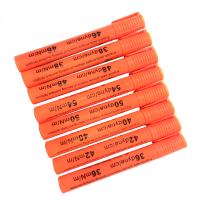
Detection method: Generally, the substrate for printing is tested first to detect its surface tension. The printing standard is above 38 dynes. You can use a dyne pen to scribble on the surface of the substrate. If the lines can be continuous, uniform and do not shrink, it means that the surface tension of the substrate is higher than the dyne value of the dyne pen label, and then test the scribble with a lower label dyne pen. Until the stroke lines just appear to shrink unevenly, the surface tension of the substrate is the label value of the dyne pen. Paper inks with a dyne value less than 38 are not easy to spread and have low adhesion. Try printing on a qualified substrate, and use a tape to stick and pull the graphic part. Generally, a 20x100mm tape is used for testing. The judging standard is that the ink layer cannot be pulled up.
(3) Folding resistance test
After the cigarette packaging box is printed, it needs to go through a die-cutting process. After the printed substrate is die-cut, a crease will be pressed out, and the cigarette packaging box will be made by folding according to the crease. If the folding resistance of the ink film is not good during the folding process of the cigarette case, it is easy to cause the ink film to break and expose the background color of the substrate, which will affect the appearance. Therefore, cigarette pack printing companies attach great importance to folding endurance indicators. At present, most printing companies use the hand test method, that is, to fold the printed product 180 degrees in half 10 times, and if there is no obvious crack, it is qualified. This method is greatly influenced by human factors. The same printed matter may be folded by different people, and the conclusion may be different. It is recommended to use the MIT folding Tester or Schober Tester, and use the method of GBT457-2008 "Measurement of Paper and Cardboard Folding Durability" to test the cigarette wrapping paper, and observe the damage of the UV ink film attached to the cigarette wrapping paper , to determine the folding resistance of UV ink after film formation. This method has high repeatability and reproducibility, and the conclusion can objectively explain the advantages and disadvantages of the folding resistance of the ink film.
(4) Wear resistance and scratch resistance testing
Wear resistance and scratch resistance and the above-mentioned folding resistance are actually two contradictory properties. The folding resistance requires that the ink film after UV ink curing should be soft, while the wear resistance and scratch resistance need to obtain a harder ink. membrane. The test of wear resistance and scratch resistance can rub the test sample on the friction resistance instrument for 30 times, there is no obvious addiction, and the coefficient of dynamic friction on the test surface of the friction coefficient instrument is between 0.2-0.25, which is qualified.
Second, the safety detection of UV cigarette pack ink
With the improvement of people's living standards and concerns about food and drug safety issues, the tobacco industry, as a special commodity, fully participates in the reaction without any residue and volatilization, so it has made great progress in environmental protection compared with traditional inks . However, it cannot be said that UV ink is safe. The raw materials of UV ink will have some harmful substances in the production process. For example, there will be solvent residues in the production process of UV resin and monomer, and heavy metal residues in the pigment production process. These substances will remain in the ink if the post-treatment is not effective.
At present, the detection of harmful substances in UV inks is mainly aimed at the residual amount of organic solvents and heavy metals in inks. In the National Printing and Decoration Products Quality Supervision and Inspection Center, the center researched and drafted the ink solvent residue limit and its determination method, and the ink heavy metal limit and its determination method.
Now cigarette pack printing companies often require UV ink suppliers to provide EU RoHS test reports to prove that the inks are qualified for heavy metal limits. In fact, RoHS is aimed at the electrical and electronic equipment industry. On January 27, 2003, the European Parliament and the Council of the European Union passed the Directive on Restricting the Use of Certain Hazardous Substances in Electrical and Electronic Equipment, which did not cover the ink and printing industries. In view of the heavy metal impurities mixed in pigments, the European Trusted Sector Dyestuff Manufacturing Industrial Ecology and Research Association has made regulations on the limits of heavy metal impurities in pigments, which involve 16 kinds of heavy metals, as shown in Table 1. The European Commission's eco-labelling scheme has established ecological standards for many different product categories, which stipulates the limits of heavy metal ion impurities in pigments, involving ten heavy metal ions, see Table 2. UV ink suppliers use pigments that meet the above two standards, and UV inks should be safe in terms of heavy metals.
The detection of UV ink dissolution residues is generally detected indirectly through printed products. In addition, developed countries have also made detailed regulations on prohibited substances in the printing ink industry. For example: the list of banned substances in printing inks and related products formulated by the European Union Printing Inks Association (EuPIA), which includes substances that are carcinogenic, mutagenic, and highly toxic in the EU CLP regulations, and also includes substances based on brocade, steel, six prices, and Beijing Pigments synthesized from heavy metals such as heavy metals, as well as pigments that can decompose aromatic and dirty substances, are also included in the list for plasticizers and rice rings; the same Japan Printing Ink Manufacturers Association also stipulates as many as 501 prohibited substances, May 2013 In the monthly version, it was added to 548 species. As people's understanding of the toxicity of compounds progresses, the list will gradually increase.
(2) Detection of self-volatile organic compounds in cigarette packs
The detection method of volatile organic compounds is according to the standard, within 24 hours after printing, the headspace gas chromatography is used for testing. Table 3 shows the limits of volatile organic compounds, listing 16 kinds of volatile organic compounds, of which benzene is an undetectable substance, and if benzene is detected, the batch of test samples is unqualified; the other 15 kinds of organic compounds are based on the exceeding ratio of each substance ( Exceeding the standard ratio = detection value / index value - 1) the cumulative value does not exceed 15, which is qualified.
The two standards formulated by the State Tobacco Monopoly Administration are aimed at the packaging of cigarette packs, not printing ink or paper alone. For paper, such as silver cardboard used to bond paper base and aluminized film Glue agents also contain volatile organic compounds. This article only considers VOCs in UV inks.
In addition to the harmful substances remaining in the raw materials of UV ink, the photoinitiator (a component of UV ink) will also produce volatile organic compounds during the photocuring process. According to research, photoinitiator 184 will produce volatile organic compounds during the photolysis process. Cyclohexyl by-product; photoinitiated Jing l173 photolysis process will produce a small amount of acetone by-products, when the UV ink photoinitiator is added too much, the amount of by-products will increase. In order to pursue the ink curing speed, UV ink designers generally increase the content of photoinitiator, which will result in unqualified cigarette pack crystal formation.
3. Conclusion
Regarding the detection of UV ink on cigarette packs, although the major cigarette printing companies have different standards, the overall trend is to gradually improve the printing performance and safety performance of UV ink. The problem of harmful substances remaining in UV ink raw materials and the migration of some substances in ink to the packaging itself after printing will be the focus of future testing. UV ink detection depends on more scientific and reliable detection methods and more professional detection equipment. Improving the detection level of u and v cigarette pack inks is also improving the manufacturing level of UV inks and improving the level of the entire UV packaging printing. .