The larger its size, the larger its surface area compared to a single object. But it's not the same for things like paint. The total surface area of an object is related to its dispersion, the finer it is dispersed, the larger its total surface area. We can imagine that, taking paint as an example, if the degree of dispersion is large enough, when the degree of dispersion of the system increases, the surface area of solid particles will also increase. Therefore, for highly dispersed paint, the surface area is quite large!
Different pigment particles have a variety of shapes, and this different shape has brought great trouble to predicting the way the particles will accumulate. Highly dispersed systems have a range of physicochemical properties. For example, objects are affected by the gravitational force of the earth, and sink quickly in the dispersed medium. The smaller the particle, the stronger its movement ability, the stronger the resistance to the gravitational force of the earth, and the less likely it is to sink. This is the reason for the dust and smog that we usually see. Sometimes the small particle size can bring us benefits, and sometimes it can bring us disadvantages. For highly dispersed systems such as smoke and dust dispersed in the atmosphere to form a sol, causing environmental pollution; dust in the workshop may also cause a fire or even an explosion due to a little spark.
In the paint dispersion system, the pigment is one of the very important components. The size, shape and surface characteristics of the particles have a great influence on the dispersion characteristics of the pigment, and finally affect the performance of the coating film. Studies have shown that for a specific pigment and medium system, the relationship between light scattering intensity and particle size increases first and then decreases; pigments with different refractive indices also have a critical particle size range for a given light wave, within this range the theory Glazing has the strongest scattering. The hiding power, coloring power, and brightness of the pigment are closely related to the particle size of the pigment.
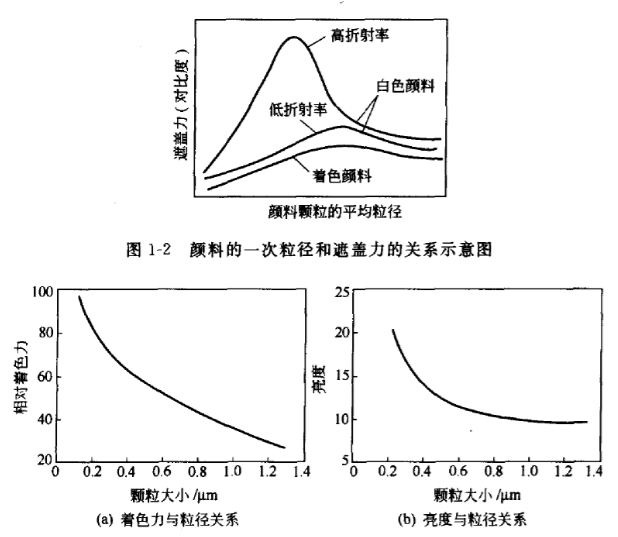
Taking the hiding power as an example, the relationship between the hiding power of the pigment and the particle size of the pigment varies with the refractive index of the pigment. The relationship between the high refractive index pigment and the particle size of the pigment is relatively large, and vice versa, but it has a good particle size. diameter range. For most pigments, the effective particle size is half the wavelength of visible light. Tinting strength is the ability of a certain pigment to be mixed with another pigment to form a strong or weak pigment, and the relative tinting strength increases with the decrease of particle size.
In addition, the particle size distribution and shape also affect the optical properties of the coating film. The narrower the particle size distribution of the system, the higher the brightness, and the acicular particles have stronger tinting power than non-acicular particles.
The weather resistance of the pigment is also related to the size of the particles. Titanium dioxide with large particle size has better weather resistance in different paints, while smaller ones have poor weather resistance. The reason is that pigments with small particle size have large specific surface area and high photoactivity.