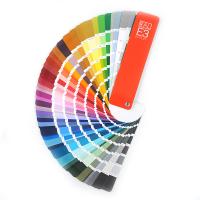
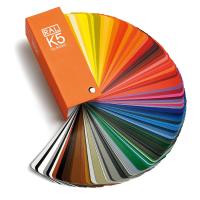
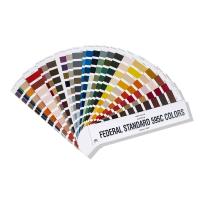
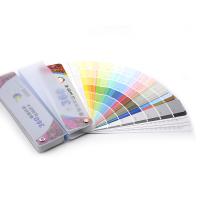
"Architectural Coating Color Card" numbered GSB16-1629-2003 is another paint Color Chart standard after GSBG51001-1994 "Paint Film Color Standard Sample Card". This standard is applicable to the color selection of architectural design, decoration, construction and architectural coating production, and serves as a unified standard for color selection in the construction industry.
Originally, there was no Color Chart standard for architectural coatings in CHINA, and there was no uniform color code for this industry abroad, only the standard Color Charts of some enterprises.
Domestic users often use the "Paint Film Color Standard Sample Card" as a substitute, and the printing industry Color Chart standard is also used as a substitute. Therefore, the release of this standard fills the gap in the architectural paint Color Chart, which has important use value and practical significance.
design principle
Color is a sensation stimulated by the brain via the eye and optic nerves.
This feeling is the result of electric pulses generated by the light reflected from the surface of the observed object, that is, the color is the result of the joint action of the properties of the object and the properties of the light source.
Color representation methods are:
(1) Hue method: use the customary name to express the color;
(2) CIE (International Commission on Illumination) three-color color scale system data method, including:
① Expressed by three stimulus values X, Y, Z;
② Expressed by stimulus value Y and chromaticity coordinates X, Y;
② Expressed by color coordinates *L, a*, *b in CIE uniform color space.
(3) Hue, lightness, and chroma (HV/C) labeling method: Hue, lightness, and chroma are the three attributes of color vision. Hue judges the main color of a color or the intermediate color of an adjacent color pair; lightness judges the lightness and darkness of a color, and its scale is based on absolute black as 0 and absolute white as 100; chroma is used to indicate that the color deviates from the same lightness Degree of neutral color.
The tristimulus value is the amount of the three original stimuli required to achieve color matching with the light to be measured in the three-color system. The CIE1931 standard chromaticity system, that is, the 2° field of view chromaticity system, is represented by X, Y, and Z. CIE1964 supplements the standard chromaticity system, that is, the 10° field of view chromaticity system, represented by X10, Y10, and Z10.
The uniform color space suggested by the International Commission on Illumination CIE in 1976 is called CIE 1976 *L, a*, b* color space. The space is a three-dimensional Cartesian coordinate system, and the position of the color in the color space is represented by lightness *L and chromaticity coordinates *a, b*.
The tristimulus values X, Y, and Z of the color can be directly measured by a Spectrophotometer , and *L, *a, b*, and HV/C can be calculated from the tristimulus values.
The architectural paint Color Chart standard uses the c IE 197 6 *L, a*, b* color space to describe each color block, which is conducive to the comparison and evaluation of color difference. According to the CIE 1976 standard of the International Commission on Illumination, the color is represented by *L, *a, *b coordinates (Figure 1). Vertical coordinate L indicates lightness, 0 is black, 100 is white; abscissa a indicates red-green phase, + a is red phase, -a is green phase; vertical coordinate b indicates yellow-blue phase, + b is yellow phase, -b is blue phase. A set of fixed values of L, a, and b determines a color.
![[Architectural paint Color Chart] Introduction to design principles and how to use the paint Color Chart with picture 1](http://img.nbchao.com/system/upload/day_150929/201509291021172810.jpg)
When looking down along the L axis, the graph is shown in Figure 2. A profile along a certain hue (purple as an example) is shown in Fig. The entire color space system is shown in Fig.
![[Architectural paint Color Chart] Introduction to design principles and how to use the paint Color Chart with picture 2](http://img.nbchao.com/system/upload/day_150929/201509291021539049.jpg)
Under the measurement conditions of a standard illuminator and a field of view of 10°, the measurement is carried out with an integral Spectrophotometer , the instrument model is x-Rite sp62, and the wavelength range is 100nm.
Measure each color block of the standard sample to obtain the *L, *a, and *b values of each color block. Each color patch was read 3 times.
Statistical processing of the measurement results: The data measured according to the prescribed method shall be tested for normal distribution, and the measurement results shall conform to the normal distribution.
The Grubbs test was used to test the measured data for outliers. Use the single-factor multi-level analysis of variance method, that is, the F test method, to judge whether the homogeneity of each group and each group of samples meets the requirements. Calculate the color difference with CIE's L*, *a, b* color difference formula.
Determine the standard value of each color according to the Color Chart rating report.
Its uncertainty is S≤3.
The color difference is △E≤0.5.
The architectural paint Color Chart designed according to the above principles complies with the following principles:
(1) Meet the use requirements of the architectural coatings industry, including the requirements for color breadth, gloss, compatibility and repeatability;
(2) Satisfy the requirements of color retention, weather resistance and aging resistance due to the vast geographical area of the paint market;
(3) Meet the requirements of international market exchange, and facilitate the import and export of architectural coating products and the export of Color Chart standard samples.
standard structure
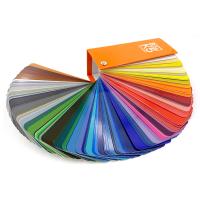
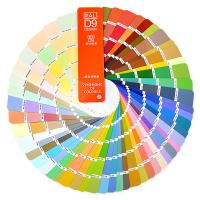
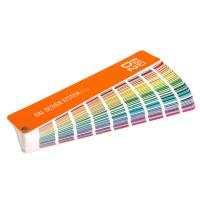
The architectural paint Color Chart is a strip structure. There are 7 color blocks per page, and each color block represents a uniform and stable color. The layout of the entire color block conforms to the distribution of tones in the Munsell Color Atlas. There are two kinds of Color Charts: 1162 colors and 280 colors. 1162 Color Charts with a total of 166 pages. It is divided into 3 parts: the first few pages are light-colored parts, which are some soft colors; the middle 137 pages are commonly used colors, which are transitional colors from light to dark colors; the last 14 pages are dark-colored parts.
280 Color Charts with a total of 40 pages. It is divided into two parts: the first 39 pages are the light color part, which is the soft color part, and the last 1 page is the dark color part. The 250-Color Chart is a simplified version of the 1162-Color Chart.
Bar card combination: 1162 Color Charts are 26.1cm long, 5.2cm wide, and 5.3cm thick; 280 Color Charts are 25cm long, 5.0cm wide, and 1.2cm thick. Packaged in a rectangular plastic box.
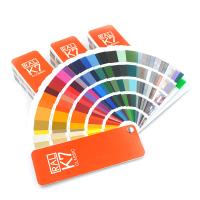
Raul paint Color Chart RAL-K7 , including color types: 213 kinds of RAL classic series color fan-shaped Color Chart; fan-shaped Color Chart specification: 5.0x15.0cm; color sample: 2.0x5.0cm color quantity per page: 5 colors Type: Glossy.
Instructions
When using the architectural paint Color Chart, directly select the corresponding color block from the standard sample and compare it with the color of the desired configuration.
Users should perform visual comparisons under natural daylight.
When using a Color Chart, the standard sample should be kept clean and free from contamination and damage.
After use, the strip card should be put together and stored in a plastic box, stored in a clean and dry environment, and should be protected from fire, moisture, and mildew.