Viscosity is an important process performance parameter of investment casting coatings, and Flow Cup viscometer is often used for measurement in production. The viscometer has a simple structure, is easy to manufacture and is easy to operate, and is suitable for testing and controlling the performance of coatings on the production site.
The Flow Cup viscometer belongs to the viscosity test method of the short tube outflow type. It measures the viscosity value by the time (s) when the quantitative paint flows out of the Flow Cup. There are many types of outflow viscometers, such as Engler viscometer in Germany, Redwood and BS viscometer in Britain, Shell, Ford, Zahn viscometer in the United States, Babey viscometer in France, and TQC in the Netherlands. It is widely used in chemical industry, geology, drilling, Xu materials, ceramics and casting coating testing.
Flow cup viscosity value (s) is the emptying time of the fluid to be tested under variable pressure head. For Newtonian fluids, this time is determined by the following formula:
In the formula
T good time out, s
F. —The surface area of the Flow Cup, cm2
h is the initial height of the liquid column, cm
μ— flow consumption coefficient
f — Flow Cup outlet area, cm2
g — gravitational acceleration, cm/s2
It can be seen from the above formula that, in addition to structural factors, the outflow time is mainly determined by the outlet velocity. The outlet flow rate determined by the self-weight pressure head is a variable during the measurement, so the shear stress also changes. In addition, the aspect ratio at the outlet is very small, so it does not obey the Hagen-Poessuille law, and there is no definite theoretical relationship between the outflow time and the absolute fluid viscosity (kinematic viscosity or dynamic viscosity), and only some empirical formulas can be used for reference.
Since the measured value is related to conditions such as the structure size of the Flow Cup and the coating state at the time of measurement, it can be called conditional viscosity.
The casting paint is a non-Newtonian fluid, and the outlet flow rate of the paint in the Flow Cup depends not only on the pressure head, but also on its internal structure and rheological properties, that is to say, on the flow pattern of the fluid. For liquids with the same viscosity at low shear rate (10-1 S-1)), the flow velocity of dilatant fluid is smaller due to shear thickening effect, while that of plastic fluid is larger due to shear thinning effect, and Newtonian fluid ranks second. Between the two and the viscosity does not change with the shear rate.
Experiments have proved that there is a positive correlation between the Flow Cup viscosity and absolute viscosity of non-Newtonian fluids, so the Flow Cup viscosity value can reflect the viscosity and fluidity of the fluid to a certain extent, that is, the higher the Flow Cup viscosity, the greater the paint viscosity , and the mobility is lower.
In addition, the viscosity of Xu material also reflects the change of coating composition (especially the powder-liquid ratio) to a certain extent, and the authenticity of the reflection is related to the flow pattern. The smaller the paint flow pattern deviates from Newtonian fluid, the better the correlation between Flow Cup viscosity and powder-liquid ratio. From this point of view, the degree of confidence in using Flow Cup viscosity to control the composition of silica sol coatings is much higher than that of water glass coatings. The relationship between Flow Cup dryness and coating yield value (tv) is complicated.
From the theory of rheology, when a fluid with a yield value flows in a pipeline, the center of the flow line forms a plug flow because the shear velocity is zero or very small (Figure 1), and the fluid at the plug flow only moves without shearing. Deformed flow (particle displacement). Let the plug flow radius be r. , and when rr. Shear stress at : When r=ry, a plug flow zone is formed within the range of 2r. If the paint is two, high, 2r. Just big, when r. When greater than or equal to R, that is to say the maximum shear stress formed by the indenter. In the case of Ermao Lin, the entire outlet will be blocked by the plug flow area and the flow will be cut off. At this time, the time of the flow can not be measured.
In addition, during the test process, due to the gradual decrease of the pressure head, the average flow velocity and shear stress are also continuously decreasing. At this time, when the pressure is high, the flow will also occur. The higher the value of the coating, the longer the flow time will be. morning.
For paints with high viscosity, if the viscosity is small, the flow will generally not occur, but the flow time will be longer. Conversely, if the viscosity of the coating is high or the thixotropy is strong, even if the viscosity is not high, the flow will be cut off halfway due to plug flow blockage. This phenomenon is common in actual testing on the production site. Therefore, when the Flow Cup viscometer is used to measure the viscosity of high-ry coatings, large errors will occur.

Figure 1 Plug flow at the outlet of Flow Cup dryness meter
Since the Flow Cup viscosity cannot simulate all rheological parameters, let alone accurately control the change of paint composition, other test methods (density, smear weight, etc.) must be used in production to cooperate with it. For example, when the silica sol paint contains air bubbles, its viscosity will increase, but its density will be lower. After negative pressure degassing or defoaming, the viscosity of the coating decreases while the density increases. From this point of view, the paint density can better characterize its composition (powder-liquid ratio). However, from the perspective of coating reusability and coalescence stability, the Flow Cup viscosity is more sensitive than the density, because when the coalescence stability of the coating decreases, the viscosity will increase but the density will not change much. Therefore, it is appropriate to use a Flow Cup viscometer and a liquid density meter to monitor the silica sol coating in production. Figure 2 shows the viscosity and density of silica sol colloidal powder coatings.
degree of relationship. It can be seen from Figure 2 that when the density of the coating is small, the viscosity change is small, and when the density is high (commonly used range), the viscosity is very sensitive to the change of density. This change rule is similar to the relationship between viscosity and powder-liquid ratio, which shows that density can better reflect the change of silica sol coating composition (powder-liquid ratio).
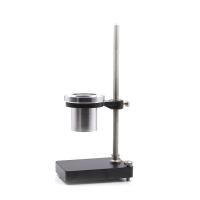
The ordinary Flow Cup viscometer widely used in my country's investment casting industry has a capacity of 100mL and an outlet diameter of 6mm (standard HB535O·6-86 of the Ministry of Aeronautics and Space). It is basically a Flow Cup used in oil drilling and coating industries. Operation It is necessary to block the exit with fingers, the end point judgment is difficult to grasp accurately, and the test accuracy is low.
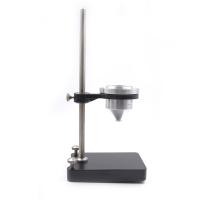
A Flow Cup viscometer with a stopper rod was used in the coating research (Fig. 3), with a capacity of 100 mL, an outlet diameter of 5.6 mm, and no overflow groove at the upper end of the Flow Cup. During the test, inject grout to the top of the three quantitative pins (adjust to the level with the base screw, not shown in the figure). Pull out the stopper rod for timing (the paint adhering to the rod should flow back into the Flow Cup), and the paint flows into the measuring bottle until the liquid level rises to the scale line on the neck of the measuring bottle as the end point. The advantage of this kind of Flow Cup is that the paint does not overflow, the quantification is accurate, the instrument is clean, easy to maintain, the end point is easy to observe and judge, the test accuracy is high, and the reproducibility is good.

Figure 3 Flow cup flow meter with plug rod

Figure 4 Zahn Cup Dryness Meter
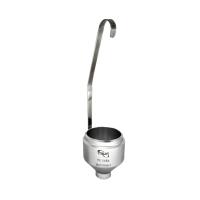
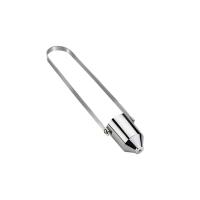
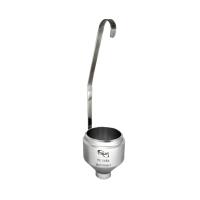
In recent years, with the widespread application of silica sol coatings, Zhan-type Flow Cup viscometers are more popular. This Viscosity Cup is used to test the viscosity of paint in the investment casting industry in the United States, Japan, Canada, South Korea and Hewan Province. Western European countries also often use Ford cups, which are similar in structure to the popular funnel cups in my country. The 4Ford cup has a capacity of 100mL and an outlet diameter of about 4 mm (0.162 in). There is no sudden contraction at the outlet of the liquid flow, so it is characterized by only laminar flow and avoiding turbulent flow. The dimensions of Zhan cup viscometers vary by manufacturer. Figure 4 shows three different sizes of Zahn cups. At present, the more common one is the Zahn cup (c of Figure 4) manufactured by the American Boekel Company and conforming to the ICI (American Investment Casting Institute) standard. There are specifications for this kind of Flow Cup, as shown in Table 1. Table 2 is the test result of low viscosity solution with IZhan cup.
The General Electric Company of the United States (GE Company) numbered the five Zahn cups as Gl~GS, and #4 and #5 cups are mostly used in precision casting workshops. The characteristic of using the Zahn cup is to immerse the Flow Cup in the paint tank, lift the timing after it is full, there is no overflow groove on the upper edge, and there is no need to block the outlet before the test, the operation is relatively simple, and the test volume is also high.
Table 2 Test results with #l zhan cup

For water glass coatings, because the rheological flow pattern deviates greatly from Newtonian fluid and the yield value is high, the density meter is usually not used in the field test, but the Flow Cup viscosity and smear weight method are used to monitor the performance of the coating. A 40mmx40mmx2mm stainless steel sheet is used for the smear.
The smear weight of water glass coating is usually controlled in the range of 70~125 mgc/m2. The smears used abroad are generally 60 mm x 60 mm 2 Mnr stainless steel sheets (ICI standard), called Tempora plates. It has two purposes, one is to measure paint viscosity, and the other is to measure smear weight (adhesion). The method of measuring the viscosity of the TemrPoa board is to dip the board in the slurry to the marking line (the marking line is 5mm away from the top angle of the board on the lifting line) for 2-3 seconds, then lift the board and count until the paint flows out.

Figure 5 Relationship between paint Zahn cup viscosity, density and smear weight
There is a certain correlation between the test results and the Flow Cup viscosity (Figure 5), but the data range is very narrow and it is difficult to control accurately. The method of measuring smear weight with Tempora plate is basically the same as that used in CHINA. For silica sol coatings, because of their very small yield value (< 3.0 Pa), the test results are far less sensitive than water glass coatings. For example, for silica sol colloidal powder coatings with a density of 2.0~2.5gc/m3, the smear weight only changes within the range of 13~30mgc/m3. Compared with water glass coating, not only the absolute value is small, but also the range of variation is very narrow.
In order to make the test results of the Flow Cup viscometer have good accuracy, reproducibility and comparability, the following points should be paid attention to during use:
(1) No matter what kind of paint, it should be sampled and tested under stirring conditions to eliminate the error caused by the segregation of components caused by precipitation and the rise of static viscosity. Special attention should be paid to the paint with high yield value and strong thixotropy.
(2) Wash twice with clean water (deionized water for silica sol coating) before use, so that the Flow Cup can be measured in a wet state. The number of measurements was not less than 2 times, and the average value was taken.
(3) Ordinary funnel-type Flow Cup is quantified by the upper overflow tank. It is better to take the same standard as the end point of the cut-off or light-transmitting hole for easy comparison.
(4) There are many methods for judging the end point of the Zahn cup. Some literatures have introduced that the continuous flow length at the orifice is 10 mm as the end point (Fig. 6), which is more accurate.
(5) The Flow Cup must be cleaned after use, especially the orifice should be kept clean to prevent oil from adhering. With a well-maintained Flow Cup, the human error can be within 15 during the test.

Fig.6 Judgment of end point of Zahn cup twist meter