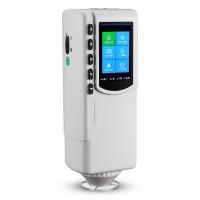
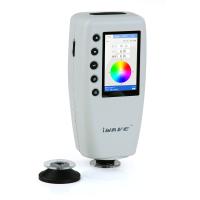
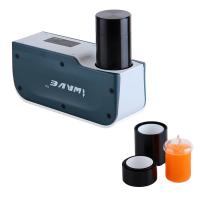
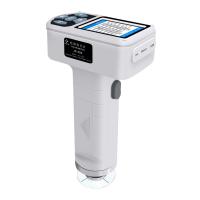
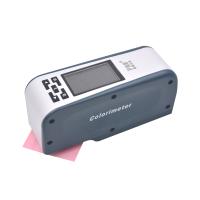
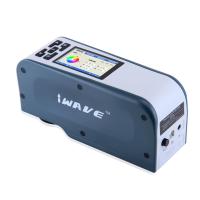
With the application of color difference meter in textile, printing and dyeing, chemical industry, papermaking, metallurgy, ceramics, book management, machinery manufacturing, etc., it has brought development to various industries and at the same time brought good opportunities to measurement and testing work. It is a problem that every person engaged in metrology and testing should start to solve by color difference meter. The author is to provide a reference for those engaged in metrology and testing by studying the matters that need to be paid attention to during the verification process of the color difference meter.
Whiteboard Calibration
In general, each Colorimeter comes with a standard white board, and the instrument needs to be calibrated with this white board or standard white board before each use.
Measuring light source
Generally, an object does not emit light, and its shape and color can only be seen under the illumination of a certain light source. That is to say, the color of an object depends on the color of the light source that illuminates it. Therefore, in order to accurately describe the color of an object, it is first necessary to indicate under what light source the color appears. The same object appears in different colors under different light sources. For example, clothes that look blue in the sun appear black in red light. Therefore, the choice of light source in color difference measurement should be paid attention to. The International Commission on Illumination stipulates several standard illuminants, named after A, B, C, and D respectively. A——black body radiated light with a temperature of 2 856 K; B, C—direct sunlight with a correlated color temperature of about 4 874 K and average daylight at 6 774 K; D—standard illuminant (D55-color temperature value is 5 504 K, D65-color temperature value is 6 504 K, D75-color temperature value is 7 504 K).
The color temperature value describes the spectral composition of a light source to a certain extent. Generally, the higher the color temperature, the more blue and green components of the light source. It can be seen from this that choosing different light sources will inevitably result in different color measurement results. Therefore, it is necessary to choose a good light source when measuring, and indicate under which light source the measurement is performed.
Field of view
The resolution of the human eye when observing colors is related to the size of the viewing angle of view. Experiments show that the human eye has a low ability to distinguish differences when observing colors with a small field of view (< 4°), and when the observation field increases from 2° to 10°, the accuracy of color matching and the ability to distinguish color differences increase; However, when the field of view is further increased, the accuracy of color matching is not greatly improved. Under the 2° and 10° field of view, the difference in color matching is specifically reflected in the fact that the colors presented by the same color are different. Therefore, in the process of color difference measurement, it is also necessary to select and mark the color used in the measurement. field of view.
Lighting and viewing conditions for measurements
The illumination and observation conditions of the instrument are indicated by "illumination/observation". There are 4 types as follows: 45°/vertical (expressed by 45/0), vertical/45° (expressed by 0/45), diffuse/vertical (expressed by d/0), vertical/diffuse (expressed by 0/d express). During the measurement process, the lighting and observation conditions should be indicated on the referenced color plate verification certificate, and the data under the same lighting and observation conditions should be selected for verification according to the lighting and observation conditions of the color difference meter. If the data under different conditions are selected, the results may vary greatly, so it is also necessary to correctly select the data under the corresponding lighting and observation conditions in the data reference to ensure the correct data processing.
mirror reflection
The reflection of light on the surface of an object is often related to the angle. Generally, it can be divided into specular reflection and diffuse reflection. Specular reflection and diffuse reflection. Generally speaking, the specular reflection light of the sample does not represent the color characteristics of the sample itself, but more reflects the color characteristics of the light source. Therefore, it is necessary to clarify whether specular reflection is included during the verification process of the Colorimeter, otherwise the measurement results will vary greatly. For instruments using diffuse/perpendicular and vertical/diffuse conditions, the influence of specular reflection components can be dealt with by setting glossy absorption traps, and specifying the size, shape and position of glossy absorption traps. When measurements including specular reflection are required, under 0/d conditions, measurements should not be made under strictly vertical illumination; conversely, under d/0 conditions, samples should not be measured under strictly vertical observation. Both should be measured without the use of a gloss absorption trap. When it is not necessary to include specular component measurements, glossy absorption traps should be used, denoted by 0/d or d/0.
color space
There are many expressions of color space such as: XYZ, Yxy, L*a*b*, L*C*H*, L*U*V*, Yu*v*, etc. Choosing a color space is actually choosing a measurement result Form of expression. Yxy is used in the regulations, but many Colorimeters use other forms of expression, and the results of color difference are also different with different forms of expression. Therefore, it is also necessary to choose the expression form of the color space in the verification process.
Choice of color difference formula
Color difference is an important indicator for sample quality testing and evaluation. Due to the different selection of color difference formulas, the color difference value may also vary greatly. For example, Table 1 lists the measurement results of two pairs of colors using three color difference formulas. It can be seen that the color difference results measured using different color difference formulas are very different, which may cause misjudgment in the test. Therefore, when measuring color difference, the choice of color difference formula should also be paid attention to.

Table 1 Measurement results of two pairs of colors
Tab.1 Measurement results of two pairs of colors
conclusion
From the above analysis, it can be seen that in the process of calibrating the color difference meter, it is necessary to pay attention to the selection of various conditions, and to indicate them in the measurement results, so that customers can understand the measurement conditions, which is conducive to the implementation of data and standardization of the production process by enterprises, and is also conducive to The reproducibility of test results.