The development of modern e-commerce has penetrated into thousands of households. Shopping that people used to say in the past does not necessarily have to go shopping. In the fast-paced life, more people choose online shopping. An experience of color difference, and this kind of experience is often unpleasant. Therefore, the manufacturer must ensure that the same product has no color difference, and the merchant must find a way to eliminate the color difference in the customer's impression.
Therefore, the research on chromatic aberration is not limited to the production stage of commodities, and has even penetrated into the online marketing stage of commodities. It can be seen that the research on chromatic aberration is a common problem faced by industrial enterprises and commercial circles. The color difference formula is used to evaluate A scientific and effective method for the color difference between two samples. According to the calculated color difference obtained by the color difference formula, it can be judged whether the color difference of the color sample pair is visually acceptable. At present, scholars at home and abroad have conducted multi-angle research on color difference Among them, the color difference formula is an important research basis and a reliable research method. In order to obtain better research results, the selection of the color difference calculation model is particularly important for the color difference evaluation (1). Through the analysis of the typical color difference calculation formula, It is possible to better grasp the color difference evaluation theoretically.
1. Overview of color difference theory
1. 1 Color
Color refers to a visual effect on light produced by the observer through the eyes, brain and existing life experience. Color is essentially a dynamic visual process. The color visual process mainly includes light sources, objects, human eyes, and brain Four elements, as shown in Figure 1. The light of different spectrums emitted by the light source hits the surface of the object, and after the object selectively absorbs, reflects or transmits light, it acts on the human eye, and the light stimulus is converted by the human eye's inner visual cells It is a nerve impulse and is transmitted to the brain through the optic nerve, and then judged by the visual center in the brain to generate the color perception of the object. Color has three properties, namely lightness, hue, and saturation (2). Lightness refers to the degree to which a spectral color of a dominant wavelength is diluted by white light, essentially indicating the proportion of the tristimulus value of the spectral color of the dominant wavelength in the tristimulus value of the sample (3), and refers to the degree of lightness and darkness of the color. Each color will produce a difference in light and shade under different intensity of lighting light. The various colors of objects need to be displayed under the illumination of light. Hue, also known as hue, is the most prominent feature of color, which refers to the qualitative difference between different colors. They are the unique visual signs of electromagnetic waves of different wavelengths in the visible spectrum. Saturation (also known as saturation purity, color purity) refers to the purity of the color, that is, the purity of the color, and the degree of shade (4). It expresses the ratio of the color components contained in the color. The larger the color ratio, the higher the saturation of the color, and vice versa, the lower the saturation.
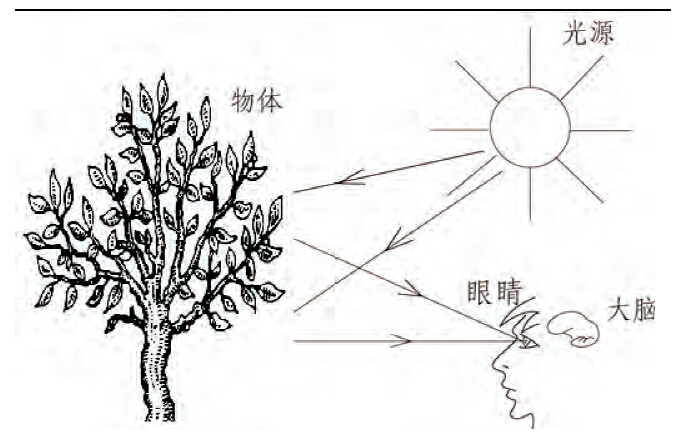
Figure 1 Color vision process
1. 2 Chromatic difference
The term chromatic aberration appears frequently in modern e-commerce, especially in online marketing, and has been widely used in related fields of people's lives. difference in color.
1.3 Color difference model
In order to further improve and unify the method of color evaluation, in 1976, CIE proposed a new color space and its related color difference formula, that is, CIE1976LAB (or L* a* b*) system, which has now been officially adopted by countries all over the world as an international standard. Color measurement standard. The CIE1976L* a* b* space is converted by the CIEXYZ system through mathematical methods, and the conversion formula is as follows:

Among them, X, Y, and Z are the tristimulus values of the object, and X0, Y0, and Z0 are the D65 light source 10° of the desired white object. The L* a* b* chromaticity space is currently the most common chromaticity space for measuring the color of objects. The specific model is shown in Figure 2 and has been widely used. Figure 2 shows the La*, b* chromaticity space model, L* represents the psychological lightness, a*, b* are the psychological chromaticity. Transform from X, Y, Z to L*, a*, b*, and the converted space is represented by Cartesian rectangular coordinate system, forming a psychological color space for expression, + a* means red, - a* means green , + b* means yellow, - b* means blue, and the lightness of the color is represented by the percentage of L*. The central vertical line L* in the figure is a colorless line. When the values of a* and b* increase, the farther the color point is from the central vertical line, the greater the color saturation.

Figure 2 La*, b* chromaticity space model
2. Two typical color difference formulas
The color difference formula is to put the color in a LAB color space, and then calculate the geometric distance of the two colors in the space. The premise is that the color geometry space is average. At first people thought it was a circular space, and later it was an elliptical space, and it was later found that the ellipse could not be accurately described. The development of CIE formula to CIE2000 has further improved the visual consistency of color difference evaluation. It is the most perfect color difference formula at present, and its color difference accuracy is as high as 95%, which is greatly improved compared with CIElab's 75% accuracy, and is closer to For the human eye effect, CIE2000 is currently recommended.
2.1 CIE94 color difference formula

ΔE*94 is the obtained color difference result, which is displayed on the LCD screen. Users can obtain the color difference test data of the sample by observing the results on the display screen, so as to make further decisions on color screening
2.2 CIE 2000 color difference formula
Due to the difference in the color evaluation method and shape of the human eye and the color difference meter at different positions in the chromaticity diagram, many problems caused by the mismatch between the measurement data and the visual conclusion during the color evaluation, the CIE 2000 color difference calculation formula is proposed to solve the problem This problem and problem. The CIE 2000 color difference formula does not create a new uniform color space in the human eye's discrimination critical area, but redefines the color difference calculation method so that in the entire CIE Lab (L* a* b* chromaticity space), the color difference calculation The value is closer to the human eye evaluation. Based on the original color difference calculation formula, the new color difference formula specifically quotes three new weight coefficients SL, SC and SH, which respectively represent the degree of difference in the directions of brightness ΔL*, saturation ΔC* and hue ΔH*.
CIE 2000 color difference formula

calculation steps:
G represents the adjustment factor for the axes of the CIELAB color space, and a* is a function of chroma. C*ab is the arithmetic mean of C*ab.
in


Among them, L' is the arithmetic mean of the two samples L'1 and L'2; C'ab is the arithmetic mean of the two samples C'ab,1 and C'ab,2; h'ab is the two samples h'ab , 1, h'ab, the arithmetic mean of 2.
Step5.Substitute into CIEDE2000 color difference formula to calculate.
3. Comparison of the two formulas
The CIE 2000 color difference formula has several improvements over the CIE94 formula: rescaled the L* a* b* chromaticity space closer to the a* axis in the middle range, thereby improving the prediction performance of neutral colors; introduced three new correction coefficients SL , SC and SH, modify the degree of difference in the direction of saturation ΔC*, brightness ΔL* and hue ΔH*, so as to improve the consistency between the calculation results of color difference and visual evaluation.
4 Conclusion
Based on the color difference theory, the CIE 94 color difference formula and the CIE 2000 color difference formula were analyzed and compared, and the applicability of the two formulas was compared and evaluated by applying the color difference meter. The uniform chromaticity space redefines the color difference calculation method, so that in the entire L* a* b* chromaticity space, the characteristics of the human eye's discrimination critical area can better meet the three parameters closely related to human eye evaluation: brightness , Hue, Saturation needs.