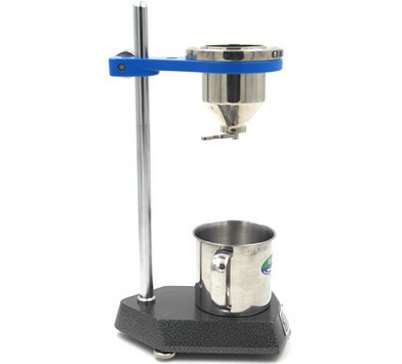
 Viscosity is a measure of the ability of the interaction between liquid molecules to hinder the relative movement of its molecules, and it also indicates the magnitude of the internal friction that occurs when the liquid flows.
In the viscosity expression method, there is absolute viscosity, also called dynamic viscosity; conditional viscosity, also called relative viscosity, kinematic viscosity, specific viscosity, etc. In the production and construction of coatings, the general department uses the conditional viscosity expression method. The most convenient instrument for removing viscosity is the Tu 4 viscometer.
For paint construction, if the viscosity of the paint is too high, the construction will be difficult, the brush cannot be opened by the brush method, or brush marks will be left, and the nozzle will be blocked when the paint is applied, the paint atomization will be poor, the leveling property will be poor, and the surface will not be smooth, etc.; If the viscosity of the coating material is too low, it will cause sagging, forming an uneven coating with thin top and bottom thickness, and the protective effect of the coating film cannot be achieved. Or after drying, because the coating film is too thin and does not cover the bottom, increase the number of spraying. Therefore, during coating construction, it is necessary to strictly control and measure the construction viscosity. Tu-4 viscometer is used to measure the viscosity of coating products with a conditional viscosity not higher than 150s (Tu-4 cup), and it needs to be measured according to the national standard GB/T1723-93 coating carried out according to the law.
Use a Tu 4 viscometer to test the viscosity. Adjust the temperature of the paint to be eliminated and the Flow Cup to (23±0.5)°C. During the test, hold the pick of the Flow Cup with your fingers, pour the sample slowly, and use a ruler to measure the viscosity. Scrape along the edge of the cup so that the cup is just filled with the sample and wipe off excess paint; place a suitable container under the Flow Cup so that the distance between the outlet of the leak nozzle and the surface of the container receiving the sample is greater than 100mm; release your finger and start the stopwatch at the same time, Stop the stopwatch when the sample flow is interrupted for the first time, and record the time when the sample flows out. In this way, with the same method, test twice, and the error of the two determinations should not exceed 2% of the average value.