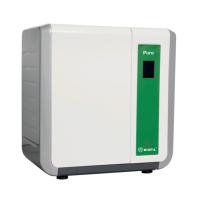
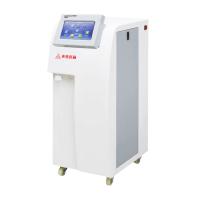
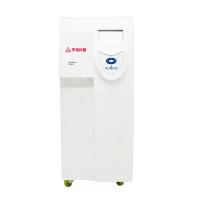
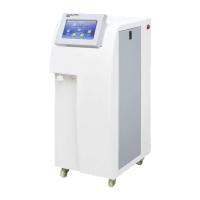
First, let’s have a brief understanding of the ultrapure water machine. The tap water is pretreated by a precision filter element and an activated carbon filter element to filter particles such as sediment and absorb odors, etc., so that the tap water becomes cleaner, and then the water quality is purified and desalinated through a reverse osmosis device to purify the water. After entering the water storage tank for storage, the water quality can reach the national third-grade water standard, and the wastewater produced by the reverse osmosis device (also known as "concentrated water") is discharged. Reverse osmosis pure water is desalinated through the purification column to obtain first-grade water or ultrapure water. Finally, if the user has special requirements, ultraviolet sterilization or microfiltration, ultrafiltration and other devices are added behind the ultrapure water to remove residual water. Bacteria, particles, heat sources, etc.
Precision filter elements, activated carbon filter elements, reverse osmosis membranes, and purification columns are all materials with relatively long lifespans. Precision filter elements and activated carbon filter elements are actually protection for the reverse osmosis membrane. Short, if you continue to turn on the machine, the quality of the pure water produced will decrease, and then the burden on the purification column will be increased, and the life of the purification column will be shortened. The end result is to increase the cost of using the ultrapure water machine.
Therefore, in the use of ultrapure water machines, the following things need to be paid attention to.
1. Precision filter element
Precision filter element is also called filter element, wire wound filter element and PP melt-blown filter element, which mainly filter large particles such as sediment in raw water, and its filtration accuracy is 5 microns, 1 micron, etc. The new filter element is white. If the surface will be silted and brown after a long time, it means that the filter element cannot be used. After washing off the surface silt with tap water, it can barely continue to be used for 1-2 weeks, but it cannot be used for a long time. . The filter element is placed in the filter bottle. Some filter bottles are transparent, and the color change of the filter element can be observed intuitively. Some filter bottles are opaque, and the change of the filter element needs to be unscrewed. According to empirical statistics, the service life of precision filter elements is generally 3-6 months. If there is more sediment in the raw water, the service life will be shorter, and if there are less particles such as sediment, the service life will be slightly longer.
2. Activated carbon filter
The activated carbon filter element mainly removes peculiar smell and organic matter in the water through adsorption. There is residual chlorine in tap water, which has a great oxidation effect on the reverse osmosis membrane, so it needs to be removed by activated carbon. The activated carbon filter element has no intuitive changes on the surface. According to experience, it generally reaches saturated adsorption in about a year and needs to be replaced.
3. Reverse osmosis membrane
The reverse osmosis membrane is a very important part of the ultrapure water machine. Its pore size is very small, so microscopic substances such as bacteria are often deposited on its surface during use. Generally, the pure water machines of various manufacturers have backwashing functions. Wash away contaminants. If the water consumption is within 10 liters/day, it can be washed 3-5 times, and if it exceeds 10 liters, it can be washed several times. If it is not used for a long time (such as more than 1 month), it needs to be taken out and soaked in disinfectant to avoid the growth of bacteria. The water is formed to circulate, minimizing the accumulation of stagnant water for too long. The life of the reverse osmosis membrane is 2-3 years, which is mainly determined by the water consumption, so you must choose the matching specification when choosing.
4. Purification column
The purification column is sometimes called an ultra-purification column according to the water quality requirements of customers. Its function is to perform deep desalination of reverse osmosis pure water, and finally reach the level of first-class water or ultra-pure water. The principle is ion exchange. The life of the purification column is represented by the resistivity online. Less than a certain resistance indicates that the purification column is expired, which is relatively intuitive. In addition to the water consumption resistance, the lifespan of the ion exchange resin is the filling amount of the ion exchange resin and the quality of the ion exchange resin in the production design of each manufacturer.
5. Water
The ultra-pure water machine with tap water as the water source generally has two water outlets, namely the third-grade water and the first-grade water. Take it immediately, don't store it. The third-grade water does not pass through the purification column, the first-grade water passes through the purification column, and the cost of the first-grade water is higher than that of the third-grade water. Therefore, in daily use, water should be drawn according to the water quality requirements. When the third-grade water can be used, the first-grade water should not be used as much as possible to avoid the increase in use costs.