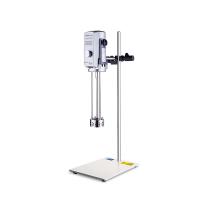
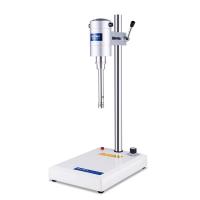
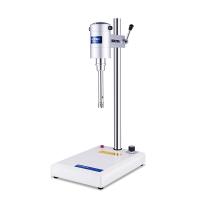
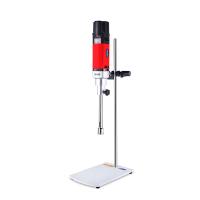
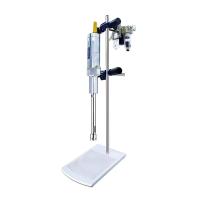
Emulsifiers play an important role in the mixing system of industrial equipment, especially in solid-liquid mixing, liquid-liquid mixing, oil-water emulsification, dispersion homogeneity, and shear grinding. The reason why it is called an emulsifier is that it can realize emulsification.
Now the application of emulsifier is not limited to "emulsification". Due to its unique shearing effect, the pulverization and impact of powder in liquid will finally be refined to a satisfactory particle size, so that the solid can be fully mixed into the liquid. And form a relatively stable suspension, this process is also "dispersion". Of course, like emulsifiers, the stability of the suspension can be enhanced by the addition of dispersants. When a certain solid substance can be effectively dissolved by the liquid after a certain period of contact with the liquid, the small particles formed by shear impact will be dissolved by the liquid faster because its specific surface area has increased many times.
When people get used to the use of high-pressure homogenizers to obtain fine particles, "refinement" is equated with "homogeneity", so the role of emulsifiers in refining and fully mixing materials is "homogeneity". "The process is over. Therefore, we can also put the emulsifier
It is called a homogenizer. For the sake of distinction, it can generally be crowned with a high-speed or high-shear homogenizer, so that there are many names for an emulsifier: high-shear emulsifier, high-shear homogenizer, high-shear homogenizer, and high-shear homogenizer. Dispersing emulsifier, high-shear homogeneous emulsifier, high-shear homogeneous dispersing emulsifier, etc.
The strength of the shearing effect of the emulsifying machine directly affects the final fineness. After analysis, it is mainly related to the sharpness of the blade, hardness, rotor-stator gap, the relative movement speed of the two cutting edges and the particle size allowed to pass, etc., usually Under the circumstances, the blade sharpness, hardness, rotor-stator gap, and particle size allowed to pass through have basically been finalized or do not want to be changed, so the relative movement speed of the blade is a very influential factor, which is expressed as the circumferential speed of the rotor. , the cutting or impacting density of the fluid flowing in the radial direction is high, so the thinning effect is strong, and vice versa. But the linear velocity is not as high as possible. When it reaches a high value, there is a tendency to block the flow, so the flow becomes very small, and the heat is high. Some materials will accumulate in turn, making the result unsatisfactory.
So is the stirring speed we usually talk about the shearing speed? Anyone who has studied high school physics knows that speed is divided into angular velocity and linear velocity. Shear velocity of course refers to linear velocity. Linear velocity = angular velocity × diameter × π, so why the speed of emulsifiers used in industrial production is generally only 3000rpm or 1500rpm, The speed of the laboratory emulsifier is as high as 10000rpm or 280000rpm, which is to consider the factor of diameter, so that the shear line speed of the two is close, and the final effect is also close.
From another point of view, the laboratory test is characterized by a small amount, so if the physical size of the rotor stator is to adapt to the corresponding small amount, the diameter must be small. In order to compensate for the negative impact of the small diameter on the linear speed, it is necessary to increase The angular velocity of rotation, thus forming the "high rotational speed" of the experimental instrument. It can be seen from the above that the rotational speed of the emulsifier should be considered in conjunction with the actual processing capacity, but due to the existing processing level and production economy, the rotational speed of the 2-pole motor is often used for 18.5KW or less, while the rotational speed of 22KW to 55KW is usually 3000rpm. 1500rpm of 4-pole motor, 1000rpm of 6-pole motor can be considered if it exceeds 75KW.