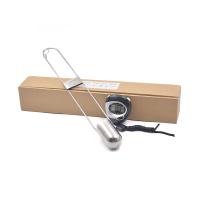
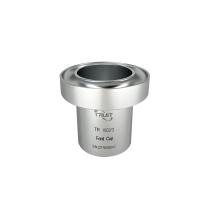
There are many kinds of instruments for measuring viscosity. At present, the mainstream measuring instrument at home and abroad is the Viscosity Cup. According to the division idea of Beichao Mall, it can be divided into
domestic: 4 cups of Tu, 1 cup
of Tu abroad: Zahn Cai En Cup Din Cup Ford Ford Cup ISO Outflow Cup JIS Iwata Cup
Of course, from the perspective of the industry market, more domestic standards are adopted in CHINA The Tu-1 cup and Tu-4 cup, while the ISO outFlow Cup is recommended by the International Organization for Standardization. This issue introduces the ISO outFlow Cup.
The history of ISO outFlow Cup
The standard outFlow Cups of various countries in the world have different measured viscosity values due to the different volume and size of the outflow hole. Although various countries are equipped with outFlow Cups with different apertures to form a series in order to expand the measurement range of viscosity, such as a set of 5 Ford cups in the United States and DIN cups in Germany, there is still a lack of interchangeability, which affects international technical exchanges. In order to standardize the design of outFlow Cups and improve flow stability, and to unify the size of outFlow Cups in various countries and facilitate the comparison of measured values, the International Organization for Standardization proposed an improved ISO outFlow Cup.
In the first edition of the international standard "ISO2431 paints and varnishes - Determination of outflow time by outFlow Cup" published in 1979, only one kind of outFlow Cup with an aperture of 4mm is specified. In the second edition, three kinds of outFlow Cups with apertures of 3mm, 4mm and 6mm are changed, which are called No. 3 cup, No. 4 cup and No. 6 cup respectively. When the 4th edition was promulgated in 1993, four kinds of outFlow Cups with apertures of 3mm, 4mm, 5mm and 6mm were added. It can be seen that the development of the ISO outFlow Cup is gradually serialized and continuously improved and improved.
Standard structure of ISO outFlow Cup
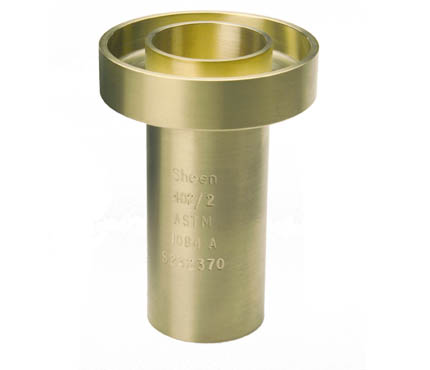
The ISO outFlow Cup is designed according to ISO2431-1993 and GB/T6753.4-98. It is an internationally used tool for testing product viscosity and is used to measure the outflow time of Newtonian or near-Newtonian liquids (outflow time 100 seconds). The ISO outFlow Cup is the easiest paint viscosity measuring instrument available in laboratories, production workshops and construction sites. Due to the large volume of the Flow Cup and the short and thick outflow hole, it is convenient to operate and clean, and can be used for opaque paint.
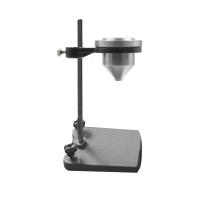
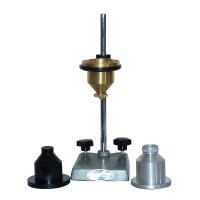
The ISO outFlow Cup is also a container with a cylindrical upper part and a conical lower part. The bottom of the cone is an elongated small cylindrical leak nozzle. There is a protective sleeve on the outside to prevent the protruding mouth of the outFlow Cup from being accidentally damaged. The reasonable professionalism of the ISO outFlow Cup is that the cone angle is 120°, which is larger than that of the Tu-4 cup (the Tu-4 cup is only 81°), which more effectively overcomes the turbulence caused by the liquid entering the outflow hole. Secondly, the length of the outflow hole of the ISO outFlow Cup is 20 mm, and the ratio of the length to the hole diameter, that is, L/D, is 5, while the L/D of the Tu-4 cup is only 1. The larger the value of L/D, the better the capillary action of the outflow hole. The more pronounced, the more stable the liquid flow. In addition, the viscosity test range of the ISO outFlow Cup is wide, and the outFlow Cups with different apertures have different kinematic viscosity ranges of the test samples. The test range of the No. 3 cup is 7 ~ 42mm2/s, the No. 4 cup is 34 ~ 135 No. cup 91 ~ 326 mm2/s, No. 6 cup 188 ~ 684 mm2/s, the serialization not only increases the test range, but also improves the test accuracy
The viscosity measured by the ISO Viscosity Cup is kinematic viscosity, that is, a certain amount of sample. The time, in seconds, to flow through an orifice of specified diameter at a certain temperature. This is a commonly used method for measuring the viscosity of paints. Because it can be used conveniently on many occasions, it is widely used all over the world.
Calibration of the ISO outFlow Cup
OutFlow Cups with different apertures have the following correction formulas:
3mm outFlow Cup V=0.443t-(200/t)
4mm outFlow Cup V=1.37t-(200/t)
5mm outFlow Cup V=3.28t-(200/t)
6mm outFlow Cup V=6.90t-(200/t)