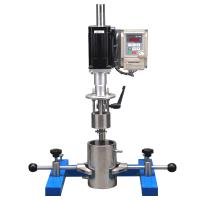
The sand mill avoids the batch limit of the ball mill, and is currently the most important grinding and dispersing equipment. Initially, the grinding media used sand with a diameter of about 0.7mm, so it was called a sand mill. Sand is still used, but glass beads with a particle size of 1 to 3 mm are commonly used. After years of development of sand mills, there are two types of vertical sand mills and horizontal sand mills.
A conventional vertical sand mill consists of a jacketed cylinder, a dispersing shaft, a dispersing disc, and a balance wheel. The schematic diagram of the sand mill is shown in Figure 5-8.

The barrel contains a proper amount of grinding media such as glass beads or sand. Several (such as 8~10) dispersing discs are installed on the dispersing shaft. The pre-dispersed paint slurry is input from the bottom with a feed pump, and the flow rate of the feed pump can be adjusted. The bottom valve is a special one-way valve to prevent the glass beads from flowing back into the pipeline and the feeding pump after the pump is stopped. After the paint slurry is fed in, start the sand mill, the dispersing shaft drives the dispersing disc to rotate at a high speed, and the peripheral speed of the dispersing disc reaches about 1 om/s (the speed of the dispersing shaft is usually between 600~1500r/min depending on the size of the dispersing disc. ). The paint paste and glass beads close to the surface of the dispersing disk are affected by the viscosity resistance, and with the operation of the dispersing disk, they are thrown to the cylinder wall of the sand machine, and then return to the central area. The overall turbulent flow pattern formed at this time can be roughly described as a double-annular rolling pattern. This double circular motion produces good dispersion, especially near the surface of the dispersion disc and in the area between the outer edge of the dispersion disc and the cylinder wall. In the process of rising, the paint paste rotates between the two dispersing discs several times for highly turbulent flow. The pigment particles are sheared and impacted by the high-speed moving glass beads here, and the pigment is dispersed in the paint. The dispersed slurry overflows from the outlet through the sieve, and the glass beads are retained by the sieve.
The reason for the high efficiency of the sand mill (many times higher than that of the ball mill) is that the grinding medium sphere obtains a high speed (about 1om/s) in the sand mill, so the centrifugal force acting on the sphere is several times greater than the gravity Ten times or even more than a hundred times, the collision and friction between the spheres produce strong impact and shearing. The second is that the diameter of the grinding medium sphere is very small (usually 1~3mm), and the number is very large, so there are many contact points where the grinding medium collides with each other in a unit volume.
The intense stirring of the dispersion disc and sand in the sand mill will cause the temperature of the paint paste to rise, so the cylinder of the sand mill is equipped with a cooling water jacket for cooling. The concentration of the resin solution in the abrasive should be slightly greater than the minimum point of the Daniel flow point curve. The greater the viscosity of the abrasive, the longer it stays in the mill and the greater the degree of shearing. For pigments that are easy to separate, a lower viscosity can be used to make the passing speed faster, and the general viscosity is 0.3~1.5Pa·s. Difficult-to-separate pigments need to be milled two or three times (or a set of mills connected in the middle), and there are also sand mills designed to automatically recycle part of the abrasive. The investment and operating costs of sanding are lower. It needs to be pre-mixed separately, and needs to be thinned and painted separately, and the batch size can be large or small. Cleaning is the problem, generally certain mills are reserved for similar colors to minimize cleaning. Sand mills are effective for separating pigment aggregates as long as the aggregates are smaller than the grinding media. Laboratory sanding correlates well with production sanding. Laboratory sanding is to pour the pre-mixed abrasive from the top instead of the bottom.
The sand mill is an effective dispersion equipment with high production capacity, good dispersion precision, low energy consumption, low noise, less solvent volatilization, simple structure, easy maintenance, and continuous production. Therefore, it is widely used in the production of various types of enamel and primer widely used in.