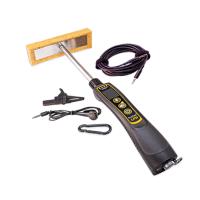
On the inner wall of storage tanks, ship ballast tanks, chemical tanks, inner walls of desulfurization devices in power plants, buried pipelines and seawater pipelines, etc., it is often used to detect pinholes and leak points, and can find cracks and needles in the coating film. Holes and other discontinuities are corrected. After the final testing and repair of the coating, the coating should be inspected again.
There are generally three types of leak and pinhole Detectors: (1) wet sponge pinhole Detectors; (2) ultraviolet pinhole Detectors; (3) DC high voltage electric spark Detectors.
The main standards for the detection of leakage points of anti-corrosion coatings are:
(1) NACE RP0188: Recommended method for testing film discontinuities (leaks) of new protective coatings on conductive substrates
(2) ASTM-D5162: Method for testing non-conductive protective paint film discontinuities (leaking points) on metal substrates
1. Low pressure wet sponge type
NACE RP0188 specifies that low-pressure wet sponge apparatus can be used for holidays on non-conductive coatings less than 500 μm (20 mils) thick on conductive substrates. Saturate the sponge with a solution of tap water (not distilled water) and a low-foaming wetting agent (such as the developer used in photographic film) at a mixing ratio of 1 part wetting agent to 128 parts water. The sponge should be well wetted, but avoid water dripping as the sponge is moved over the coating. To ensure proper grounding of the instrument, touch a wet sponge to an exposed point on a conductive substrate. For painted steel, attach directly to bare metal, and for concrete, attach directly to concrete reinforcement. If reinforcing steel is not available, attach the bare ground wire by placing it on the concrete and secure the ground wire with a sack filled with wet sand.
Wipe the coated surface with a wet sponge at a maximum rate of 30cm/S. Avoid using excess water in the sponge, as the run-off water will touch the leak at a distance, creating an electrical circuit that will give incorrect readings and the instrument will beep when a leak is found. Then use a marker pen to mark all the leaks.
2. UV pinhole Detector
The ultraviolet pinhole Detector emits long-wave ultraviolet light. Apply the UV emitting additive to the base coating, and use the ultraviolet pinhole Detector to irradiate purple light above the coating. It is observed that the base coating is not covered by the subsequent fluorescent coating. Where it is covered, it is clearly stated that this is the location of the pinhole. This method is low in cost and easy to use, and it is necessary to wear UV protective glasses during operation.
3. DC high voltage electric spark Detector
High voltage pulse type holiday Detectors typically have output voltages from about 900 volts to 15 000 volts. Usually this device is used for paint film thickness from 300μm to 4000μm. Pass the probe electrode over the surface. At any leaking point, blank point, discontinuous part of the paint film, etc., the gap between the electrode and the substrate will flash like an arc, and the Detector will make a sound at the same time.
The voltage is fixed according to the specified value or the value indicated by the reference standard. If no specification is provided, the US industry's rule of thumb is to fix at a voltage of 4 volts/micron (equivalent to 100 volts per mil). The European empirical method is 5 volts/micron (equivalent to 125 volts per mil). When using the instrument, move the electrode (NACE RP0188) at a rate of about 0.3m per second each time. Move the electrode too fast and you may miss missed spots, and move too slowly and you may damage spots with thin films. High-voltage leak detection is a destructive test, and the voltage fixed too high may cause pinholes on the coating and damage the coating. The high-pressure leakage point Detector is not inherently safe. When operating in a confined space such as a ship cabin or inside a storage tank, a professional explosion test is required.
The selection voltage of SY/T 0036 "Test Method for Detection of Pipeline Anti-corrosion Layer" is calculated according to the following formula:

In the formula: V - detection voltage Tc - coating thickness mm
NACE RP0188 and ASTM D5162 standards have different voltages for different dry film thicknesses, but they are generally the same, see Table 1 and Table 2.
Table 1 NACE RP0188 high voltage spark test voltage

Table 2 ASTM D5162 high voltage spark test voltage