When the steel surface is blast cleaned, a certain surface roughness or surface profile is obtained. Surface roughness can be characterized by shape and size. After blast cleaning, the surface area of the steel plate will be significantly increased, and at the same time, many anchor points will be obtained which are beneficial to the coating system. Of course, bigger roughness is not necessarily better, because the paint needs to be able to cover the peaks of these roughness. Too much roughness requires more paint consumption. The roughness required by general coating systems is usually Rz40~75 microns.
1. Definition of Roughness
There are several definitions of surface roughness:
hy: within the sampling length, the maximum height from the peak to the trough, ISO8503-3 (microscope focusing method)
Ry: within the sampling length, the maximum height from the peak to the trough, ISO8503-4 (stylus method)
Ra: mean distance of peaks and troughs to imaginary centreline, ISO 3274
Ry5: Within the sampling length, the arithmetic mean of the maximum height from the five peaks to the trough, the expression of Rz in ISO8503-4 (stylus method) is actually the same as Ry5, and the expression of Rz comes from the German standard DIN 4768-1. The relationship between Ra and Rz is that Rz is equivalent to 4~6 times of Ra.
2. Evaluation standard of surface roughness
In order to determine the surface roughness of steel sheets, different standards stipulate that corresponding instruments can be used, and the measured values are in micrometers (µm) .
The international standard ISO 8503 describes surface roughness in five parts:
ISO8503-1:1995 Technical requirements and definitions of surface roughness comparison samples
ISO8503-2: 1995 Classification of surface roughness of steel after blast cleaning - sample comparison method
ISO8503-3:1995 Method for calibration of ISO reference blocks and determination of surface roughness - microscopic focusing method
ISO8503-4:1995 Method for calibration of ISO reference blocks and determination of surface roughness, stylus method
ISO8503-5:2004 Duplicate Tape Determination of Surface Profile
my country's national standard GB/T 13288-91 "Assessment of Surface Roughness Grade of Steel before Painting (Comparison Plate Method)" was formulated with reference to ISO8503.
3. Evaluation of surface roughness by comparison sample method
The more commonly used roughness evaluation method in the coating field is the comparative sample method. Commonly used roughness comparison blocks include Elcometer 125 from the UK, TQC LD2040 and LD2050 from the Netherlands, and PTE R2006 and R2007 from the UK.
The ISO 8503-1 comparison sample block has four parts, which have been sprayed with steel grit (sample block G) and steel shot (sample block S) respectively, and labels S and G are attached to the back of the comparison sample block to distinguish them (Table 1).
Table 1 Nominal values and tolerances of ISO surface roughness comparison samples
Nominal value of roughness sample a/µm Tolerance/µm 1 25 3 Steel grit (G) injection 2 60 10 3 100 15 4 150 20 1 25 3 Steel shot (S) injection 2 40 5 3 70 10 4 100 15
Note: a. When using the microscope focusing method (ISO 8503-3), its nominal reading is hy, and when using the stylus method (ISO8503-4), its nominal reading is Ry5.
GB/T13288 divides the surface roughness formed by abrasive spraying and shot blasting on the steel surface before painting into three roughness grades: fine, medium and coarse (fine grade and coarse grade are extensions of roughness grades, Generally not used in the industry), these grades are defined by text and standard comparison samples respectively, and the roughness parameter is the maximum height value Ry of the contour in GB3505. The division of roughness grades is shown in Table 2.
Table 2 Classification of GB/T13288 roughness grades
The grade code defines the roughness parameter value Ry pellet abrasive angular abrasive fine steel surface roughness is less than sample 1 roughness <25<25 fine F steel surface roughness is equal to sample 1 Between 25~<4025~<60 and the roughness presented by sample block 2, the roughness presented on the surface of M steel is equal to the roughness presented by sample block 2, or between that presented by sample block 2 and sample block 3 The roughness between 40~<7060-<100 rough C steel surface roughness is equal to the roughness presented by sample block 3, or between the roughness presented by sample block 3 and sample block 4 70 ~<100100~<150 Roughness 1) The roughness of the steel surface is equal to or greater than that of the sample block ≥100≥150
When using ISO8503-1 or GB/T13288 comparison sample block for roughness evaluation, you can compare the sample block with the sprayed surface by visual inspection and fingering the surface. If necessary, you can also use a magnifying glass no greater than 7 times to help judge.
4. Evaluation of roughness by replica tape method
ISO ISO8503-5: 2004 "Determination of Surface Profile by Duplicate Tape", NACE RP0287 "On-Site Measurement of Surface Profile of Abrasive Jet Cleaned Steel Plate - Duplicate Tape", and ASTM D4417 Method C, can effectively measure the specific value of surface roughness , Surface roughness can be measured with replica tape, which is a patented product produced by Testex. Two types of tape are commonly used: coarse, for measuring surface roughness from 0.8mils to 2.0mils (20µm to 50µm); extra-coarse, for measuring surface roughness from 1.5mils to 4.5mils (38µm to 114µm) .
Usually, three points are measured in a certain area, so that it can be seen whether the roughness is uniform, and the average value can be obtained. Detection procedure:
(1) Remove impurities such as dust and abrasives for sandblasting on the surface to be measured;
(2) Choose a suitable copy tape with a piece of incompressible polyester film (Mylar) and a small square of compressible foam plastic, stick it on the surface that has been sandblasted, with the dark side facing down, and lift the corner for tearing remove;
(3) Scrape back and forth to flatten the round part on the top, use a hard round friction tool, such as a wine stirring stick, to press the foam tightly on the surface cleaned by sandblasting, and wait for it to appear dark evenly, forming the actual An exact back-imprint replica of the surface roughness;
(4) Remove the tape from the surface, and measure the thickness of the foam and plastic film with a micrometer. Subtract the Mylar film thickness of 50µm (2mils) from the micrometer reading to get the surface roughness reading.
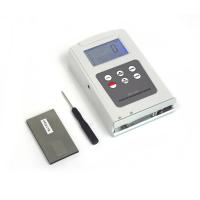
5. Evaluation of surface roughness by stylus method
The stylus method measures the height from the top of the surface to the bottom of the valley, at least 5 points are measured and the average value is taken. Commonly used roughness meters include Elcometer 123 and Elcometer 224 from the UK, TQC SP1560 from the Netherlands, Defelsko PosiTector SPG from the US and PTE R1006 from the UK. The most accurate way to measure is to copy the tape method, but the stylus method is convenient for measurement, direct reading without additional consumables, and low cost, so it is also a commonly used method.