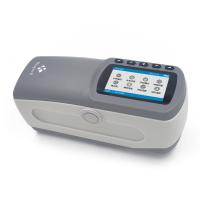
At present, there are a variety of brands and types of Colorimeters on the market. How to choose a Colorimeter product that meets your own requirements is becoming more and more troublesome, but this does not mean that there is no way to do it. Some product indicators can still be referred to when choosing a Colorimeter. of:
Do you choose a Colorimeter or a Spectrophotometer ?
It should be noted that Colorimeters and Spectrophotometer s are different instrument products. The measurement accuracy of the Colorimeter is low, which is suitable for the general quality monitoring of the production line.

Minolta CR400 Color Difference Meter
The Spectrophotometer has high measurement accuracy and can be used to measure the "reflectance curve" of each color point (10nm or 20nm wavelength interval), while the Colorimeter cannot. Spectrophotometers can simulate a variety of light sources, while Colorimeters generally only have one or at most two simulated light sources. Therefore, Spectrophotometer is more suitable for laboratory research and development.

Minolta 3600A Spectrophotometer
The difference between "0/45 degree" and "d/8 degree integrating sphere"
"Spectrophotometer" is divided into two measurement-observation methods: "0/45 degree" and "d/8 degree integrating sphere": "0/45 degree" can only be used to measure smooth surfaces, and cannot be used Color matching by computer. "d/8 degree integrating sphere" can be used to measure various surfaces and can be used for computer color matching. And, when choosing, you should also consider whether there is a measurement mode that eliminates specular reflection and includes specular reflection. If both modes are available, it is very useful when measuring the color of smooth surfaces and obvious reflective surfaces.
The difference between various "d/8 degree integrating sphere" Colorimeters
Most companies choose the "d/8 degree integrating sphere" color measuring instrument, but it should be noted that there are still great differences between different brands and different models, resulting in different measurement accuracy.
In addition to the microprocessor and related circuits, a color measuring instrument has four main components: light source, integrating sphere, grating (spectral monochromator) and photoelectric Detector. This is also the main indicator to measure the pros and cons of an instrument.
The difference between "dual-beam measuring principle" and "single-beam measuring principle"
Dual beam instruments have two gratings and two Detectors. The light source only flashes once during the measurement, and the sample and reference white are also measured. In this way, errors caused by system changes are overcome, and the accuracy of measurement data is very high. Only the instrument cost is higher.
Single beam instruments have only one grating and one Detector. Therefore, the light source flashes twice during the measurement, and the sample and reference white are measured respectively. The systematic error (difference in light intensity distribution of the light source, optical path change, temperature change, circuit drift, etc.) during the two measurements is regarded as the difference between the sample and the reference white, so the error is relatively large, and the difference between the instruments is also relatively large.
The difference between various light sources
In color measuring instruments, when choosing a light source, the first consideration should be stability, light source orientation, lifetime, and the validity of the finally obtained spectral curve. CIE specifies the spectral specificity of several different types of typical light sources.
1. D65: normal sunlight (including ultraviolet wavelength region) with a correlated color temperature of 6504K, used to measure samples illuminated by sunlight (including ultraviolet radiation).
2.C: Normal sunlight with a correlated color temperature of 6774K (excluding the ultraviolet wavelength region), which shall be used to measure samples illuminated by sunlight within the visible wavelength range (but excluding ultraviolet radiation).
3.A: Incandescent light with a correlated color temperature of 2856K is used to measure samples illuminated by incandescent light.

4.F2: cool white fluorescent light source
5.F7: daylight fluorescent light source
6.Fll: Three narrow-band cool white fluorescent light sources