Hardness can be understood as the resistance exhibited by a paint film to another harder object acting on its surface. This action usually takes the form of indentation, scratching, and collision. Therefore, the hardness measurement methods of the coating film are also divided into indentation hardness method, scratch hardness method, and pendulum damping hardness method. These three methods express different types of resistance of the coating film, each representing a different stress-strain relationship. The unit of hardness is the same as the modulus, which is the force per unit area (N/m 2 ). When stating hardness and modulus values, it is necessary to indicate how the force is applied (elongation, shear, bending, or compression), the speed at which the stress is applied, and the temperature.
Indentation hardness
Indentation hardness is a static test of viscoelasticity. The shape of the indentation hardness-temperature curve and the tensile modulus-temperature curve are very similar, and the expressed Tg is also the same. This fully demonstrates that the indentation hardness test is actually the modulus-temperature behavior of the paint film.
The test method of indentation hardness uses an indentation head to press the paint film under a certain weight for a certain period of time. Raise the indentation head and measure the length or area left on the membrane with a calibrated microscope. The indentation length of colored paint is easy to judge. There are various types of test instruments.
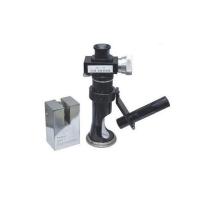
my country's national standard GB9275-88 "Paints and varnishes - Buchholz indentation test" stipulates that Buchholz (Buchholz) indentation Tester is used to test the hardness of the coating film. The measured indentation length represents the resistance of the coating to the indenter, and the result is expressed as indentation resistance. The calculation formula is:

In the formula, H is the indentation resistance; L is the indentation length, mm.
American ASTM D1474-68 (79) stipulates that Knoop indenter and Pfund indenter can be used. The Knoop indenter is a diamond pyramid; the Pfund indenter is a transparent colorless quartz hemispherical body. The test result with the Knoop indenter is called the Knoop hardness value, or KHN for short, which is the mass divided by the indentation area. Calculated according to the following formula:

In the formula, L is the load mass on the indenter, kg; ,11 is the indentation length, mm; cp is the constant of the indenter, 7.028X10⁻².
The test result with the Pfund indenter is called the Pfund hardness value, or PHN for short, and its formula is:

In the formula, L is the load mass of the indenter, which is specified as 1.0kg; A is the indentation area, mm2; d is the average indentation diameter, mm.
Indentation hardness For the same coating, the indentation hardness value of thin film is higher than that of thick film. The indentation test is inaccurate for elastic coatings such as rubber. Only the test results obtained for high T g films are meaningful, medium T g films partially recover from indentation during the experimental operation, and rubbery (low T g ) films may not leave indentations. This does not indicate that the rubbery paint film is hard, but actually soft. Indentation hardness is most widely used in baking lacquers, because the T g of the baked lacquer film is generally higher than the test temperature.