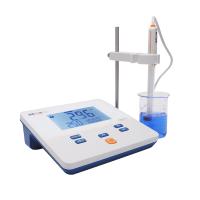
1. Preparation:
Plug the power cord of the instrument into the 220V AC power supply, install the glass electrode and calomel electrode in the electrode holder on the electrode holder, and connect the lead wire of the calomel electrode to the reference terminal on the rear panel. When installing the electrode, the bulb of the glass electrode needs to be slightly higher than the ceramic core end of the calomel electrode to avoid damage to the bulb. When the calomel electrode is in use the small rubber plug on the upper part and the rubber sleeve at the lower end should be removed, and the lower end should still be covered with a rubber sleeve when not in use.
When the glass electrode plug is not inserted into the instrument, turn on the power switch on the back of the instrument and allow the instrument to preheat for 30 minutes. Set the key switch on the panel of the instrument to the mV position, and adjust the " zero point the reading between ±0.
2. Measuring electrode potential:
1) Zero the instrument as described in Preparation.
2) Access the electrodes. When inserting the glass electrode plug, press the electrode socket cover forward at the same time, and release the cover after insertion. If the plug cannot be pulled out, it is plugged in. When pulling out the plug, as long as the socket jacket is pushed forward, the plug can jump out by itself.
3) Rinse the electrode with distilled water and dry it with filter paper.
4) The electrode is immersed in the solution to be measured, and the stable reading of the instrument is the electrode potential (mV value).
3. Instrument Calibration:
Before measuring the pH value of the solution, the instrument needs to be calibrated first. Generally, in normal continuous use, calibration once a day can meet the requirements. However, when the measured solution may damage the hydration layer of the electrode bulb or doubt the measurement result, it should be re-calibrated.
There are two types of calibration: "one-point" calibration and "two-point" calibration. The instrument should be zeroed before calibration. After the calibration is completed , the "slope" and "positioning" regulators of the instrument should not be changed.
1) One-point calibration method
(1) Insert the power plug, press the selection switch button to make it at the pH level, and put the "slope" knob at 100% or the corresponding position where the slope of the electrode is known.
(2) Choose a standard buffer solution that is close to the pH value of the solution to be tested. Clean the electrode with distilled water and blot it dry, then immerse it in the standard solution, adjust the temperature compensator to make the indication match the temperature of the standard solution. Shake the test cup to homogenize the solution.
(3) Adjust the "positioning" regulator so that the reading of the instrument is the pH value of the standard solution at the current temperature.
2) Two-point calibration method
(1) Insert the electrode plug into the instrument, press the selection switch button to make it in the pH position, and put the "slope" knob at 100%.
(2) Select two kinds of standard solutions, measure the temperature of the solutions and find out the standard . Place the temperature compensator at a position corresponding to the solution temperature. After cleaning the electrode with distilled water and drying it, immerse it in the first standard solution, and the reading of the instrument after stabilization is pH1.
(3) Then wash the electrode with distilled water and blot it dry, then immerse it in the second standard solution, and the reading of the instrument is pH2. Calculate S=[(pH1-pH2)/(pHS1-pHS2)]×100%, then adjust the " slope " knob to the position corresponding to the calculated S value, and then adjust the positioning knob to make the instrument display the second reading The pHS2 value of the standard solution.
(4) Then immerse the electrode in the first standard solution. If the value displayed by the instrument is consistent with pHS1, the calibration is completed. If not, then immerse the electrodes in the two solutions in turn, adjust the "positioning" in the solution closer to 7, and adjust the "slope" in the other solution until the two solutions are consistent.
3. Measuring pH
1) The instrument that has been calibrated can be used to measure the pH value of the solution to be tested. During the measurement, the "positioning" and "slope" regulators should remain unchanged, and the "temperature compensation" knob should indicate the temperature of the solution.
2) Immerse the cleaned electrode into the solution to be tested, shake the test cup to make the solution uniform, and the instrument reading is the pH value of the solution.