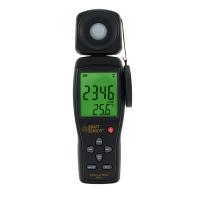
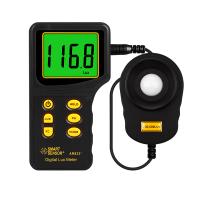
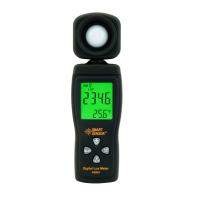
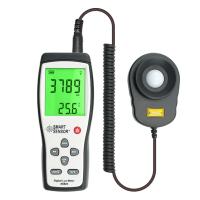
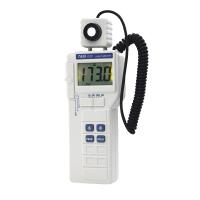
Illuminance (referred to as illuminance) is a quantity that characterizes the degree of illumination on a surface, and it is the luminous flux received per unit surface. If the luminous flux received on the small area dA is dФ, then the illuminance of the illuminated surface is E=dФ/dA. The unit of illuminance is lux (lx). The article "Illuminance Measurement of LED Lighting" firstly introduces the purpose of illuminance, the expression method of luminance, the definition and calculation method of illuminance, and then expounds the difference between LED lighting and fluorescent lamp and incandescent lighting, focusing on the introduction of illuminance meter and illuminance measurement. Precautions and how to use the lux meter.
Definition of Luxmeter
The illuminance meter is an instrument for testing the brightness of the machine and indoor ground, wall and outdoor lighting. The illuminance meter is a light measuring instrument, and JISC 1609 "Illuminance Meter" has been standardized in the Japanese Industrial Standards (JIS).
When measuring illuminance, it is necessary to select an illuminance meter that can meet the required accuracy in terms of performance according to its importance and corresponding illuminance value. For important illuminance measurements, it is desirable to use JIS C 1609 general-type AA-level illuminance meters, and when measuring in shopping malls, stores and other places that require not only brightness but also color (hue, color temperature), it is necessary to use an illuminance meter that can measure color rendering .
Precautions for illuminance measurement
(1) Before the start of the measurement, as a principle: incandescent bulbs and LED lighting should be kept constant after 5 minutes of lighting, and fluorescent lamps should be kept constant after 30 minutes of lighting;
(2) When measuring the vertical surface illuminance, normal illuminance and illuminance of the working surface, etc., place the light receiver of the illuminance meter in the specified direction, and measure the illuminance at the measuring point of the corresponding target;
(3) Reflections that cannot be produced by the figure and clothing of the measurer affect the measurement accuracy;
(4) It is necessary to exclude the influence of external light other than the measurement object (especially during the day, the illuminance measurement of artificial lighting);
(5) In the case of LED lighting, PWM dimming is used. Due to the special timing (timing) light emission, it is necessary to use an illuminance meter suitable for PWM. If an illuminance meter not corresponding to PWM is used, the illuminance value will be deviated due to dispersion and Fluctuation, stable measurement cannot be achieved.
Measurement method of illuminance
When measuring illuminance, unless stated in advance, the illuminance of the horizontal plane is generally measured, but the distance and direction of the measured illuminance will change according to the quantity of illumination, so it is necessary to determine the content of the measurement, and the height of the measurement surface is not specified. In the case of , it is generally determined in the following way.
(1) General room: 80±5 cm above the floor;
(2) Japanese-style room: 40±5cm above the grass mat on the floor;
(3) Corridors and outdoors: less than 15 cm from the ground or above the ground;
(4) Vertical plane: 120±5 cm from the floor or ground;
(5) However, if there are machinery and equipment in the room, the imaginary surface shall be on or within 5cm from the above.
When the location of the measurement point is not specified, the measurement range is determined by the distance from the person concerned, and a number of scattered measurement points are arranged; the configuration of the measurement point divides the measurement range into equal areas, and the entire range is determined by 10 to 50 points.
For the average illuminance of a wide place, first calculate the average illuminance per unit area, add these average illuminances and take the average value, which is the average illuminance value of the entire measurement range.
In principle, the average illuminance per unit area is calculated by the 4-point method, and the calculation of the 4-point method is as follows: E=1/4ΣE i .
If 1 light is installed in the middle of the room, the average illuminance at this time is calculated using the 5-point method (Figure 8). The calculation formula of the 5-point method is E=1/6(ΣE mi +2E g ).
According to the labor safety and health regulations: the illuminance for precise operations should be above 300 lx; for ordinary operations, it should be above 150 lx; for rough operations, it should be above 70 lx. The lighting equipment in the usual workplaces of office workers and labor workers needs to be tested regularly every 6 months [1].
In the occupational health management guidelines for VDT operations, the illuminance on the display screen where the monitor is used is below 500 lx, and the illuminance on the books and periodicals and the operation keyboard is above 300 lx.
In addition, various illuminance standards are established in JIS Z 9110, the Japanese Industrial Standard, so please refer to them.