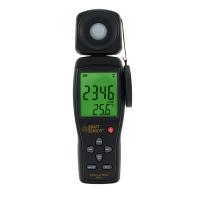
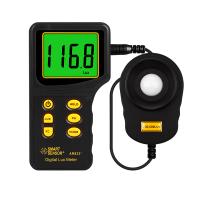
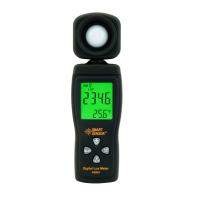
In 1967, the Thirteenth International Metrology Conference in France stipulated that candela, candela/square meter, lumen and lux should be used as the units of luminous intensity, luminous brightness, luminous flux and illuminance respectively, which are important optical measurement units used in unifying engineering technology. significance. In order to make you understand and use conveniently, the following is a brief introduction to relevant knowledge:
1. Candlelight, International Candlelight, Candela
Under the standard atmospheric pressure of 101325 Newtons per square meter, an absolute "black body" with an area equal to 1/60 square centimeter (that is, a desirable object that can absorb all external light without reflection), at the solidification temperature of pure platinum (Pt) (about 2042K At 1769°C), the luminous intensity along the vertical direction is 1 candela.
Moreover, the three concepts of candlelight, international candlelight, and candela are different and should not be equated. In terms of quantity, 60 candela is equal to 58.8 international candlepower, and 1 candlepower of a Hefner lamp is equal to 0.885 international candlepower or 0.919 candela.
2. Luminous intensity and brightness
Luminous intensity is referred to as luminous intensity for short, and the international unit is candela (candela) abbreviated as cd. Lcd refers to the luminous flux emitted by the light source within the unit solid angle of the specified direction. When the radiation of the light source is uniform, the light intensity is I=F/Ω, Ω is the solid angle, the unit is steradian (sr), F is the luminous flux, the unit is lumen, and for a point light source, I=F/4. Brightness is the brightness of the light-emitting surface, which refers to the ratio of the luminous intensity of the light-emitting surface in the specified direction to the area of the light-emitting surface perpendicular to the specified direction, and the unit is candela/square meter.
For a diffuse scattering surface, although the light intensity and luminous flux in each direction are different, the brightness in all directions is equal. The fluorescent screen of a TV is similar to such a diffuse scattering surface, so viewing images from all directions has the same sense of brightness. Give more hearing care to 1.3 billion Chinese people!! The following are the brightness values of some light sources: unit: cd/m2
Sun: 1.5*10; fluorescent lamp: (5-10)*103; moonlight (full moon): 2.5*103; black and white TV fluorescent screen: about 120; color TV fluorescent screen: about 80.
3. Luminous flux and lumen
The light energy emitted by the light source radiates in all directions. For the light energy passing through a certain area per unit time, it is called the radiant energy flux passing through this area. The frequency of each color of light is different, and the sensitivity of the eyes to each color of light is also different. Even if the radiant energy flux of each color of light is equal, it cannot produce the same degree of brightness visually. Among the various colors of light, yellow and green light can excite Remarkable bright feeling.
If green light is used as the standard to make its luminous flux equal to the radiant energy flux, then for other colored lights, the ability to arouse the feeling of brightness is smaller than that of green light, and the luminous flux is also smaller than the radiant energy flux. The unit of luminous flux is lumen, which is the transliteration of English lumen, abbreviated as lm.
The luminous flux radiated from an area of 5.305*103cm2 by an absolute blackbody at the solidification temperature of platinum is 1lm. In order to show the relationship between light intensity and luminous flux, the luminous flux emitted by a point light source with a luminous intensity of 1 candela within a unit solid angle (1 steradian) is 16. The luminous flux output by a 40W fluorescent lamp is about 2100 lumens.
4. Illumination and Lux
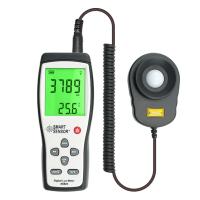
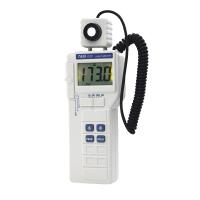
Illuminance can be measured directly with a lux meter. The unit of illuminance is lux, which is the transliteration of English lux, and can also be written as lx. When the luminous flux obtained by an object uniformly illuminated by light is 1 lumen on an area of 1 square meter, its illuminance is 1 lux. Sometimes in order to make full use of the light source, a reflective device is often added to the light source, so that more luminous flux can be obtained in certain directions, so as to increase the illuminance on the illuminated surface.
Such as car headlights, flashlights, photography lights, etc. The following are the various ambient illuminance values:
Unit lux night: 0.001-0.02; moon night: 0.02-0.3; cloudy indoor: 5-50; cloudy outdoor: 50-500; sunny indoor: 100-1000; the illuminance under the sun at noon in summer: about 10*9 The second power; the required illuminance when reading books and periodicals: 50-60; the standard illuminance of home video cameras: 1400.
The brightness calculation formula and related derivation of the diffuse reflection surface are as follows:
L=ρE/π that is: brightness = illuminance × reflectivity ÷ pi, so: E=Lπ/ρ
Example: Assuming that the reflectivity of your reflective surface is 0.7, then to achieve 10×102cd/m2, the illuminance required for brightness is: E=Lπ/ρ=1000×3.14/0.7=4485Lux