Q1. How to converge the LED light to one point?
Answer 1: This is impossible. There is a law in optics that the brightness of an image is never greater than the brightness of the light source.
LED has a light-emitting area, so it has brightness. If all or most of the light is concentrated into a small area, its brightness will exceed the brightness of the LED itself, so it is impossible.
In order to converge as much as possible, the scale of the reflective bowl/condenser can only be increased. Combining lenses or other methods will not help.
Q2. If there is an electric light source that can convert all electric power into white visible light, how high is the theoretical efficiency?
Answer 2: As mentioned above, it depends on the spectrum of white light. For sunlight, it is 94 lumens/watt. The luminous efficiency of CIE1931 chromaticity system is very poor, because red chooses the long wave of 700nm. In contrast, the light efficiency of CRT TV or LED TV is much higher, which is 300 lumens/watt.
Q3. What is the relationship between illuminance and the brightness of the illuminated object?
Answer 3: Brightness = reflectivity * illuminance / π
Q4. Why is the laser brightness high?
Answer 4: The laser is emitted by multiple resonances in a resonant cavity whose two ends are strictly parallel, so the parallelism is very high and the divergence angle is very small. And because the brightness is the light flow emitted within the unit solid angle, the solid angle used as the denominator is small, and the brightness is naturally high. High-brightness lasers can now travel very far without diverging, or can converge into very small spots at close range.
Q5. How to measure the luminous intensity of a flashlight or LED?
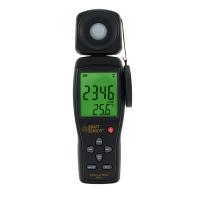
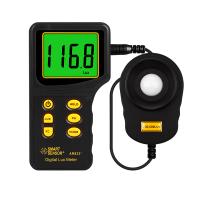
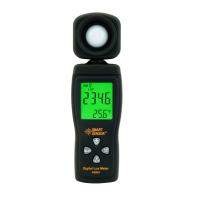
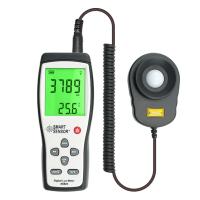
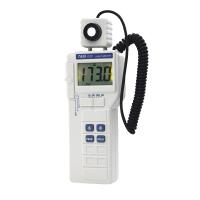
Answer 5: Put the probe of the illuminance meter on the ground in the dark, and shine the flashlight or LED at a distance of 1 meter downward to measure the lux value of the illuminance, which is the cd value of its luminous intensity.
Q6. How to measure brightness with an illuminance meter?
Answer 6: Brightness meter and illuminance meter are two things, which cannot be replaced directly. The luminance meter measures the brightness of the illuminant, while the illuminance meter measures the illuminance of the irradiated place. However, if you want to know the brightness of a luminous body with a relatively large area such as a light box, and this object is within your reach, you can use the probe of the illuminance meter to directly stick to the luminous body, read the lux value and then multiply it by a coefficient. It is the nit value of the brightness.
Q7. How to measure the luminous efficiency of a light bulb?
Answer 7: You can use an illuminance meter. To find a relatively dark and open place outdoors in a dark day, you need a relatively stable power supply and an illuminance meter. The purpose of the space is to prevent reflected light from shining on the illuminance meter, so the body should be as far away from the light bulb and the illuminance meter as possible during the test. The illuminance value measured at a distance of 1m from the head of the lux meter to the center of the light bulb is E, and the efficiency = 4 * π * E / N, the unit of the result is lumens/watt, where N is the lamp power
For example, if the bulb is N=40W and the reading is E=35.0 lx, then the efficiency is 12.56 * 35 / 40 = 11 lumens/watt.