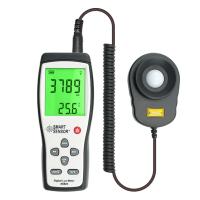
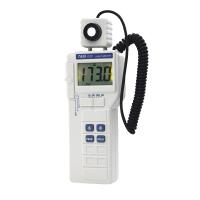
Introduction to Illumination
Illuminance, commonly known as lux (lux), represents the luminous flux per unit area on the surface of the subject. 1 lux is equivalent to 1 lumen/square meter, that is, the luminous flux irradiated vertically by a light source with a distance of one meter and a luminous intensity of 1 candlepower per square meter of the subject. Illumination is an important indicator to measure the shooting environment.
Calculation method of illuminance
Average illuminance (Eav) = luminous flux of a single lamp Φ × number of lamps (N) × space utilization factor (CU) × maintenance factor (K) ÷ floor area (length × width)
Formula description:
1. The luminous flux Φ of a single lamp refers to the total luminous flux value of the bare light source contained in the lamp.
2. Space utilization coefficient (CU) refers to how many percent of the light beams emitted from lighting fixtures reach the floor and work surface, so it is related to the design of lighting fixtures, installation height, room size and reflectivity. The rate also changes accordingly. For example, the commonly used lamp panel is used in a space with a height of about 3 meters, and its utilization coefficient CU can be taken between 0.6-0.75; and when the aluminum lamp cover is suspended, the space height is 6-10 meters, and the utilization coefficient CU value ranges from 0.7- -0.45; downlight lamps are used in a space of about 3 meters, and the utilization coefficient CU can be 0.4--0.55; and when the lamps such as light strip brackets are used in a space of about 4 meters, the utilization coefficient CU can be 0.3--0.5 . The above data are empirical values and can only be used for rough estimation. If the specific values are to be calculated accurately, the company must provide them in writing. The relevant parameters are here for reference only.
3. With the aging of lighting fixtures, the light output capacity of the lamps decreases and the use time of the light source increases, and the light source decays; or due to the accumulation of dust in the room, the space reflection efficiency decreases, resulting in a decrease in illuminance. Coefficient. Generally clean places, such as living rooms, bedrooms, offices, classrooms, reading rooms, hospitals, high-end brand stores, art galleries, museums and other maintenance coefficient K take 0.8; while general stores, supermarkets, business halls, theaters The maintenance coefficient K of places such as machinery processing workshops, stations, etc. is taken as 0.7; while the maintenance coefficient K of places with a large pollution index can be taken as about 0.6.