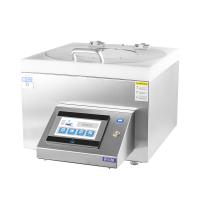
There are many titles for the coating machine. It is called SpinProcessor or SpinCoater in English. Coating instrument, Spin Coater, and film coating machine, in summary, their principles are the same, that is, dripping various glues on the high-speed rotating substrate, and using centrifugal force to make the glue dripped on the substrate evenly Coated on the substrate, the thickness depends on the viscosity coefficient between different glues and the substrate, and is also related to the rotation speed and time.
How to choose a suitable glue homogenizer In view of the current situation of many brands of glue homogenizers in the market, we have integrated many years of practical experience in the research of glue homogenizer technology. In order to help users improve their discrimination ability, it provides intuitive and clear selection criteria. From its principle, we can see several details that need to be paid attention to when purchasing a glue homogenizer:
1. The structure of the vacuum adsorption system
The Vacuum Pump must be oil-free, and the pressure calibration is accurate. The oil-free Vacuum Pump produced in CHINA is really not flattering. Because any oil stains may block the vacuum pipeline, if the vacuum adsorption force is reduced, it will cause the substrate to be unable to absorb, and the dripping liquid will accidentally enter the vacuum pipeline system and cause a complete blockage. Customers who have used domestic glue homogenizers often worry about how to clean them. Many foreign glue homogenizers have done a good job in this regard. They have a linkage mechanism. If the vacuum adsorption force is not enough, they will not start to rotate.
2. Rotation speed
The speed of rotation speed and control precision are directly related to the thickness control and film layer uniformity of the spin coating. If there is a large error between the marked speed and the actual speed of the motor, accurate experimental data cannot be obtained for researchers who require precision coating. Some domestically produced homogenizers can only provide the speed range, and cannot accurately calibrate the real-time speed. Although most of the imported glue homogenizers can calibrate the speed, most of the speed accuracy is not recognized by international standards. It is recommended to purchase speed control with internationally recognized standards, such as: American NIST standards, etc.
3. Material selection
For the application of the semiconductor chemical industry, the choice of material is particularly critical. Most glue dispensers are made of stainless steel or ordinary plastic material, because the cost of this material is very low, and the corrosion resistance of stainless steel to various chemical glues Not so good, plastic tends to warp at higher temperatures and pressures. If this deformation causes the position of the tray to lose its level, it will lead to a bumpy state during spin coating. Naturally, a good spin coating effect cannot be obtained. At present, some foreign brands use natural polypropylene or polytetrafluoroethylene (Teflon) materials. These two materials have the advantages of environmental protection, resource saving, light weight, high strength, good impact resistance, durability, natural patterns, and good gloss. When purchasing a glue homogenizer, you must pay attention to the brand and quality, and secondly, the price. The glue homogenizers on the market are not uniform, and customers should consider carefully when purchasing.