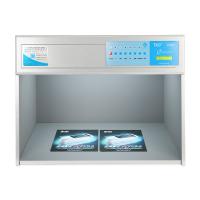
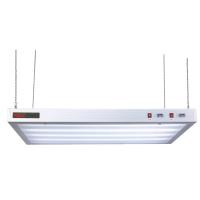
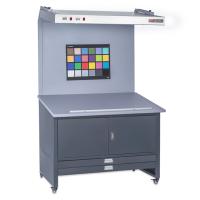
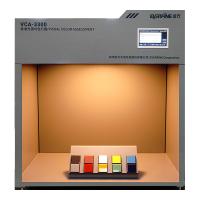
In order to improve the accuracy of color observation, it is necessary to use an artificial standard light source close to the spectral composition of natural light to observe the color of the object.
Usually two objects of the same color look very consistent under the illumination of a certain artificial light source, but there is a big difference in color when observed under natural light or another artificial light source. This phenomenon is called in physics. Metamerism of objects. In order to overcome the impact of objects on color quality management due to metamerism, the International Organization for Standardization (ISO) and the State Administration of Quality, Technical Supervision, Inspection and Quarantine require industries engaged in color reproduction and preparation to use standard light sources to observe environmental conditions to observe the color of objects. And developed related technical standards. The standard stipulates the spectral requirements of the artificial light source used in the standard light source observation environment, the illuminance or brightness and uniformity requirements of the standard observation environment, and the requirements for the standard observation surrounding environment. The standard light source is the artificial light source specified by CIE whose radiation is similar to the CIE standard illuminant. A standard illuminant refers to an illuminant that has the same or approximately the same relative spectral power distribution as daylight at a certain moment.
The CIE standard illuminant D50 represents typical daylight with a correlated color temperature of 5003K. On the CIE 1931 chromaticity diagram, its chromaticity coordinates are x=0.3457, y=0.3586. CIE standard illuminant D65 represents typical daylight with a correlated color temperature of 6504K. On the CIE 1931 chromaticity diagram, its chromaticity coordinates are x=0.3127, y=0.3291[2]. Figure 1 is the relative spectral energy distribution diagram of D50 light source and D65 light source. It can be seen from the figure that the relative spectral energy distribution of the D50 light source is flatter than that of the D65 light source. The relative spectral energy of the D65 light source reaches a peak at around 470nm, and then shows a downward trend. Theoretically speaking, the same color measured with D65 light source is slightly bluer than the result measured with D50 light source, which also shows that D50 light source is a light source with a slightly warmer color of the illuminant, while D65 light source is a light source with a slightly warmer tone. A light source in which the color of the illuminant is slightly cooler. This may be why ISO recommends using a D50 light source. In the ISO 3664:2009 "Graphic technology and photography — Viewing conditions" (printing technology and photography viewing conditions) standard, the D50 light source is considered to be a standard light source for observing colors in the true sense.
For the selection of standard light source, our country recommends to choose D65 light source. Although its relative spectral energy distribution curve is not as smooth as D50 light source, D65 light source is closer to the color temperature of normal sunlight, so it has a color rendering that is closer to the actual situation.