The rheology of paint refers to the flow and deformation characteristics of paint under the action of force. The grinding and dispersing processing of coatings , the storage stability of coatings, the workability of coatings, the leveling and anti-sagging of coatings are all closely related to the rheological properties of coatings. To truly describe the variable behavior requires accurate mathematical analysis, resulting in extremely complex mathematical expressions. In order to facilitate the application of rheology to guide the design, production and construction of coating formulations, a series of practical mathematical expressions are often obtained through reasonable mathematical simplification to reveal the rheological behavior of coatings.
(1) Definition of viscosity
As shown in the figure, assume that the second layer of liquid with area A and distance dx, under the action of shear force F, flows in parallel with a certain speed difference dv. Then for a Newtonian fluid (namely, a viscous fluid), its stress τ-strain behavior should obey Newton's law.

If the force on the unit area is defined as the shear stress τ, then:
τ=F/A
For any part of the liquid, the velocity gradient dv/dx is a constant, called the shear velocity D(S-1)
D=dv/dx
Viscosity η is the ratio of shear stress to shear rate:
η=τ/D
The absolute viscosity is obtained according to the above formula. If the absolute viscosity is divided by the liquid density, it is called kinematic viscosity:
v=η/ρ
(2) Newtonian flow and non-Newtonian flow
Newtonian flow is the desirable flow property of a liquid in which the viscosity remains constant over a wide range of shear rates at any given temperature. There are few varieties of coatings with satisfactory liquids, but liquids close to satisfactory states are also called Newtonian fluids, such as dilute solutions of water, mineral oil, solvents, and certain resins.
If the viscosity of a liquid changes as the shear rate changes, the liquid is said to be a non-Newtonian fluid, and its flow behavior is called non-Newtonian flow. Coating products are basically non-Newtonian liquids.
If the viscosity of the liquid decreases as the shear rate increases, the liquid is called a pseudoplastic fluid, that is, the liquid becomes thinner when a shear force is applied. On the contrary, as the shear rate increases, the liquid whose viscosity increases is called dilatant fluid, and the application of shear force will make the liquid thicken. The rheological behavior of these two liquids is shown below, where the viscosity varies along a curve or slope. Color paste grinding approximates dilatant flow, while most finished paints are pseudoplastic liquids.
For multi-phase systems, such as foam, emulsion, color paste, etc., the interphase force makes the dispersion system have a weak rigid structure, and the applied shear force needs to reach a certain minimum value to make the system start to flow. This minimum value is called the yield value. Below the yield value, the coating deforms like an elastic solid but cannot flow. Such fluids are called Bingham fluids.
Since the viscosity of non-Newtonian fluid changes with the shear stress, the ratio of τ/D is defined as the apparent viscosity ηa:
ηa=τ/D
At this time, there are multiple viscosities at different shear rates, so it is better to use a viscosity distribution diagram to represent this characteristic.
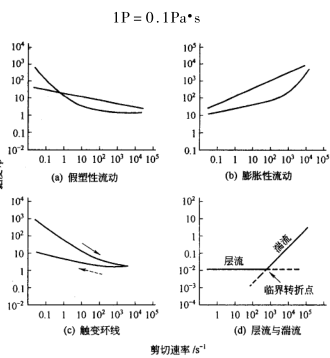
(3) Thixotropy
Thixotropy is a behavior in which the viscosity of a paint decreases upon being touched. More importantly, it is actually a time-dependent flow behavior, that is, under the continuous action of shear force, the viscosity will continue to decrease with time and tend to min. Thixotropic behavior can be seen in the figure above. In the static state, the thixotrope has a good anti-pigment sedimentation effect; and under the action of shear force during construction, the decrease in viscosity is conducive to the leveling of the coating film. Due to this special advantage of thixotropes, thixotropic agents are often added to paints to produce thixotropic effects . The size of thixotropy can be characterized by the area of thixotropic ring. The area of the thixotropic ring is related to the time of the shear stress, and it cannot completely return to the original association structure (or structural viscosity) after standing for a long time after the test.
In some expansive fluids, the phenomenon opposite to thixotropy may occur. At a constant shear rate, the viscosity increases and tends to a maximum value. This rheology is called shock coagulation.
