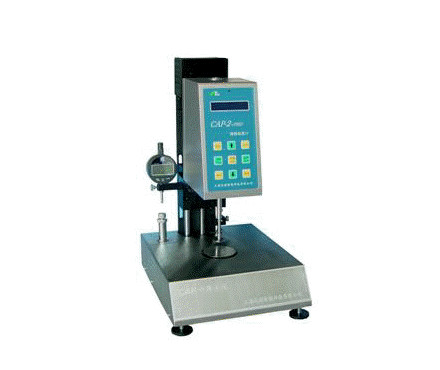
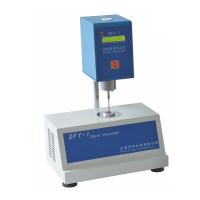
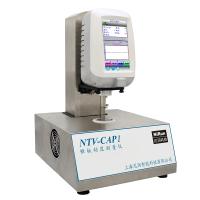
The cone-plate viscometer mainly consists of a flat plate and a replaceable cone rotor. The motor drives the conical rotor to rotate at a constant speed through the variable speed gear, and the appropriate amount of sample is kept on the plate and the fingertips of the rotor, and the friction between the molecules of the sample drives the cone to rotate. Under the action of the torsion spring in the torque Detector, the torsion spring no longer deforms after the rotor rotates at a certain angle. At this time, the torque applied by the torsion spring is related to the molecular internal friction (ie viscosity) of the sample to be tested: the greater the viscosity of the sample, the greater the torque. There is a variable capacitor inside the torque Detector, and its moving piece rotates with the cone plate to change its own capacitance value. The torque of the torsion spring reflected by this capacitance change is the viscosity of the sample to be tested, which is displayed by the meter, and the displayed data is the viscosity value of the sample.
Structural Principles of Cone and Plate Viscometers

Guess you like it

Relevant knowledge
- 1Analysis of the difference between cone-plate viscometer and Rotational Viscometer
- 2Test Principle of Cone Plate Viscometer
- 3In addition to Bollefei CAP cone plate viscometer, which domestic cone plate viscometer brand is there?
- 4American brookfield CAP2000 + Cone and Plate Viscometer Instruction Manual
- 5Several methods for determination of gel time of epoxy resin matrix
马亚峰;张凤翻 - 《高科技纤维与应用》
- 6Determination of Gel Time of Resin and Its Prepreg by Cone and Plate Viscometer Method
马亚峰;张凤翻 - 《高科技纤维与应用》
- 7Determination of Viscosity of Methyl Vulcanized Silicone Rubber at Room Temperature by Cone and Plate Viscometer
刘立国 - 《化工管理》
- 8Instruction Manual for a Cone and Plate Viscometer
Author:
刘立国
Source:
化工管理
Products