The theoretical spread rate of a paint is a key factor in calculating paint usage and cost for owners and contractors.
Theoretical spreading rate refers to the area (square meters or square feet) that can be applied per liter of paint on a smooth surface without loss, and the unit is square meters per liter (m scoop L). Due to different uses, the dry film thickness of the coating can be changed, so its theoretical spreading rate will also change accordingly. The calculation formula is:
Theoretical spreading rate = (volume solids X10)/dry film thickness
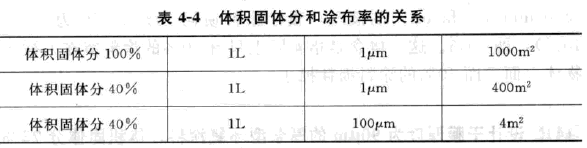
How is the theoretical spreading rate calculation formula derived? It is derived based on a coating with 100% volume solids, see Table 4-4. If the volume solids of the paint is 100%, the dry film thickness of 1µm per liter of paint can be applied to an area of 1000m 2 .
The question then arises: "If the volume solids of the paint are not 100%, how much area can be covered?" The "coverage" for coatings with less than 100% volume solids and a coating thickness of 1 µm is calculated as follows : Multiply 1000 by the actual volume percent solids of the coating being used, expressed as a decimal.