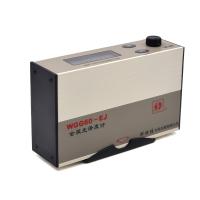
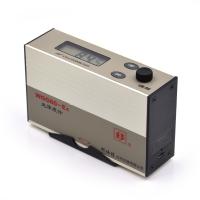
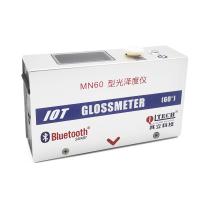
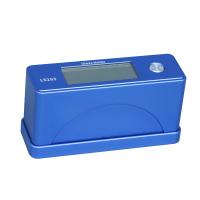
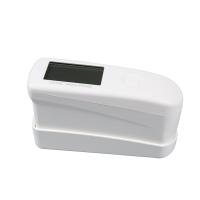
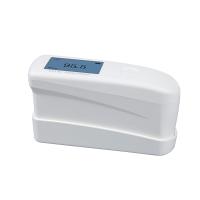
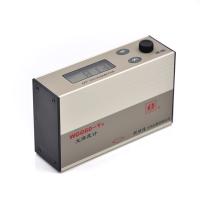
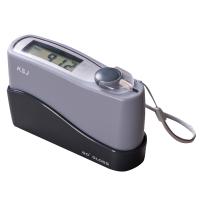
1. Some concepts of gloss
Before choosing a gloss meter, let's clarify a few concepts about paint film gloss:
Paint film gloss: This is easy to understand, so I won’t be too polite
Gloss unit: GU
High gloss: 60° gloss higher than 70%
Low gloss: 60° gloss less than 30%
Many random articles on the Internet have corrupted some rigorous concepts. The author has searched all the glossy materials in the North and South Tide Mall. For a more subdivided statement, you can refer to the following table:
| Gloss distinction | high gloss | half light | eggshell light | flat light | dull |
| luster(%) | over 70 | 30-70 | 6-30 | 2-6 | 2 or less |
It is worth noting that the gloss range above is based on the gloss data measured by a 60° gloss meter. In this way, everyone can understand why the 60° gloss meter can be called a "universal gloss meter", right? Of course, we still have to be more rigorous.
Two, the type of gloss meter
The types of gloss meters vary according to the incident angle of the light source, and there are mainly gloss meters with different angles of 20°, 45°, 60° and 85°. Among the mainstream standards involving gloss detection in CHINA, the main ones are 20°, 60° and 85°.
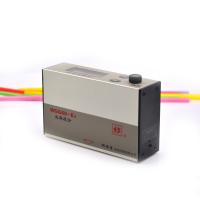
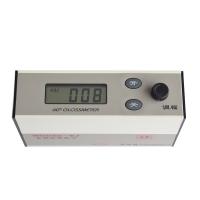
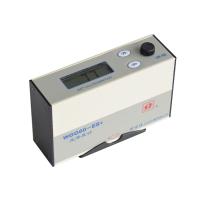
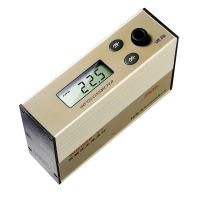
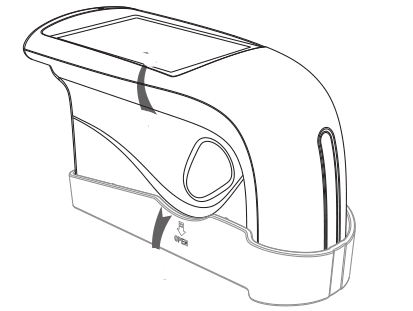
From a functional point of view, just like the division of the northern and southern tide selection tool "Check Instrument", there are single-angle, double-angle and three-angle electronic gloss meters.
In addition, in order to meet the needs of different user groups, manufacturers often have different functions and ranges. The common ranges are 0~2000GU, 0~1000GU and 0~200GU, and they are aimed at different industries, especially for metal coatings. , paper, stone, ceramics, etc. will also have customized products.
3. How to choose a gloss meter
What type of gloss meter to choose is actually confusing to users. It is not that there are no relevant standards for this type of instrument, but that it may cause problems in the actual selection. Taking GB/T 9754 and ISO2813 as an example, the 60° gloss meter is suitable for all paint films; based on the reason of improving the resolution ability, it is recommended to use a 20° gloss meter for high gloss greater than 70GU, and it is recommended to use a gloss meter lower than 30 units 85° gloss meter.
So here comes the question, how do the testing demanders know whether the gloss is high or low before purchasing the instrument? Is it possible to buy a 60° angle first and then see which angle to buy? Or spend more money to buy a three-angle gloss meter? This is clearly a problem. Of course, you can roughly make a choice through experience, please see the table below for details:
| method name | 85° mirror gloss | 60° mirror gloss | 45° mirror gloss | 20° mirror gloss |
| Application examples | paper and others | paint surface | ceramics and enamel | paint surface |
| scope of application | Specimens with gloss levels below 10, or for "brilliant" and approximate amounts of grazing incidence | Samples with a gloss lower than 70 are more suitable | The gloss measurement reflects the resistance of the surface of the object to the corrosion of acids, alkalis and atmospheric substances | Samples with a gloss higher than 70 by the 60° method |
After choosing the right type, there is still a doubt to be solved, that is, there are so many gloss meters on the market, which one is better? This question can actually be said to be nonsense, or it can be said to be the truth. The reason is that most expensive ones are better, of course, the premise is not to fool you. The accuracy, range, function, repeatability and reproducibility of electronic products are very strong supports to determine their different values. Many manufacturers intentionally or unintentionally remove repeatability and reproducibility when labeling product parameters, or remove one of them, you have to worry about this.
Taking the new ISO 2813 standard as an example, it stipulates the repeatability and reproducibility data of gloss, as follows:
| angle | repeatability | reproducibility |
| 20° | 3GU | 4GU |
| 60° | 2GU | 3GU |
| 85° | 1GU | 2GU |
Of course, for the industry, gloss is more and more accepted in terms of quality control, but how to unify the standards at home and abroad will have a good role in promoting product quality research and development and manufacturer quality control. Users who are not short of money will not only recognize imported brands such as BYK and TQC, but will return to rationality similar to the mobile phone industry.
4. Gloss testing standard
GB/T 13217.2-2009 "Liquid Ink Gloss Test Method" ------Current
JJG 696-2002 "Verification Regulations for Specular Gloss Meter and Gloss Plate" ------Current
GB/T 12032-2005 "Preparation of Gloss Printing Samples for Paper and Board Printing" ------Current
GB/T 3295-1996 "Test Method for 45° Mirror Gloss of Ceramic Products" ------Current
GB/T 8807-1988 "Test Method for Plastic Specular Gloss" ------Current
GB/T 8941-2007 "Determination of Specular Gloss of Paper and Cardboard (20° 45° 75°)" ------Current
GB/T 13217.2-2009 "Liquid Ink Gloss Test Method" ------Current
ASTM D 2457-2003 "Standard Test Method for Specular Gloss of Plastic Films and Solid Plastics"
GB/T 1743-1979 "Determination of Paint Film Gloss" ------repealed
ASTM D 6037-1996-2002 "Dry Scratch Resistance of High Gloss Coatings"
"Visual Evaluation of Gloss Differences Between Surfaces of Similar Appearance"
ASTM D 5767-95-2004 "Determination of Bright Image Gloss of Coating Surface by Instrument Method"
ASTM 430-97-2003 "Determination of gloss of high-gloss surfaces by goniospectroscopy"
Disclaimer: This article is an original article of NBCHAO Mall and may not be reproduced without permission.