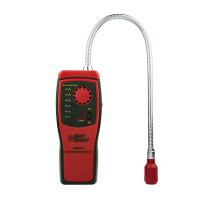
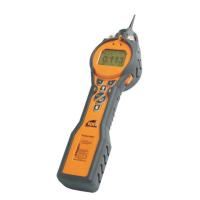
The common faults and solutions of Gaopin Technology Gas Detector are as follows:
Fault 1: It cannot be detected at low concentrations
solutions:
1. If it is a pump-suction measurement, first check whether the pump is working. There is a slight vibration when the pump is working normally, and you can feel obvious suction by blocking the air inlet with your fingers for 5 seconds. Then check whether the air inlet is blocked or the connection is not sealed well, resulting in air leakage without suction.
2. Introduce nitrogen gas to calibrate the zero point or calibrate the zero point in clean air, and test immediately after calibration.
3. After the zero point is calibrated, the measured gas cannot be detected, and it is necessary to restore the factory settings.
4. If it cannot be detected after restoring the factory settings, it is necessary to re-introduce nitrogen gas or perform zero-point calibration in clean air, and perform detection immediately after calibration.
5. Check whether the connecting wire of the sensor is artificially damaged or not in good contact.
6. After all the above four steps are done, it still cannot be detected. It is necessary to confirm whether there is a gas to be measured on site, or the concentration of the gas to be measured is really low. If it is lower than the minimum detection limit of the instrument, it cannot be detected.
Fault 2: In the air, there is no measured gas, but the value fluctuates greatly or jumps wildly
solutions:
1. Generally, the short-term zero point fluctuation range is less than 1% of the maximum range, and it is within the normal range if the long-term drift is less than 2% of the maximum range without the measured gas. Measured gas, or the temperature and humidity in the air fluctuate greatly, resulting in unstable values. Generally, the large fluctuations in temperature and humidity will cause large fluctuations in the instrument's detection values in a short time. After the temperature and humidity in the air are constant, the values will also Relatively stable.
2. Confirm whether the zero point calibration or target point calibration operation has been performed on the instrument. If the zero point calibration operation is carried out in the place where there is a gas to be measured, it may not be able to detect low-concentration gases. Point calibration, but the calibrated concentration value does not match the actual concentration value, which may cause large fluctuations in the instrument value or a small detected value, both of which can be resolved by restoring the factory operation.
3. If the problem cannot be solved after restoring the factory settings, confirm whether the power of the power supply of the Detector is sufficient, do not use a transformer to power the instrument, it is better to use a DC regulated power supply or a switching power supply, and the power must be greater than 24V, 1A (Power supply to a single device), multiple devices require more power, it should be noted that the diameter of the power cord should not be too small, and the diameter of a short-distance power supply to a single device is better than 0.75 square millimeters.
4. Check whether the routing of the signal transmission line has passed through a place where the electromagnetic field changes, such as high-power fans, motors, and frequency converters, etc., and try to avoid areas with strong electricity and electromagnetic fields, and use shielded wires as signal transmission lines. One end should be connected to the shell of the instrument, and the other end should be connected to the earth to ensure good grounding.
5. If the problem still cannot be solved, it is necessary to confirm whether a high-concentration gas has been introduced or a high-concentration gas has impacted the sensor. If there is an impact on the sensor, after the instrument is powered on and aged for 24 hours, the value may be unstable. The sensor was damaged by the impact.
Fault 3: Inaccurate detection
solutions:
1. Confirm whether the gas concentration on site is accurate. Sometimes the difference between the theoretical value and the actual value is very large. It is better to verify the accuracy of the instrument by introducing standard gas, or send it to a third-party measurement agency for testing.
2. If the sensor has been used for a long time, there may be some errors in the measured value. You need to confirm with the manufacturer whether the sensor can still be used. If the sensor itself is close to the end of its service life, it can be used normally even after calibration. After a while, it can no longer be used normally. It is recommended to replace the sensor.
Fault 4: When the value is 0 or the alarm value is not reached in the air, it will also alarm
solutions:
1. Check whether the alarm value has been modified
2. Check whether the alarm mode and alarm mode have been modified
3. Check whether the alarm state is a concentration alarm or a fault alarm. The words AL or AH will appear on the concentration alarm, and the red indicator light will flash, and the yellow light will be on for the fault alarm.
4. If the alarm caused by human modification can be solved by restoring the factory settings, the fault alarm needs to be further checked for short circuit, open circuit, poor contact, sensor failure, etc., or sent back to the manufacturer for inspection.
Fault Five: Unable to communicate with the computer
solutions:
1. Check the device address. The address set in the communication software needs to be consistent with the device address of the instrument.
2. Check the wiring of the RS485/RS232 converter. Generally, TR+ is connected to the A terminal of RS485, and TR- is connected to the B terminal of RS485. At the same time, check whether the serial port corresponding to the RS485/RS232 converter is connected in the computer’s hardware-device manager-port . For devices with USB interface, it is also necessary to detect whether the serial port is connected.
3. Check whether the device address of the upper computer software or the instrument has repeated address numbers, and there must be no duplicate numbers.