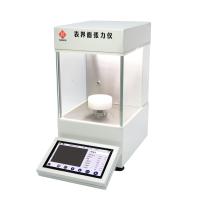
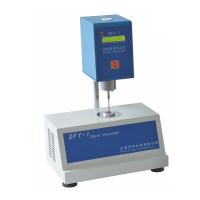
The Surface Tensiometer, also known as the interfacial tensiometer, is a professional measurement/determination instrument used to measure the surface tension of liquids. , pendant drop method, drop volume method and drop weight method to achieve accurate measurement of the surface tension of liquids. At the same time, using software technology, it is possible to measure the surface tension value that changes with time.
Depending on the technology used, the Surface Tensiometer can be classified as follows according to the test principle:
1. Platinum Ring Surface Tensiometer:
Also known as du Nouy Ring method, du Nouy ring method, suspension ring method Surface Tensiometer, off-ring method Surface Tensiometer. The principle is the platinum ring method. The measurement method is: (1) gently immerse the platinum ring in the liquid; A column of liquid, which eventually separates from the platinum ring. Platinum ring Surface Tensiometer is to sense a highest value, and this highest value is formed when the platinum ring and the liquid sample are close to each other. The accuracy with which this highest value is converted to a surface tension value depends on the viscosity of the liquid. Since this method was used very early, the original Surface Tensiometer basically adopts this method, and many existing data are also measured by this method.
☆Special points for attention when purchasing a Surface Tensiometer based on this principle:
There are problems when this method is applied to the measurement of viscous samples and surfactants. The main manifestations are that, first, it will take the viscosity into account, resulting in inaccurate measurement; second, it can only test a time The surface tension value of the point cannot be tested for the surface tension value changing with time. Therefore, most customers now choose the Surface Tensiometer with the platinum ring method as the main testing principle.
At the same time, as a purchase, you must pay attention to the design of the platinum ring, especially the thickness design of the platinum ring must see whether it meets the requirements.
2. Platinum plate method Surface Tensiometer:
Also known as Wilhelmy plate method Surface Tensiometer or Wilhelmy Plate method Surface Tensiometer. But remind you that there is a clear difference between the Surface Tensiometer of the platinum plate method and the Surface Tensiometer of the hanging plate method called by some customers. The basic principle of the hanging plate method is still the principle of the platinum ring method rather than the principle of the platinum plate method. The A20 series Surface Tensiometer newly developed by Shanghai Solon has two measurement methods, the classic platinum plate method and the improved platinum plate method, where the classic platinum plate method refers to the hanging plate method or the hanging plate method.
The principle of the platinum plate method Surface Tensiometer is: when the sensing platinum plate is immersed in the measured liquid, the surface tension around the platinum plate will be affected, and the surface tension of the liquid will pull the platinum plate down as much as possible. When the surface tension of the liquid and other related forces and balance forces are balanced, the sensing platinum plate will stop immersing into the liquid. At this point, the instrument's balance sensor measures the depth of immersion and converts it into a value for the surface tension of the liquid.
☆Special points for attention when purchasing a Surface Tensiometer based on this principle:
The entire measurement principle clearly tells us that the Surface Tensiometer using the platinum plate method needs to pay attention to three points: the first is the accuracy and resolution of the sensor; the second is the design of the platinum plate; the third is whether the buoyancy is corrected or not. Therefore, customers are advised to follow these various distinctions when purchasing.
The current good instruments all adopt the Surface Tensiometer based on the principle of the platinum plate method, and also adopt the corresponding buoyancy formal method.
3. Maximum bubble method Surface Tensiometer:
Also known as bubble pressure Surface Tensiometer, BPA Surface Tensiometer. The basic principle is that A is a Surface Tensiometer, the lower end of the middle glass tube F is a capillary tube with a diameter of 0.2mm to 0.5mm, B is a pumping bottle filled with water, and C is a U-shaped pressure gauge, which contains water with a small specific gravity. Or alcohol, toluene, etc., as the working medium to measure the micro-pressure difference. Put the liquid to be tested for surface tension in the Surface Tensiometer, make the end surface of the F tube tangent to the liquid surface, the liquid level rises along the capillary, open the piston of the pumping bottle to pump air slowly, and the liquid surface in the capillary is subjected to a The pressure is greater than the liquid surface in bottle A. When the pressure difference-additional pressure (Δp=p atmosphere-p system) exerts a force on the capillary end surface slightly greater than the surface tension of the liquid at the capillary mouth, the bubbles will flow from the capillary mouth. The additional pressure is proportional to the surface tension and inversely proportional to the radius of curvature of the bubble. The relationship is: △p=2σ/R(7) where Δp is the additional pressure; σ is the surface tension; radius of curvature. If the capillary radius is small, the bubbles formed are essentially spherical. When the bubbles start to form, the surface is almost flat, and the radius of curvature is the largest; as the bubbles form, the radius of curvature gradually decreases until a hemispherical shape is formed, at this time, the radius of curvature R and the capillary radius r are equal, and the radius of curvature reaches the minimum Value, according to the above formula, the additional pressure reaches the maximum value at this time. As the bubble grows further, R becomes larger, and the additional pressure becomes smaller until the bubble escapes. According to the above formula, the maximum additional pressure when R=r is: △pmax=2σ/R or σ=r△pmax/2 (8) In the actual measurement, the capillary end is just in contact with the liquid surface, and the air bubbles can be ignored The static pressure that bubbles need to overcome can be directly calculated by the above formula. When a liquid with a density of ρ is used as the pressure gauge medium, the measured maximum pressure difference compatible with Δpmax is Δhmax, then: σ=rpg△hmax/2 (9) when rpg/2 is combined into a constant K , then the above formula becomes: σ=K·△h max (10) The instrument constant K in the formula can be valued by the standard substance with known surface tension.
☆Special points for attention when purchasing a Surface Tensiometer based on this principle:
(1) The maximum bubble method Surface Tensiometer currently has two types of instruments in CHINA. One is a homemade instrument used for experimental teaching. It is usually designed relatively simple and the price is quite cheap, but it is not recommended.
It is recommended for customers to use it as an accurate measurement. The other is the imported largest bubble method Surface Tensiometer, usually called the BPA** model or portable Surface Tensiometer, but the quotation is usually 100,000 or less
superior. Pay attention when purchasing, this kind of Surface Tensiometer is usually used to analyze the measured value of samples with fast reaction speed of surfactant, such as millisecond level, another application is for on-site estimation. but must
Note that whether the inner wall of the capillary is cleaned or not will definitely affect the measurement results. Therefore, the issue of measurement accuracy is worthy of further investigation.
(2) The accuracy of the pressure sensor will affect the measured value.
Therefore, unless it is a special application, we do not recommend that customers choose this method as the Surface Tensiometer for measuring values.
Also known as drop volume tensiometer, drop gravimetric tensiometer, Pendant Drop tensiometer. The basic principle is: when the liquid drips from the nozzle, the size of the liquid is related to the density and surface of the liquid.
related to facial tension. The weight of the drop is related to the radius of the nozzle and the surface tension of the liquid. This method eliminates the requirement for contact angle and expands the application range of the drop shape method, but this method requires anti-vibration
Quite high, otherwise it is difficult to get the correct shape curve of the pendant drop. At the same time, this method has high requirements on pixels, and its precision depends on the number of pixels in the analysis image capture process.
☆Special points for attention when purchasing a Surface Tensiometer based on this principle:
The Surface Tensiometer of this method is usually not the first choice for purchasing a Surface Tensiometer due to the accuracy of the measured value. However, if you encounter the measured values of the following samples, it is suggested that customers can take it into consideration:
(1) Test the surface tension or interfacial tension value under special air environment or pressure environment, vacuum or inert gas conditions;
(2) Surface tension or interfacial tension value of test objects such as tin, coal, bitumen under high temperature conditions;
(3) Measurement of surface tension or interfacial tension of high-viscosity samples.
4. Spinning drop Surface Tensiometer
The interfacial tension far lower than the lowest value of the liquid surface tension is called ultra-low interfacial tension. And this range is almost not 10-3mN/m. Since the surface tension value cannot be accurately measured by the Surface Tensiometer with the above methods, we can only test it with the spinning drop method Surface Tensiometer. The principle is: by measuring the width of the equator of one liquid in another immiscible liquid and the height from the equator to the apex of the liquid drop, the interfacial tension values of the two liquids are calculated by the calculation formula. It should be noted that what he measured is the interfacial tension value, which requires the formation of two phases.
But it must be noted that the instrument using this method can only theoretically distinguish the surface tension or interfacial tension value of a certain order of magnitude. If it is necessary to test the absolute value, it is difficult for our current technology.
At present, Surface Tensiometers using this method are usually used in the following situations:
(1) It is used when analyzing the surface tension and interfacial tension value of surface active agent or ASP flooding or binary flooding in oilfield tertiary oil recovery.
(2) Interfacial tension analysis of microemulsions in the cosmetic industry.