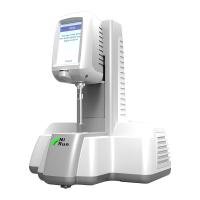
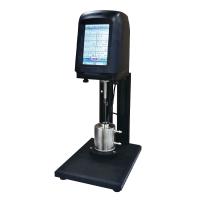
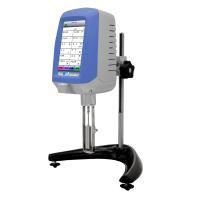
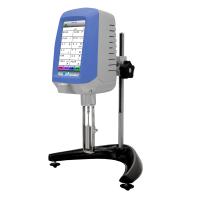
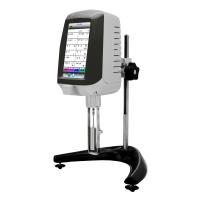
Rheometers include rotational rheometers, capillary rheometers, torque rheometers, and interfacial rheometers. The working principles of various rheometers are described below:
1. Rotational rheometer
There are two types, controlled stress type and controlled strain type
A. Control stress type
Most used, such as Physica MCR series, TA's AR series, Haake, Malven, are all this type of rheometer; among them, Physica's motor is a synchronous DC motor, which has a relatively fast response speed and strong control strain capacity; others The cup motor used by the manufacturer belongs to the asynchronous AC motor, and the response speed of this motor is relatively slow.
This type of rheometer uses a motorized grip to apply stress to the sample while an optical encoder measures the resulting strain or rotational speed.
B. Control strain type
At present, only ARES belongs to the simple strain control rheometer. The DC motor of this rheometer is installed at the bottom, and the strain is applied to the sample through the clamp. The upper part of the sample is connected to the inverted torque sensor through the clamp to measure the stress generated; this rheometer The instrument can only do simple strain control experiments, because the torque sensor deforms when measuring the torque, which requires a rebalancing time, so the response time is relatively slow, so the stress cannot be controlled through the feedback loop.
2. Capillary rheometer
The capillary rheometer is mainly used for testing the rheological properties of high polymer material melts; the working principle is that the material is heated and melted in the electric heating barrel, and the lower part of the barrel is equipped with a capillary die of a certain specification (there are different 0.25-2mm in diameter and 0.25-40mm in different lengths), after the temperature stabilizes, the material rod on the upper part of the barrel is driven by the drive motor to extrude the material from the capillary die at a certain speed or at a speed that changes regularly. During the extrusion process, the pressure at the entrance and exit of the capillary die can be measured, and combined with the known speed parameters, die and barrel parameters, and rheological models, the melt temperature at different shear rates can be calculated. shear viscosity.
3. Torque rheometer
In fact, on the basis of the experimental extruder, with different modules such as capillary, mixing chamber, single and double screw, blown film, etc., to simulate some parameters of the high polymer material in the processing process, this equipment is equivalent to the polymer The small-scale experimental equipment for processing is closer to the actual processing of materials, and is mainly used in research fields close to actual production.
4. Interface rheometer
At present, this kind of rheometer has several principles such as oscillating droplet and oscillating shear; it is the most difficult field in rheological testing to realize accurately; there is no particularly good and general method.