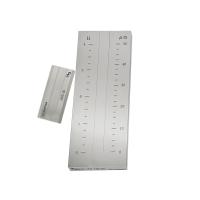
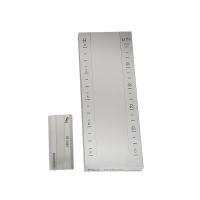
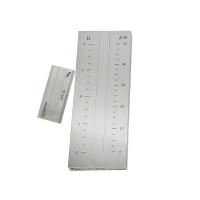
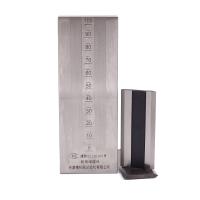
The scraper Fineness Meter is used to measure the fineness of paint. It is composed of a scraper Fineness Meter and a scraper. The accuracy of the scraper and the material of the scraper have a certain influence on the measurement result of the paint fineness.

1. The influence of scraper accuracy on the measurement of paint fineness
In general, the scraper fineness gauge specified in GB/T 1724 is made of a polished flat plate of tool gold steel (grade Cr12), and the wedge-shaped groove on the plate is (155±0.5) mm long and wide (12±0.2 )mm, there are 3 specifications of 150 μm, 100 μm and 50 μm. The flatness tolerance of the front groove bottom and reverse side of the fineness plate is 0.003 mm/full length, the front surface finish is 10, and the division value error is ±0.001 mm. GB/T 6753.1 stipulates four standard scraper fineness gauges of 100 μm, 50 μm, 25 μm and 15 μm, all of which are made of quenched and polished steel plates with a length of about 175 mm, a width of 65 mm, and a thickness of 13 mm. Its surface has one or two wedge-shaped grooves about 140 mm long and 12.5 mm wide. The squeegee is verified by an optical comparator, but the user of the squeegee does not have an optical comparator, and generally it is only inspected by the manufacturer. A limited number of points are taken to inspect the flatness of the plane on the scraper.
Take the plane of a certain micron scale line as 0, measure the groove depth of this point; then take the plane of another micron scale line as 0, measure the groove depth of another point, and so on. Attention should be paid here: whether the number of microns on the reference plane of any micron scale line is 0, that is, whether the two sides of the scraper groove are flat. Manufacturers generally talk about how to grind out the plane to ensure that the plane error is within a certain amount, which leads users into misunderstandings. There is a simple way to overcome it, that is, use a calibrated scraper to scrape the adjusted paint from top to bottom. If the two sides can be scraped clean without hanging paint, the surface can generally be considered as a plane; If the surface can be scraped clean, if the surface farther from the groove cannot be scraped clean, it is judged as medium-high; otherwise, it is concave. If there are patterns on both sides of the groove after scraping, it means that the upper surface of the scraper is not flat.
2. The influence of scraper on the measurement of paint fineness
GB/T 1724 stipulates that the scraper is made of high-quality tool carbon steel (grade T10A), with a length of (60±0.5)mm and a width of (42±0.5)mm. Both sides of the blade need to be polished, and the blade straightness tolerance 0.002 mm/overall length, 8 surface finish, 10 edge grind finish. GB/T6753.1 stipulates that the scraper is made of a double-edged steel sheet with a length of about 90 mm, a width of about 40 mm, and a thickness of about 6 mm, and the radius of the scraper blade is 0.25 mm. In order to achieve the flatness index of the scraper, some manufacturers grind the blade into a small plane perpendicular to the blade. Although the straightness of this kind of knife reaches the target, it can only be used when the knife edge is completely vertical in the test, and other angles are not suitable. In serious cases, the paint on the planes on both sides of the groove cannot be scraped at all. Accurate detection results cannot be obtained using this scraper. When the scraper is used, it should be held vertically to scrape off, which is only vertical by visual inspection. There is always a certain error in the specific operation. The edge of the satisfactory scraper should be ground into a 15° arc to avoid this error. Generally speaking, the smaller the arc, the sharper the knife, and the lower the scraping fineness (fine), and vice versa The same is true.